
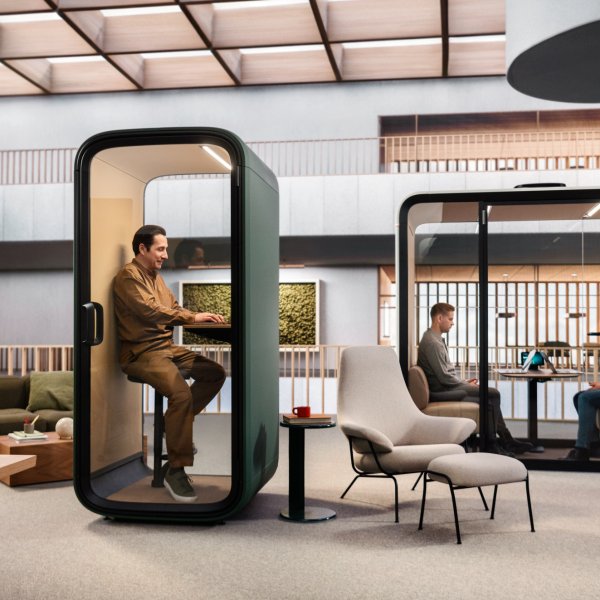
One Compact
$ 21,150
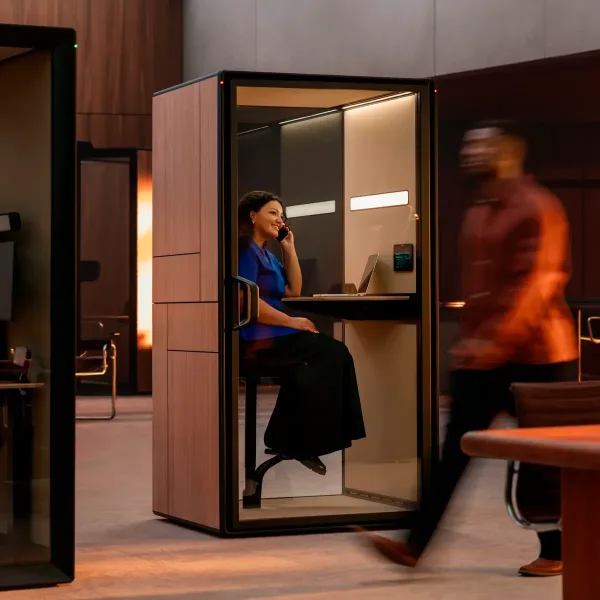
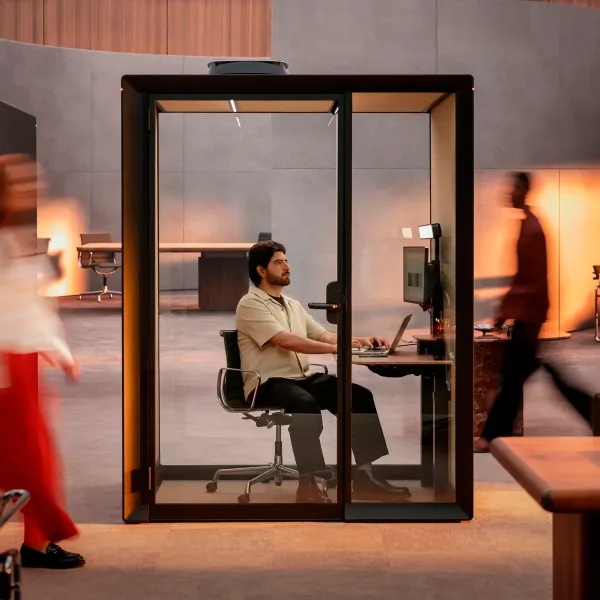
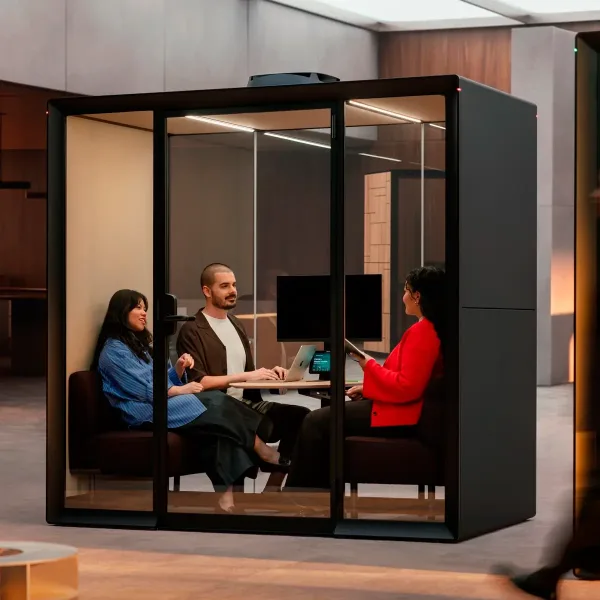
The open plan didn’t fail in general. It fails at specific moments — the client call taken from a stairwell, the performance conversation with nowhere to go, the hour of real thinking that never happens. Soundproof office pods fix the failure points without rebuilding the floor with partition walls: self-contained rooms for one to four people that sit on the slab, plug into a standard outlet, and give speech a place to stay private in both directions. What’s said inside stays inside, and the floor’s noise stays out.
Two things separate a pod that gets used daily from one that stands empty by the second month. Air, first: a booth without properly designed ventilation is abandoned within weeks regardless of its acoustics, so airflow at the seated position matters as much as the panel build-up. And the camera: a large share of American office speech now happens on video, which makes interior lighting direction, echo control, and a calm back panel part of the acoustic package rather than accessories to it.
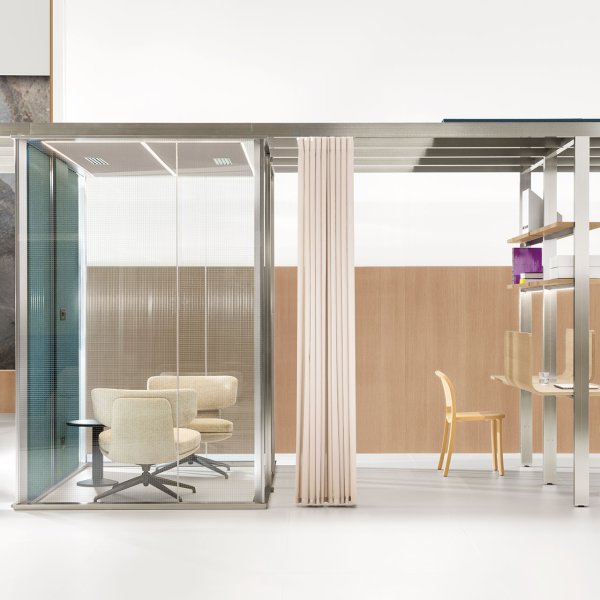
The pods selected here come from Italian manufacturers who treat the booth as architecture at furniture scale — proportioned, finished and lit like a room you would choose. La Mercanti configures pod programs for US floors, from selection and finish coordination through white-glove delivery and placement.
Bring a colleague and a list of sentences they have never seen. Speech privacy — whether a normal conversation inside stays unintelligible outside — is the acoustic claim that actually matters for a compensation discussion or a client negotiation, and it can be tested in fifteen minutes without a consultant. Have the colleague sit inside and read your sentences at conversational volume with the door closed: numbers, street addresses, anything unpredictable enough that context can’t fill in the blanks. Stand where a desk would realistically be. If you catch words rather than murmur, the pod fails for confidential use, whatever the brochure implies.
Run the test in a quiet showroom deliberately; your open floor will add masking noise, so a unit that passes in silence performs better in service. And treat the physics honestly. A structure light enough to ship, assemble and relocate attenuates sound rather than eliminating it, which is why the test measures intelligibility instead of chasing silence. A vendor comfortable being tested this way is usually a vendor whose other numbers hold up too.
Three questions, asked precisely, sort the engineered pods from the sealed boxes. Where does air actually arrive relative to a seated person’s head — at the face, or pooling near the ceiling? Do the fans run continuously, or only when an occupancy sensor decides someone exists? And how loud is the fan on a call, because a ventilation hum the microphone picks up defeats the purpose of the booth. A vendor who answers all three from the engineering rather than the brochure is describing a pod designed around a working human, not around a render.
The stakes are adoption. A sealed volume concentrates heat and exhaled air within a single long call, and users learn to avoid a stuffy pod without ever filing a complaint about it — the unit just goes quiet in the utilization report. So verify the one way that counts: spend a full hour in the demo unit with the door shut, working. Your body will grade the ventilation more honestly than the spec sheet will.
Light direction, echo, and background — in that order. Overhead-only lighting produces the interrogation-room look that flatters no one on camera; a pod built for video puts light on the face from the front or at a soft angle, so the person reads as present rather than shadowed. Second, echo: a small volume with hard walls makes voices sound boxy on the far end of the call, which is why the interior treatment matters — upholstered panels, perforated surfaces, and soft finishes tame the reflections a bare booth would send into the microphone. Third, the back panel: whatever sits behind the user becomes their professional backdrop for every call, so it should be calm, neutral, and free of glare.
Worksurface geometry finishes the job — a laptop at the right height puts the camera near eye level instead of up the nose. The reliable acceptance test: take a real call from the demo unit, record it, and watch yourself. Two minutes of playback settles what an afternoon of spec-reading cannot.
Yes, and it estimates better than any published ratio, because ratios assume an average office that doesn’t exist. Your meeting mix is already on record: pull ninety days of calendar and room-booking history and separate the load into solo video calls, heads-down blocks, and two-to-four-person conversations. A floor of recruiters or account executives lives on calls all day; an engineering team of the same headcount might need half the booths and twice the focus capacity. The data tells you which floor you actually are, team by team, before a vendor tells you which floor you should be.
Let the mix drive the fleet rather than the count. Several solo booths plus one or two meeting pods almost always outperforms the same spend on identical units, because the demand splits into different jobs with different hardware answers. Then buy slightly under the projection and let a month of real usage justify the balance — demand you can demonstrate is a budget conversation that wins itself.
Pod procurement usually starts with a showroom demo and ends with a spec sheet nobody wrote. Reverse the order. A one-page RFP drafted before the first visit forces the decisions that actually determine whether pods get used — air, light, weight, logistics, booking — while they are still yours to make, and it turns every vendor conversation from a pitch into an examination. These are the four sections that belong in it, in the order American buildings will ask about them.
Write ventilation as requirements, not preferences. The RFP should oblige each vendor to state in writing where fresh air enters relative to a seated occupant, how continuously the fans run, what duration of occupancy the airflow is designed to support, and what the fan itself contributes to a live microphone. Those four lines convert the vaguest area of pod marketing into comparable answers, and they signal that the sealed-box shortcut will be noticed before the invoice, not after.
Add an acceptance clause while the document is open: a payment milestone tied to a working session of realistic length in the installed unit, door shut. Vendors with engineered ventilation agree readily; hesitation is a data point of its own.
Air leads the document for a reason. Acoustic performance decides whether a pod can be used for confidential speech; ventilation decides whether it gets used at all. A booth that turns stale mid-call trains the whole floor to avoid it within weeks, and no finish schedule, no glass and no discount recovers a pod the occupants have already voted against.
Most pod hours on an American floor are video hours, so the RFP should treat the camera as a primary occupant. Require each vendor to describe how light reaches the face — from the front or at a soft angle, never from overhead alone — and what the interior does about echo: upholstered panels, perforated surfaces, finishes that keep a small hard volume from sounding boxy on the far end. Ask what sits behind the occupant, because the back panel is a professional backdrop hundreds of times a year and should be calm, neutral and glare-free by design rather than by accident.
Put worksurface geometry in the same section: laptop height that brings the camera near eye level, power and data at the surface, room for a notebook beside the machine. These read as small items until you watch a candidate interview conducted from a pod that fails all three.
One more line separates serious vendors: ask whether the lighting can be adjusted after installation. Floors differ and glazing differs, and a color temperature chosen in a factory may need tuning under the glass of a Dallas tower. Adjustability written into the RFP costs nothing; discovering its absence after twelve units are installed costs the program its credibility.
American buildings interrogate pods in three ways, and the RFP should answer all three before procurement starts. Weight first: pods are heavy, point loads matter on raised access floors, and the document should require loading data your property manager can actually review. Route second: state the freight elevator dimensions, door widths and the tightest corridor turn on the delivery path, and make each vendor confirm whether their unit arrives assembled or gets built in place — the answer changes cost, schedule and how much of a working day the installation consumes.
Then the sprinkler question. Buildings treat enclosed volumes on an open floor differently, and how coverage above the unit is handled is a conversation between your facilities team and building management that belongs before the purchase order, not after delivery. The RFP’s job is to force it early: require each vendor to state what their unit assumes about overhead conditions, and attach the building’s written answer to the file.
None of this is exotic; it is the diligence a facilities team applies to any large object entering a leased floor. Writing it down before the demo simply keeps the showroom’s charm from negotiating on the building’s behalf.
The last section decides how the fleet behaves after the invoices are paid. Require room-booking integration to be stated plainly: which calendar systems the pod’s sensors and displays actually talk to, what occupancy data you get out, and what happens when the integration fails — because a meeting pod invisible to the calendar becomes a private office by squatter’s rights within a month. If a unit offers no integration, the RFP should say how usage will be measured instead; a program you cannot measure is a program you cannot defend at lease renewal.
Add the commercial clauses that keep the program honest: pre-agreed pricing for follow-on units so a growing fleet doesn’t reopen the negotiation, relocation support written into the contract — pods move when floors re-stack, and the crew that knows the system moves them without drama — and a stated parts-and-warranty position on fans, lighting and door hardware, the three components that carry the daily wear.
Written this way, the RFP does quiet double duty. It procures the right pods, and it documents the reasoning while the reasoning is fresh — exactly the file you will want when someone new to the budget asks, a year in, why the program looks the way it does.