Let's discuss your project
Trade terms for professionals and design studios
Let's discuss your project
Trade terms for professionals and design studios
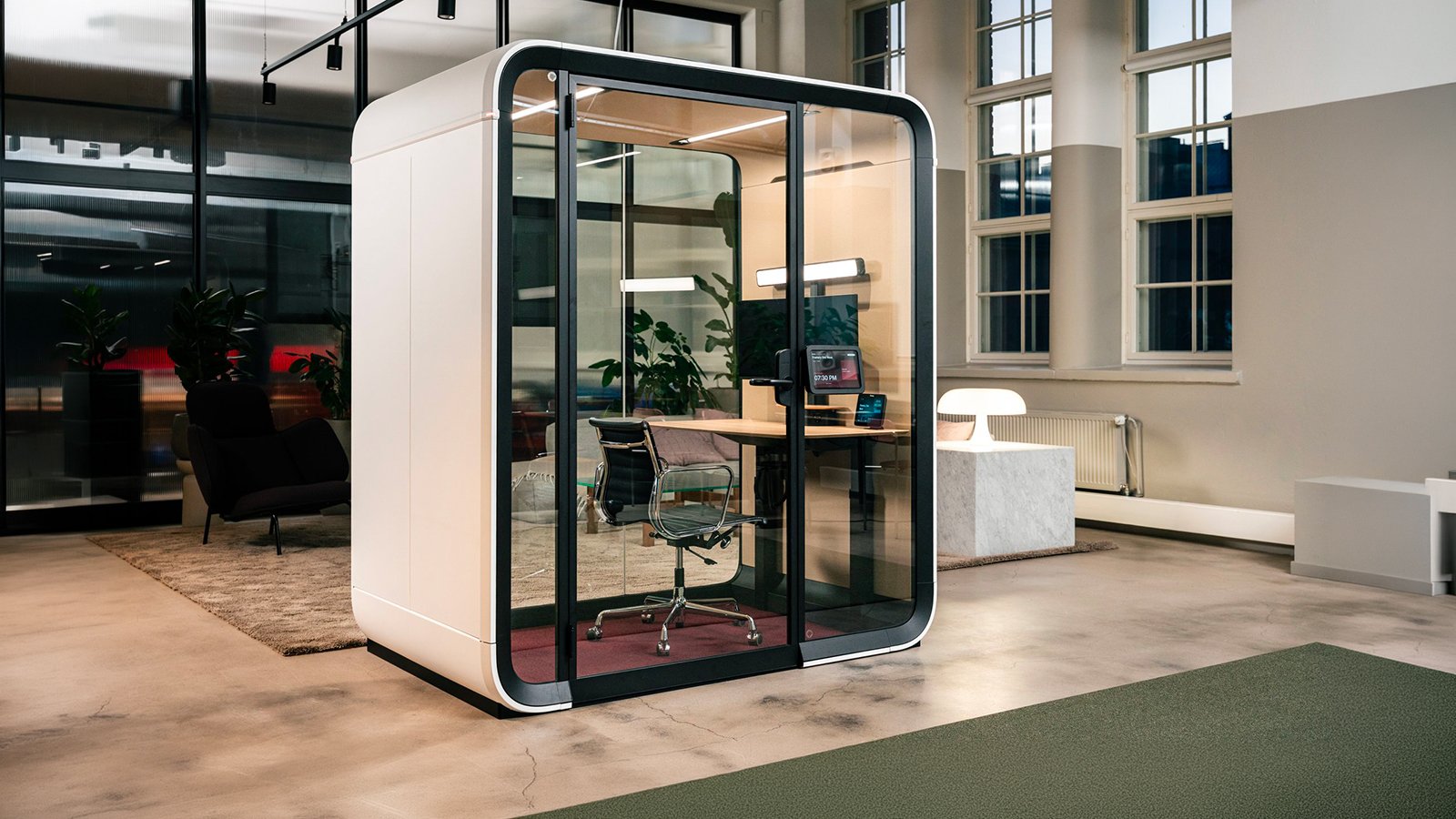
«One Work belongs to whoever has the hardest work that day.» Joonas Vartola, Framery's Chief Design Officer, is describing a pod and really describing a policy: in hybrid offices the private offices often sit empty while the person with the toughest task of the morning hunts for a door. Walk in, and the pod creates its own reservation and syncs it to the company calendar; walk out, and it releases the slot. In a lineup of soundproof phone booths this is the one Framery built as a one-person workstation for long stretches of concentrated work.
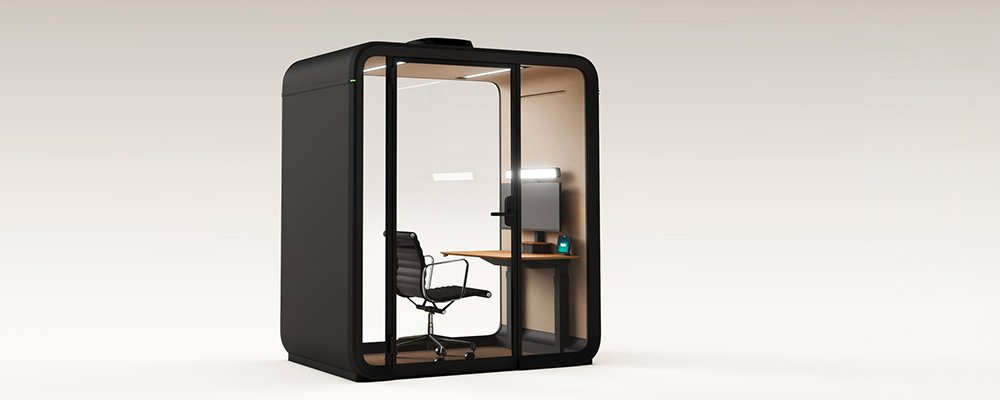
Behind the glass sits a desk of 46.9 × 23.6 in, flush to the wall, on a fixed leg at 27.6 in or an electric column running 27 to 46.7 in. Speech drops 30 dB, Class A on the ISO 23351-1 scale; the corner lights outside read green, yellow or red before anyone knocks. At 69.5 in of interior width it is the largest single-person pod Framery makes, and it holds up against an executive office suite as a place to spend a whole morning.
The leg decides the layout. Base has the fixed desk and the three standard colors, upgradable to the electric column later; Essentials has the electric desk and the full palette; Essentials+ adds a Framery Room Display at the door, tablet kit included. A chair is not part of any layout. La Mercanti maps the floor's heads-down hours before specifying how many pods, so the count follows the calendar rather than the headcount.
Let us know which finishes you'd like to explore
Framery answers with a measured unit rather than a promise: one of its pods in the field has logged over 15,000 work sessions with no loss of performance. The structure behind that number is modular, every component can be replaced, and the materials are kept to four mono-materials, steel, aluminum, glass and acoustic PET, which is what makes repair and refurbishment realistic instead of scrapping. For a facilities team it changes the math on a re-stack: the pod moves to the next floor plan on its movability kit rather than into a dumpster, and the sessions keep counting.
Yes. The airflow direction is adjustable between direct and indirect from the touchscreen on the desk. Direct sends the stream toward you, which some people want on a warm afternoon; indirect ventilates the room without the draft landing on your neck or your papers. The volume is handled by the pod itself: sensors read occupancy, temperature and humidity and set the fan on their own, with a manual override if you disagree. Nobody in the next pod feels your choice, and you do not feel theirs.
Because a desk and a face need different light. The Standard preset puts up to 375 lux on the desktop for reading, writing and screen work; the Video call preset redirects up to 500 lux onto the face, at the same 4000 K, so the camera sees a person instead of a silhouette against the office. Both can be adjusted by hand. Framery describes the two sources as automated dual lighting that adapts to the task, and the practical rule is simple: switch when the call starts, not when someone on the other end mentions it.
Because an IBCCES expert board reviewed Framery's product against its competency areas for autism and certified the alignment. Translated into the pod, it is about what the occupant can control: a lighting preset instead of overhead glare, airflow that can be turned indirect, a door that shuts against the floor's noise with 30 dB of Class A speech reduction. For a workplace that hires neurodivergent colleagues it is a documented designation rather than a sympathetic adjective, and it can be written into an accommodation plan.
Yes, as long as it is connected. Framery delivers over-the-air updates automatically to connected pods: new functions, system software and maintenance updates arrive over the pod's own 4G link, which comes with its own SIM, or over the office wireless network. Framery lists the ventilation modes and the lighting logic among the things it tunes this way, so the pod's consumption and comfort can improve after installation without anyone opening a panel. A pod left offline keeps working; it simply stays the pod it was on delivery day.
Eight exterior colors, four fabrics, four carpets, four desktops and three film patterns. Five decisions, in the order a designer makes them, each anchored in the data sheet Framery publishes for One Work.
Framery One Work comes in eight Ultramatt exterior colors on powder-coated steel, and three of them are the standard set: White RAL 9016, Black RAL 9005 and Gray S 7500-N. They are the only colors offered on the Base layout, so a project that intends to stay on Base makes its exterior choice among these three and no others.
The other two layouts add the remaining five: Navy S 7020-R90B, Sand S 2010-Y20R, Powder Blue 3421-R86B, Winter Moss S 7010-G10Y and Blush 2728-R01B. The codes are NCS color notation, which is what lets a designer match the pod to a wall or carpet already specified on the drawings instead of trusting a swatch name.
The interior panels are PET laminated with a recycled polyester fabric, and the upholstery textile is Gabriel Tonal in four colors: Pure Gray as standard, Arctic Blue, Sand and Rouge. Framery describes the look as vibrant and dynamic because the fabric is woven in two colors. Pick it against the exterior color, not on its own: the two are read together through the glass every day.
The Fletco carpet, antistatic and stain-resistant with a low loop, comes in Light Gray as standard, Dark Blue, Champagne and Grape. The desktop is birch plywood laminated in white or in anti-fingerprint black, or veneered in oak or walnut. Four and four: the floor and the work surface are the two finishes your hands and eyes meet most, and they are decided here.
The acoustic laminated glass can carry a privacy film in three patterns, Solid, Line or Grid, for what Framery calls smooth visual privacy. It is applied by professional installers, which is why it is the last decision and not the first: once the pod is placed and you know what sits in front of the glass, you know how much of the view needs to go.