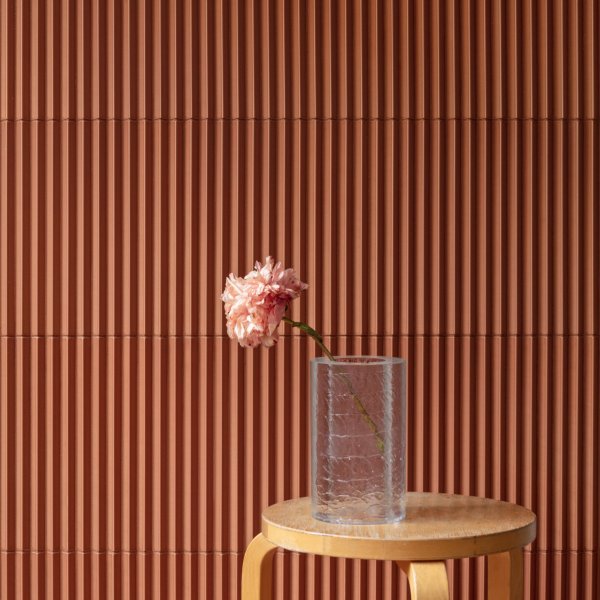
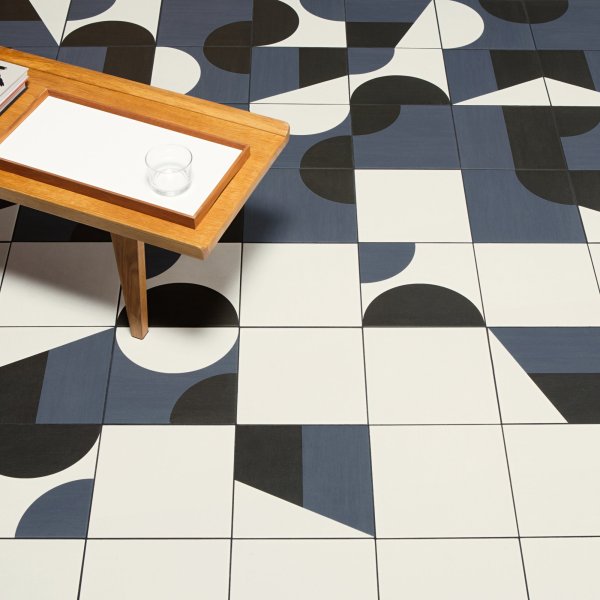
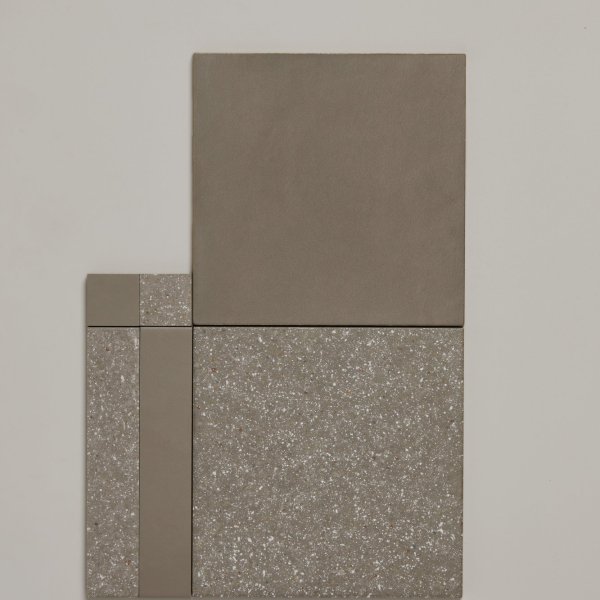
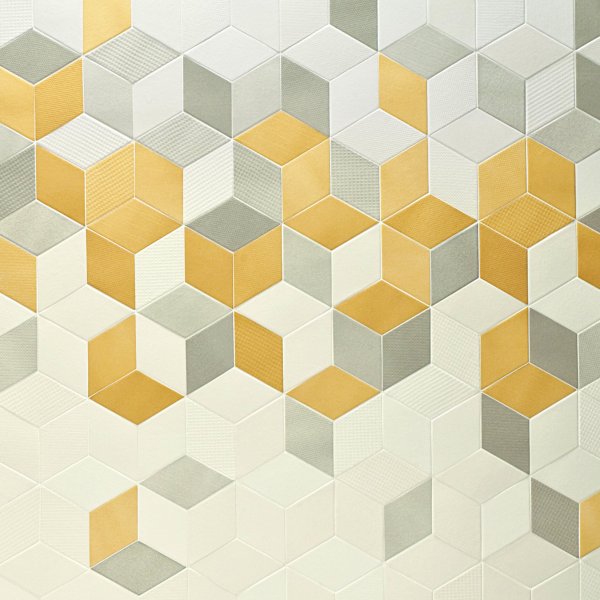
Tape by Mutina installed with mixed patterns in glazed porcelain stoneware

Tape by Mutina, the collection Raw Edges drew while house-hunting

Mutina

Raw Edges

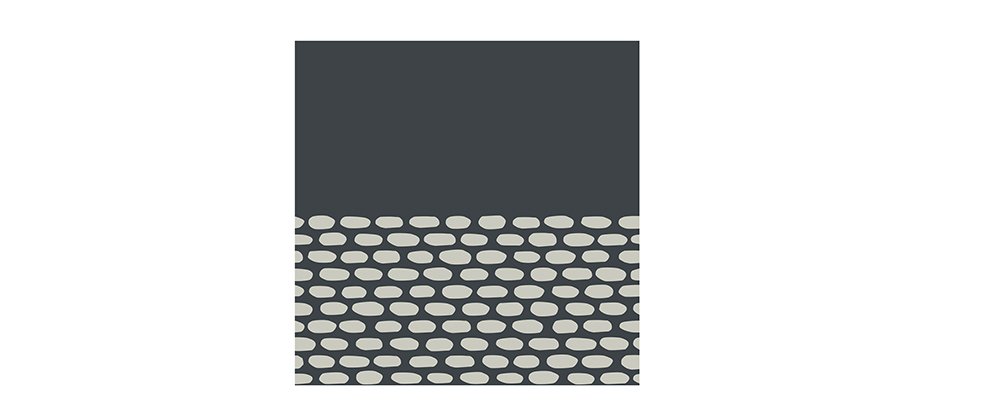
Cobble Half Black
Cobble Half Black Available now
$ 959

Let's discuss your project

Trade terms for professionals and design studios

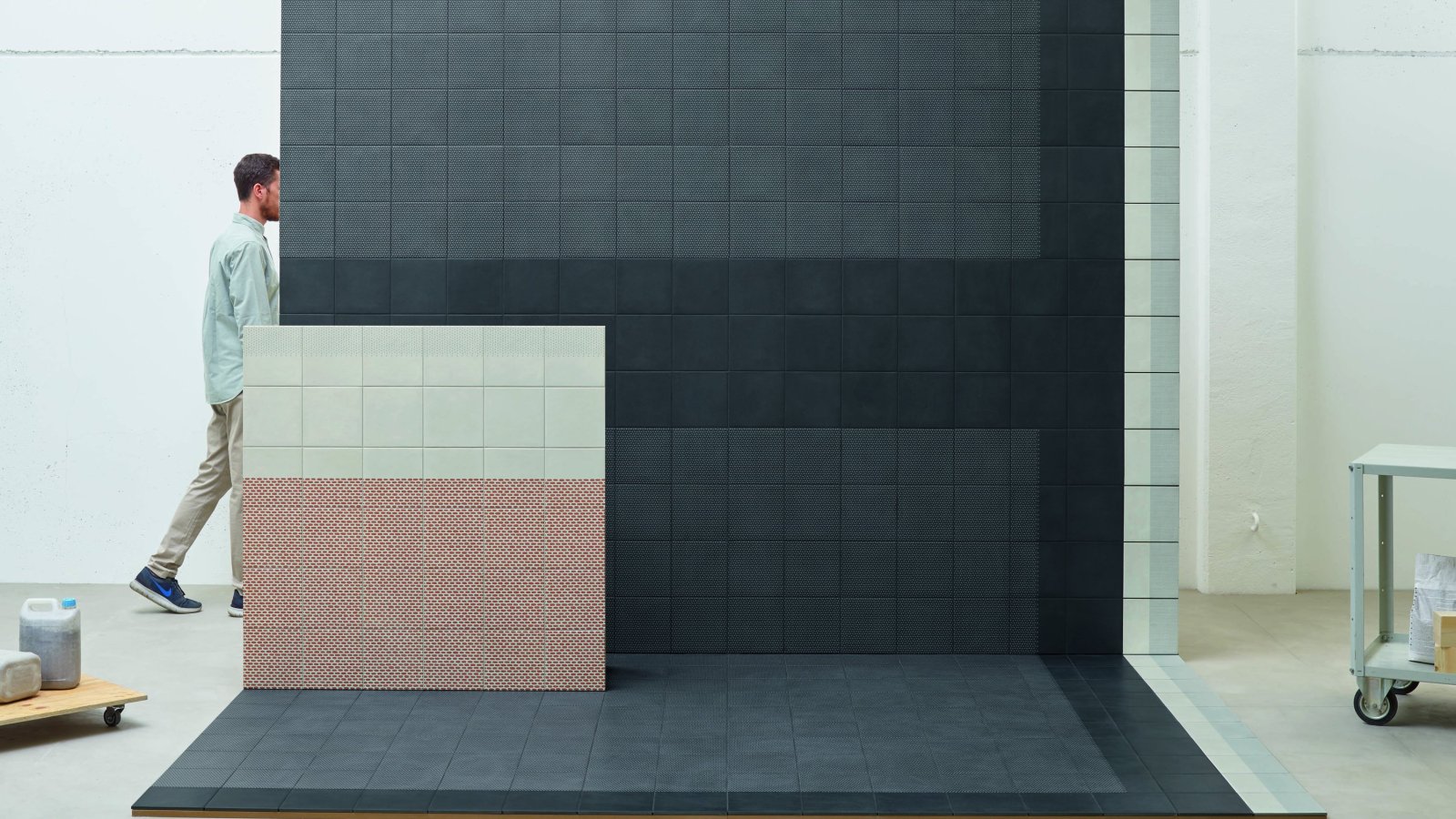
While Raw Edges were designing Tape, Yael Mer and Shay Alkalay were house-hunting, reading one floor plan after another. That search shaped the collection: they imagined it, in their words, as rolls of colorful patterns resting on raw tiles, and realized the transitions between shapes could define the rooms themselves. Tape is that idea fired into glazed porcelain stoneware.

The format is a single 8"×8" square (20.5×20.5 cm, 10 mm thick) that builds a whole plan: two bases, White and Black, four graphic families — Mesh, Cobble, Grainy, Zigzag — in five shades, plus eight half patterns that fade each motif into the base. A faint chalky ground runs beneath the graphics, and five different glazing textures are mixed at random, so no two runs read identical. Patterns are perfectly centered, tile after tile.

The spec sheet holds up on a commercial walk-through: DCOF 0.69 against the 0.42 threshold, stain class 5, 0.06% absorption, frost-proof for the patio, Robinson-rated for heavy use. One order can draw the open plan, the executive office and the outdoor corner of the same project. The technical sheet, VOC class A+ and LEED declarations download from this page.

Technical information based on data declared by the manufacturer.

Collection: Tape
Manufacturer: Mutina
Design: Raw Edges (Yael Mer and Shay Alkalay), 2017 — registered design no. 004427748-0001/0027 (10/31/2017)
Material: glazed porcelain stoneware — UNI EN 14411 App G (BIa) GL
Size: 8"×8" (8.1×8.1 in) — non-rectified, perfectly centered patterns
Thickness: 0.39 in (3/8")
System: 2 bases (White, Black) — 8 patterns + 8 half patterns (Mesh, Cobble, Grainy, Zigzag) — 5 color combinations (white, blue, green, brown, black) — 5 glazing textures mixed at random — V2 shade variation
Use: floor and wall — indoor and outdoor
Declared values: water absorption 0.06% (ISO 10545/3) — breaking strength min 1300 N — resistant to frost, thermal shock and chemicals — stain class 5 — DCOF 0.69 (above the 0.42 threshold) — R10 (DIN 51130) — Pendulum 27, P2 (AS/NZS 4586) — Robinson test: heavy use
Sustainability: LEED 4.1 declaration — 20% pre-consumer recycled content, all colors — VOC emission class A+ — HPD available
Installation: 0.08 in joint with spacer wedges — porcelain tile adhesive — cement-based or epoxy grout; catalogue pairings Nero 06 (Base Black) and Calce 01 (White bases) — blend tiles from several boxes
Packing: 16 pieces per box (7.2 sq ft) — 96 boxes per pallet
Documentation: technical sheet, VOC, LEED and HPD downloadable; EPD, SDS and BPD3 on request

La Mercanti USA Llc — your partner for Italian design and contract supply.
Los Angeles, CA, USA · +1 855 335 8079 · info@lamercanti.us
Supply, quotes, specifications and project support across the United States and North America.

Let us know which finishes you'd like to explore

$ 180

Credited in full toward your purchase

FAQ

Is Tape rated for commercial floors in the US?
The declared DCOF is 0.69, well above the 0.42 threshold commonly required for level interior floors, with stain class 5 and a Robinson rating for heavy use. Check each area's duty — ramps and wet zones follow their own criteria.
Where did the Tape concept come from?
From a house hunt. Raw Edges were reading floor plans while designing it and imagined rolls of colorful patterns resting on raw tiles — the collection was built so that transitions between patterns define the spaces.
What sizes does Tape come in?
One size only: 8"×8" (20.5×20.5 cm), 10 mm thick. The variety comes from the system — two bases, eight patterns, eight half patterns and five shades — not from the format.
Can Tape run out onto a patio or terrace?
Yes. Absorption is 0.06%, frost and thermal shock resistance are declared, and the same patterns exist for floor and wall, indoor and outdoor, so the drawing can cross the glass line.
How is the shade variation of Tape managed?
The collection is rated V2 with five glazing textures mixed at random. Blend tiles from several boxes during installation and the surface gains an even, low-key vibration instead of visible batches.

From floor plan to floor: five moves to draw a space with Tape

A concept born over real-estate listings, turned into a method: mapping functions, patterns and transitions before the first box ships.

Start on the plan, not in the showroom
Print the floor plan and mark the functions: focus work, meetings, break, reception, outdoor. Tape was conceived over floor plans — let the plan decide where each pattern lives.
Choose the base per zone
Base White opens four color routes; Base Black sets a darker register for lounge or evening areas. Assign the base first — it is the paper the patterns rest on.
Draw the hand-offs with half patterns
Wherever two functions touch, specify the half version of the outgoing pattern. The motif fades into the base across one or two courses, so no metal trims interrupt the floor.
Write joint and grout into the spec
2 mm joints with spacer wedges, porcelain adhesive, cement-based or epoxy grout — Nero 06 on Base Black, Calce 01 on White bases. The joint belongs to the drawing, so specify it like one.
Order by area and blend on site
Count 16 pieces per box and order zone by zone. On site, pull from several boxes at once: the five random glazing textures spread evenly and the V2 variation becomes texture, not patchwork.

You May Also Like