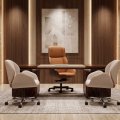
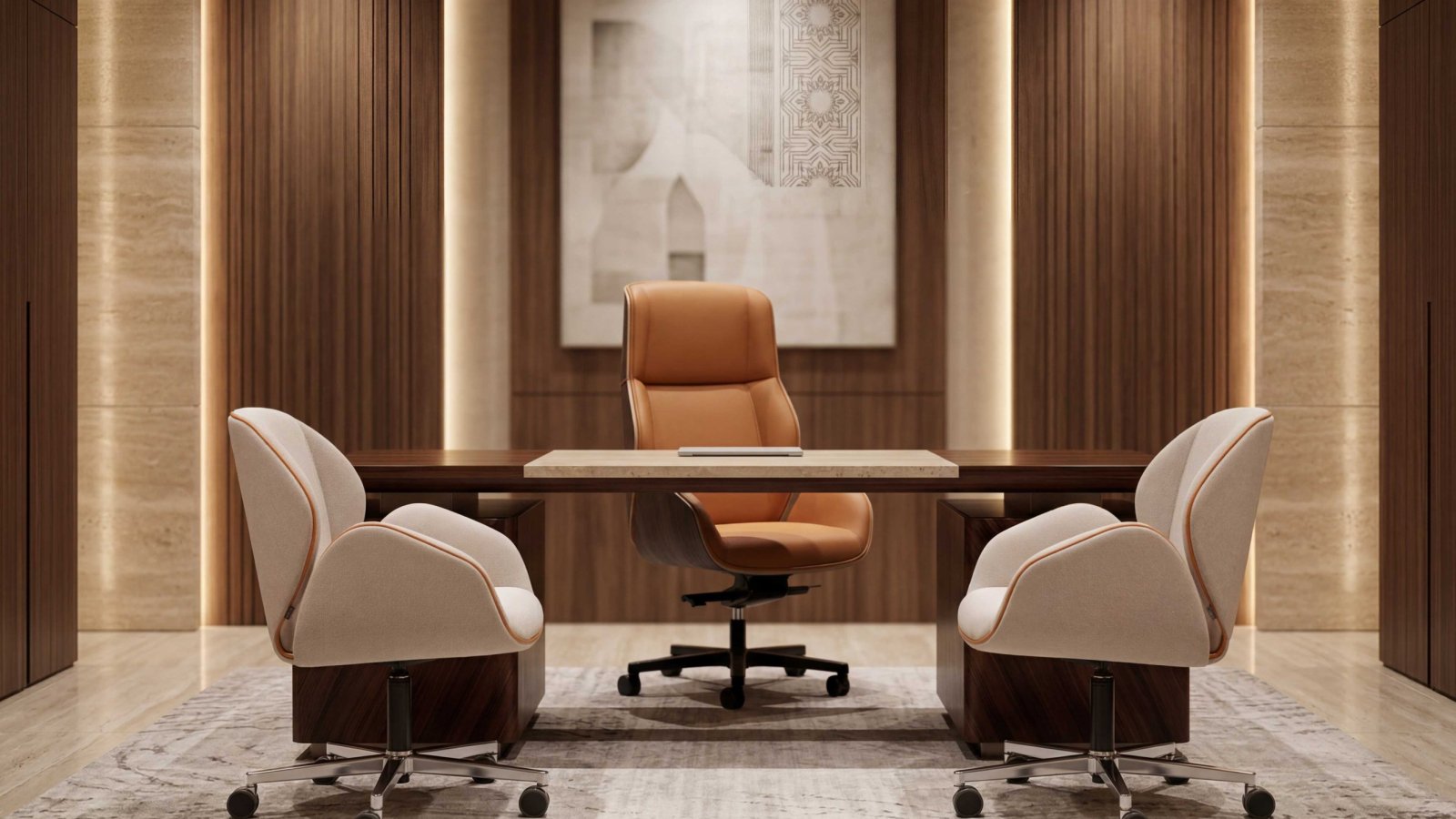
Executive armchair Suoni by Vaghi in a corner office

The detail nobody photographs: rosewood caps on the Vaghi Suoni base

Vaghi
Executive chair
Suoni The piece that makes the room Executive chair
$ 6,287

What did you have in mind?

Trade terms for professionals and design studios

Look at the base of most executive chairs and you find the same thing: black nylon or bare aluminium, chosen because nobody looks at it. On the SL and SM versions of Suoni the aluminium base carries rosewood caps — the same timber as the outer shell, on the part of the chair closest to the floor.

It is a small decision with a visible consequence. In a corner office with a timber executive desk and a wooden floor, a chair whose base repeats that material stops reading as equipment and starts reading as furniture. Vaghi also offers the base in polished aluminium and in RAL 9017 for rooms where the opposite is wanted: a base that disappears and leaves the shell alone.

The armchair is drawn by the company's own research department and tested to EN 1335 by CATAS. La Mercanti handles specification, fabric selection and delivery coordination for clients across the United States.

Technical information based on data declared by the manufacturer.

Model: Suoni Executive Armchair, Vaghi — design Vaghi R&D

Shell configurations: SI upholstered with plain edge · SL wooden with plain edge · SM wooden with contrasting edge · SH upholstered with contrasting edge · SB two-tone upholstery

Versions: high and low backrest · Executive codes SBD8X, SHD8X, SHD6X, SLC8L, SLC6L, SLD8L · matching Guest Chair SHO6X, SHO6K, SLO6L, SLO6K

Executive dimensions: width 27.2 in · depth 27.2 in · overall height 46.9/50.8 in (high backrest) or 35/39 in (low) · seat height 16.5/20.5 in · armrest height 25.6/29.5 in

Guest dimensions: width 27.2 or 28.7 in · depth 27.2 or 28.7 in · overall height 35/39 in · seat height 16.5/20.5 in · armrest height 25.6/29.5 in

Mechanism: height-adjustable seat · tilting mechanism with tension adjustment and anti-return lock

Base: polished aluminium, aluminium RAL 9017 or rosewood · SL and SM with aluminium base and rosewood caps

Certification: Executive Armchair tested to EN 1335 by CATAS · Guest Chair tested to EN 16139, EN 1022 and EN 1728 by CATAS

La Mercanti USA Llc — your partner for Italian design and contract supply.
Los Angeles, CA, USA · +1 855 335 8079 · info@lamercanti.us
Supply, quotes, specifications and project support across the United States and North America.

FAQ

Which shell versions are built in timber, and which in fabric?

Two are built around a wooden outer shell — SL with a plain edge, SM with a contrasting one — and three are upholstered: SI with a plain edge, SH with a contrasting edge and SB in two-tone fabric. Dimensions and mechanism are identical throughout, so the choice affects appearance and maintenance, not ergonomics. In practice the wooden versions suit single-occupant rooms and the upholstered ones rooms in constant use.

How high does the chair sit?

Overall height is 1190 to 1290 mm for the high-backed version and 890 to 990 mm for the low-backed one; the seat itself adjusts between 420 and 520 mm. Width and depth are 690 mm in both. Those two numbers matter when the chair stands against a glass partition, because the high back becomes a visual element in the corridor as well as in the office.

Does the tilt lock in position?

The mechanism tilts with adjustable tension and includes an anti-return lock, which holds the backrest instead of letting it spring forward when you shift your weight. It is the feature that makes a tilting chair usable during a long meeting rather than only when reclining, and it is specific to the Executive version.

Who designed the collection?

Vaghi's in-house research department, credited in the catalogue as Vaghi R&D. There is no external signature on this family, which is unusual in Italian office furniture and says something about where the product decisions are made: inside the factory, next to the people who build it.

Is the guest chair certified for public spaces?

It is tested to EN 16139, EN 1022 and EN 1728 by CATAS — the standards for seating in non-domestic use, covering strength, stability and durability. The Executive Armchair carries EN 1335 instead, the standard for office work chairs. Two different roles, two different test regimes, both documented by the manufacturer.
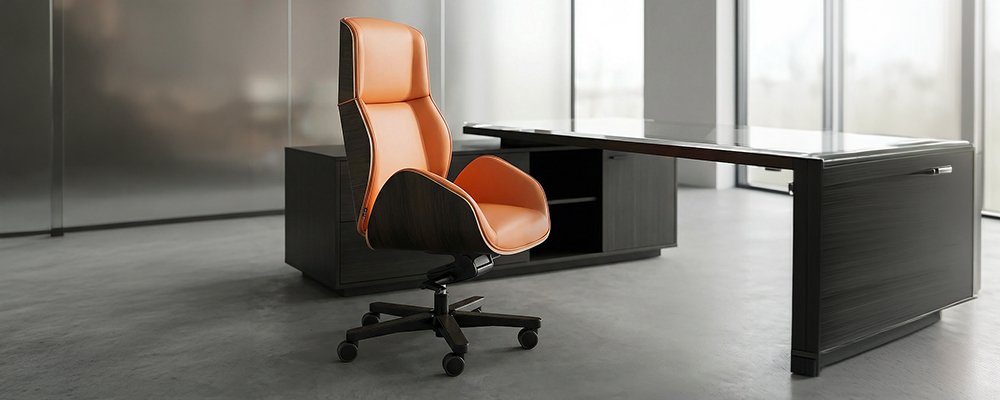
How to specify a chair that matches existing millwork

Executive offices are usually built around joinery that arrived first. Five steps so the chair joins it instead of competing with it.

Record the timber tone in daylight

Wood tones shift dramatically under artificial light. A daylight reference of the desk and the panelling is what the supplier actually needs.

Decide whether the chair should match or contrast

A rosewood shell next to walnut joinery reads as a deliberate pairing only if the tones are close enough. Where they are not, an upholstered shell is the safer specification.

Look at the base as part of the floor

Rosewood caps work over timber floors; polished aluminium suits stone and carpet. The base is seen against the floor far more than against the desk.

Check the edge against the wall colour

A contrasting edge only reads if there is contrast behind it. Against a dark panelled wall, a plain edge often does more.

Approve samples together, not separately

La Mercanti sends fabric, edge and base samples in one set so the combination is judged as a whole; the cost is credited in full when the order is confirmed.

You May Also Like