Already have something in mind?
Trade terms for professionals and design studios
Already have something in mind?
Trade terms for professionals and design studios
One piece of Clift runs the other way. Most of the sectional is 40.5 inches deep; the chaise ignores it and reaches 72.8 inches into the room, on a footprint 44.5 inches across. It has one arm and a back at the full 33.5 inches, and Cierre draws it twice, as a left and as a right. Which is which gets read off the drawing on the technical sheet. Next to other design sofas and sectionals, this is the piece that decides whether people sit on Clift or settle into it.
Cierre pairs it with a 77.9-inch one-arm section in the first layout it draws: 122.4 by 72.8 inches overall. Design: the architect Marco Fumagalli, 2019. The maker sums the idea up in three items: a seat it calls “extra deep,” backrests that are soft, arms bent outwards. We see it in an executive suite, across from the desk, and our advice is to put the chaise on the side people do not walk in from.
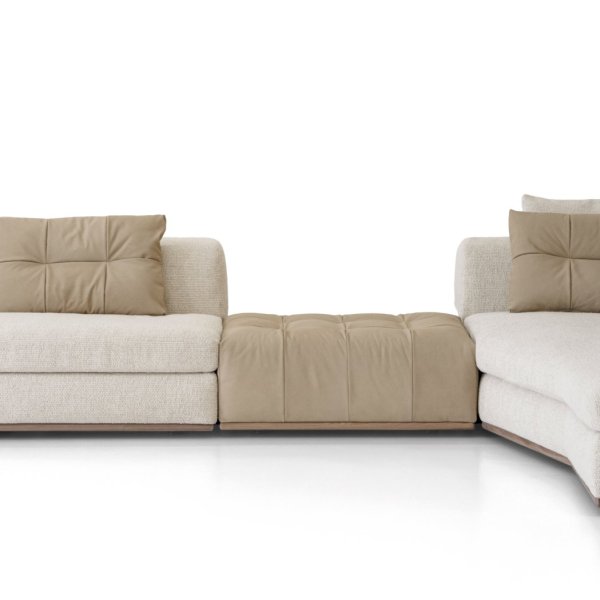
Take the family from the piece you lie on to the piece you perch on. Longest is the chaise. Then the three ready-made sofas and the one-arm sections, long enough to stretch out along. Then the seats for sitting upright: one-arm end seats, armless center sections, the square corner. Last come the two low-back pieces, a center section and an end piece with open seat beside its short back, and the cushion the sheet draws by itself. La Mercanti asks who in the office stays after six, and gives that person the long seat.

Let us know which finishes you'd like to explore
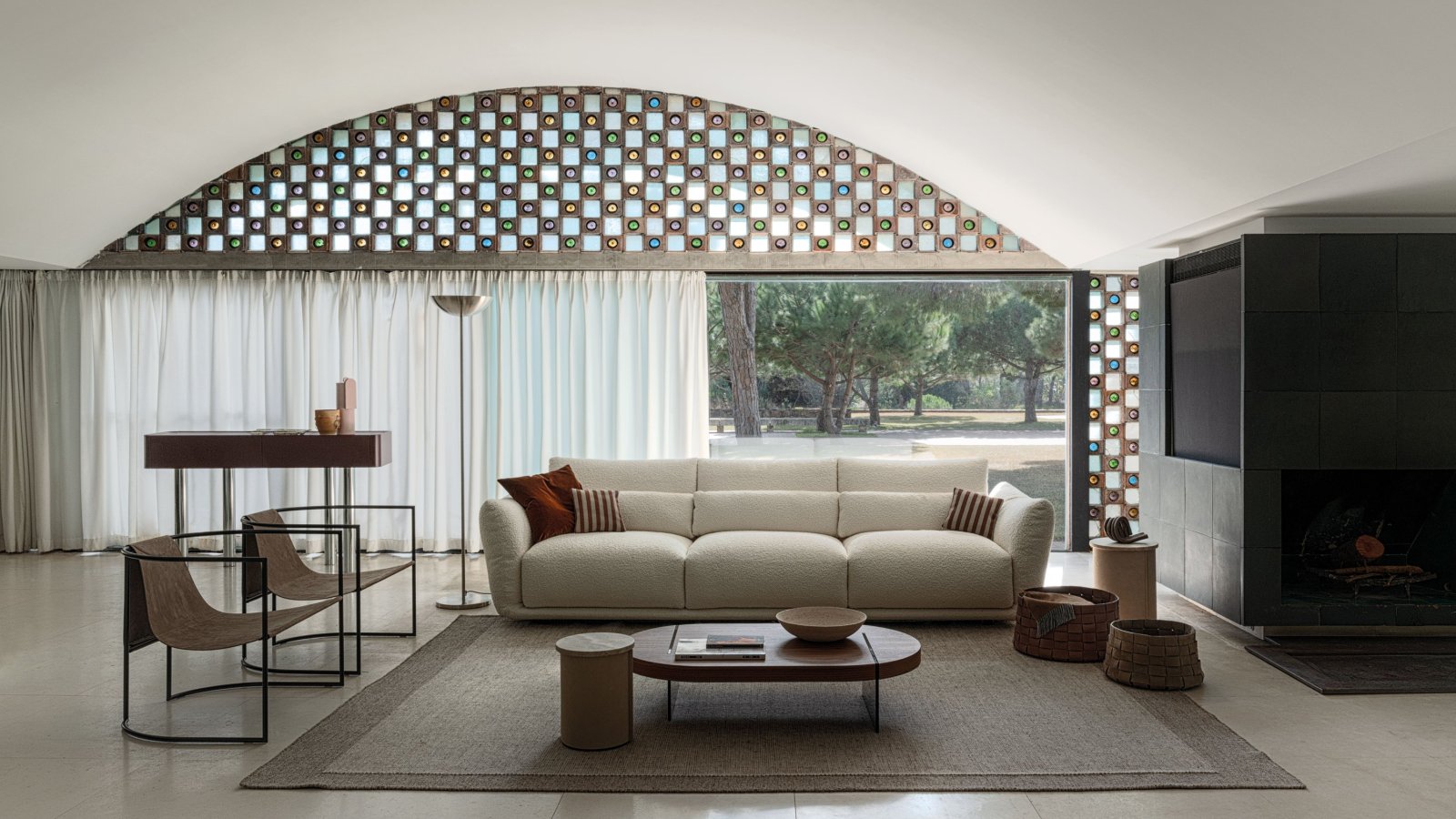
The line comes from Cierre's own presentation: Clift is “an expression of nature” that “softens any sternness” of its surroundings. Read as a brief, it describes a room of hard edges, glass, stone, a large desk, and a sofa that answers them with arms bent outwards, soft backrests and a body the maker itself calls voluminous. That reading of the room is ours; the words are the maker's. If your office is all straight lines, this is the argument for one piece that is not.
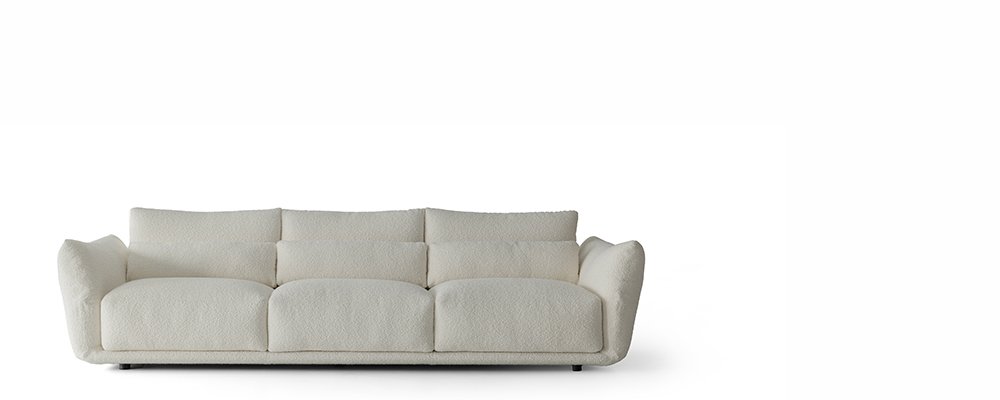
On feet of black polymer, 1.5 inches high. The technical sheet gives the material in a single line and the height in its dimension table, and leaves it there. In the maker's photographs the feet are barely visible, so the sofa reads as a volume resting almost on the floor, with the seat at 17.7 inches. For a planner, the line to check is the bottom edge of the upholstery against the rug or the flooring, since very little shows beneath it.
Because Cierre designed them that way: the English text of the sheet calls them “bended outwards.” Each arm is 11 inches wide and 25.2 inches high, well under the 33.5-inch back, and it opens as it rises instead of standing straight. To our eye it works as a second backrest for anyone sitting sideways with their legs up on the seat. One note from us, not from the maker: arms that open want a little clearance at each end, so leave Clift some air where it meets a wall.
Yes. On the technical sheet the seat cushions are polyurethane foam of three densities with memory foam added, all of it covered in acrylic batting. That is the full statement. How the layers are stacked, and how much of the cushion each one makes up, the maker keeps to itself, so those details stay out of our answers too. What a buyer can take from it is that the seat is a built-up cushion and not a single block of foam, and that the place to judge it is on the sofa itself, seated for more than a minute.
A metal core. Cierre lists soft backrests “with the support of lumbar cushions” among the things that define Clift, and the build notes say backrests and arms are made in metal, then covered with polyurethane foam and acrylic batting. So the softness is on the outside. The data sheet also draws a separate cushion of 24.8 × 17.7 inches; taking it for the lumbar cushion is our reading, a reasonable one. When you compare layouts, remember that two pieces have a back only 25.2 inches high.
A Clift order is a short list of pieces, and each line can go wrong in its own way. Read it in this sequence: hand, width, back height, cushions, and finally the whole plan against a drawing.
Four Clift pieces are drawn as mirrored pairs: the one-arm sections, the one-arm end seats, the chaise and the low-back end piece. On each of those lines the order must say left or right, and the answer is read from the drawing on Cierre's technical sheet, not from memory of a photograph.
One-arm sections come 77.9 or 89.8 inches wide, end seats 44.5 or 50.4. Check each figure against the wall dimension on the plan, and keep in mind that the three ready-made sofas, at 89, 100.8 and 122.4 inches, are single pieces with both arms and need no handing at all.
Most pieces stand 33.5 inches high. Two do not: a center section 33.5 inches wide and the 58.6-inch end piece both stop at 25.2 inches. If the plan shows a low stretch, make sure the line names the low-back version, since an armless center section also exists at full height in the same width.
Cierre speaks of lumbar cushions that support the soft backrests, and the sheet draws one cushion at 24.8 × 17.7 inches. Give the quantity its own entry in the order: write it as a number, next to the pieces it is meant for, so it is read along with everything else.
Add up the pieces and compare the result with Cierre's four drawn layouts: 122.4 × 72.8, 118.5 × 118.5, 122.4 × 132.6 or 155.9 × 132.6 inches. If your list matches a drawn layout piece for piece, the overall footprint on your plan should match it too.