Already have something in mind?
Trade terms for professionals and design studios
Already have something in mind?
Trade terms for professionals and design studios
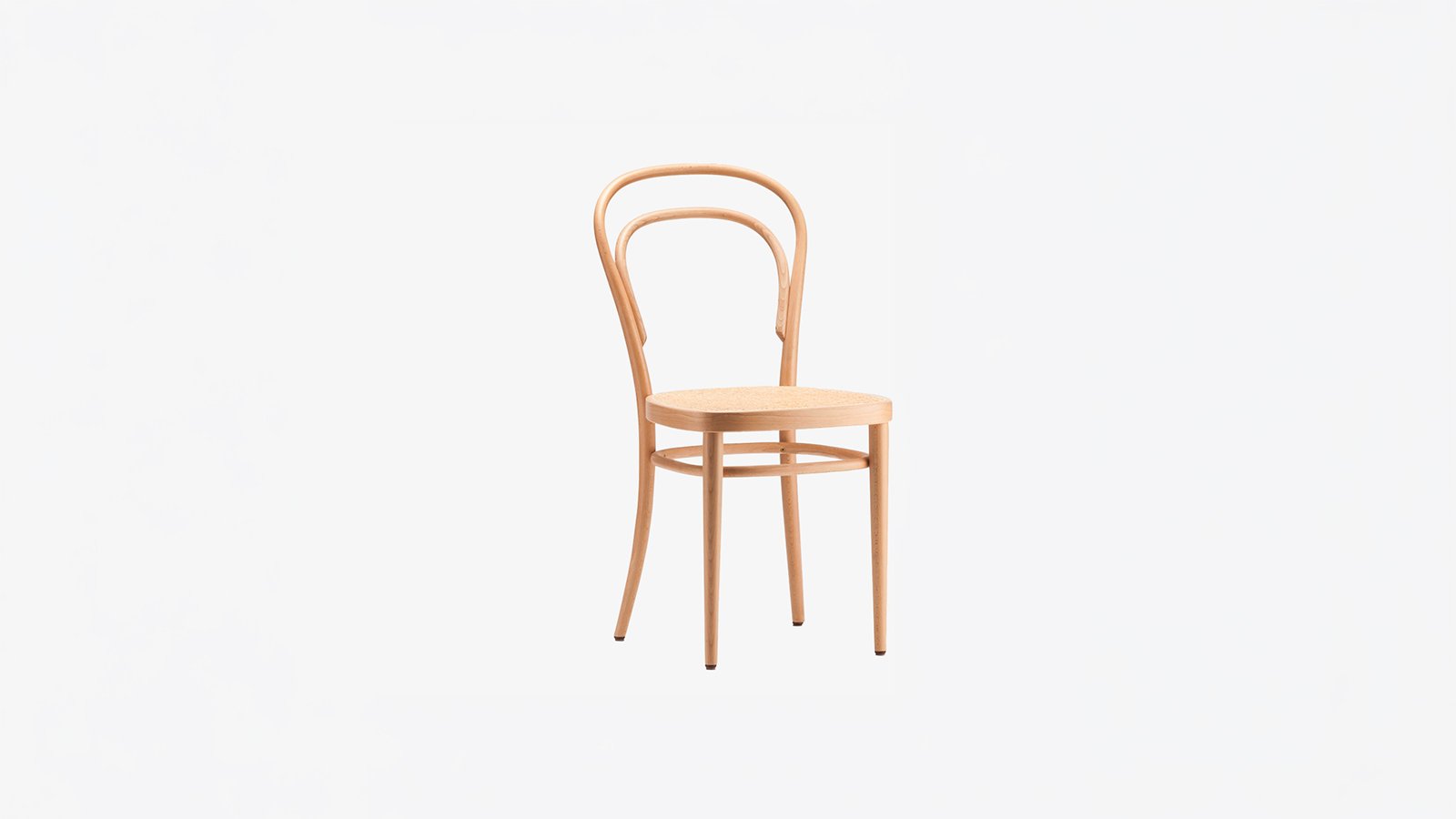
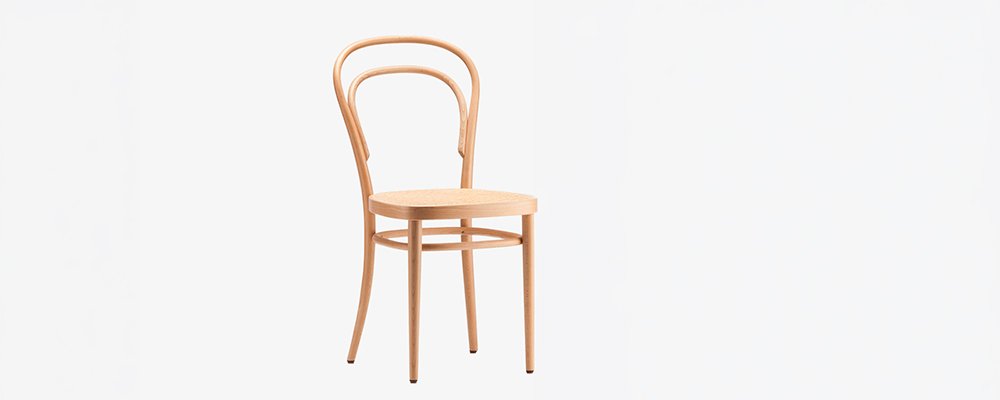
Thonet makes a large claim for the 214: it calls the coffee house chair “the most successful mass-produced product in the world to date”, the piece that set the history of modern furniture in motion. The claim rests on a technique. Michael Thonet worked out how to bend solid wood and refined the method until, for the first time, furniture could be made in series; the 214 of 1859 is what came of it, and its clear, reduced lines have stayed in use for more than 150 years. It is the reference point for any collection of designer chairs and armchairs, because modern furniture, by Thonet’s account, starts here.
In 1900 the founder’s sons, working as Gebrüder Thonet, took the same bentwood to an armchair, the 209, whose projecting frame curves into back and arms in one sweep. It is the seat we give to whoever leads the table, at the head of a dining room or among boardroom chairs, while 214s fill the long sides.
Nine versions grew from the two designs. The chair: 214 in cane, 214 M on molded plywood, 214 P upholstered, and the oval-backed 215 R and 215 P. For the armchair: 209 with cane, 209 P padded, plus 210 R and 210 P, an oval inside the arc. We picture them in restaurants, hotel dining rooms and home kitchens where the table is the center of the room. La Mercanti has clients sit in a 214 and then in a 209, at their own table, before the mix is decided.

Thonet says it can manufacture each piece individually as required, and it does so at Frankenberg, Germany, the company’s home since the end of the war. Version and seat are fixed when the order is placed. For a restaurant or an office project, that is the moment to have the final number and the mix of 214s and 209s settled, since each chair is made to that list.
In every Thonet photo of these designs, a bentwood ring joins the legs below the seat, on the 214 and the 209 alike. It belongs to the drawing as much as to the frame: seen across a room, it repeats the round of the seat a little lower down. Line up a dozen 214s and that second circle turns a row of chairs into a pattern, worth keeping in mind wherever chairs are seen from a distance.
He was born in 1796 in Boppard, on the Rhine, and opened his own workshop there in 1819. In 1842 Prince Metternich called him to Vienna; in 1849 he founded a company with his sons, which soon became a worldwide success, and he died in Vienna in 1871. For a client who wants the story behind the chair, it runs from a Rhine town to Vienna and, today, to Frankenberg, where Thonet still makes the 214.
Michael Thonet’s five sons: Franz, Michael Jr., August, Josef and Jakob. They joined Gebrüder Thonet in Vienna in 1853 and, after their father’s death in 1871, ran it together, developing new machines, new work processes and new furniture. Around the turn of the century a third generation joined. When an architect credits the armchair, the right line is Gebrüder Thonet, a family firm, rather than a single designer’s name.
Thonet gives the 214 a width of 16 7/8 inches, a depth of 20 1/2 and a height of 33 1/8; the 214 M, the 214 P and the 215 versions share the same frame size. We plan rows from that width, adding the room each guest needs between chairs, which is what decides whether a long table feels generous or tight.
Five checks for setting Thonet’s bentwood chair and armchair at a dining, café or meeting table, working from the dimensions Thonet publishes and leaving the table itself to your own tape.
Thonet lists the 209 at 21 1/4 inches wide and 22 1/2 deep, wider than the 214. At the ends of a table the extra width is easy to give; along the sides it adds up fast, which is why we usually keep the armchairs for the heads and the chairs for the long edges.
The arms of the 209 sit at 27 1/2 inches. Before ordering, check on the actual table that they clear the apron or the underside of the top, so the armchair can be pushed fully in. If they catch, the armchair stays a step back from the table, and the whole setting changes.
Cane and plywood seats sit at 18 1/8 inches, the upholstered P versions at 18 1/2. At the same table the gap is small but real; for a long meal or a meeting, choosing one seat type for everyone keeps every guest at the same height.
The 209 stands 29 1/2 inches tall, so the armchair is lower than the 214 chair beside it. Around one table that sets a gentle rhythm, taller backs along the sides and a lower, wider silhouette at the ends, worth seeing on a drawing before the order is written.
Thonet points these designs at homes, workplaces and hospitality. At one table we put 214s where many places are needed and 209s where the seat should hold the guest a little more, or where one person leads. The two share the same beech and the same cane, so the mix reads as one family.