
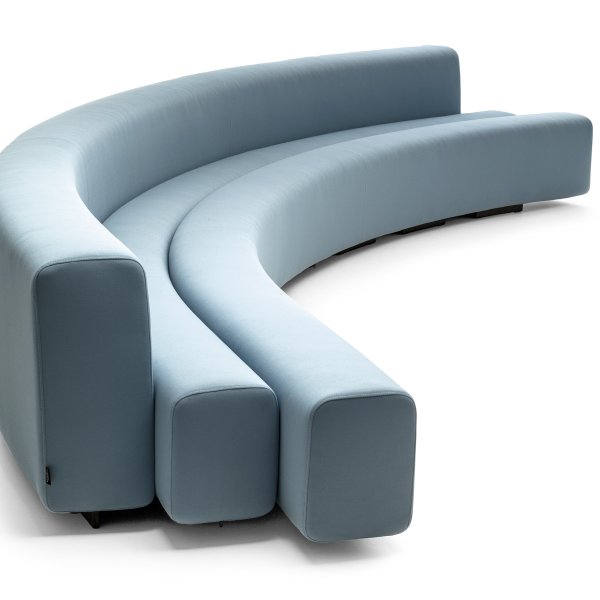
Osaka
$ 26,730
Ask what makes a Pierre Paulin seat and the answer is a technique, not a shape. From 1958 he worked with the Dutch manufacturer Artifort on seating built as foam over a tubular frame, then pulled tight under a jersey cover that could be taken off — furniture treated the way a tailor treats cloth. The results are in every survey of the period: the Ribbon chair in 1966, the Tongue in 1968, the Tulip in 1965, all still in production. Paulin himself had trained far from pop culture, under the cabinetmaker Maxime Old and in Marcel Gascoin's studio, which is why the wildest of his shapes still sits square on the floor.
American specifiers reach that catalogue through laCividina, which reissues the Osaka sofa he drew in 1967: straight and curved modules, a chassis built up for continuous public duty, flame-retardant foam in several densities, stitching backed with carbon fibre. Corporate lobbies and hospitality floors furnished with La Mercanti get a 1967 drawing with a 2026 spec sheet behind it.