Already have something in mind?
Trade terms for professionals and design studios
Already have something in mind?
Trade terms for professionals and design studios
Past the largest standard size, Fiam stops counting in steps. The top of Bright can be ordered as large as 94 1/2 by 47 1/4 in, and the English edition of the data sheet adds a detail worth having: by the centimeter. In practice the length can follow the wall, the window bay or the gap between two built-ins, instead of the room bending around a catalog figure. When we shortlist designer desks for private offices with an awkward wall, that freedom is what puts Bright on the list. Valerio Cometti designed it for Fiam.
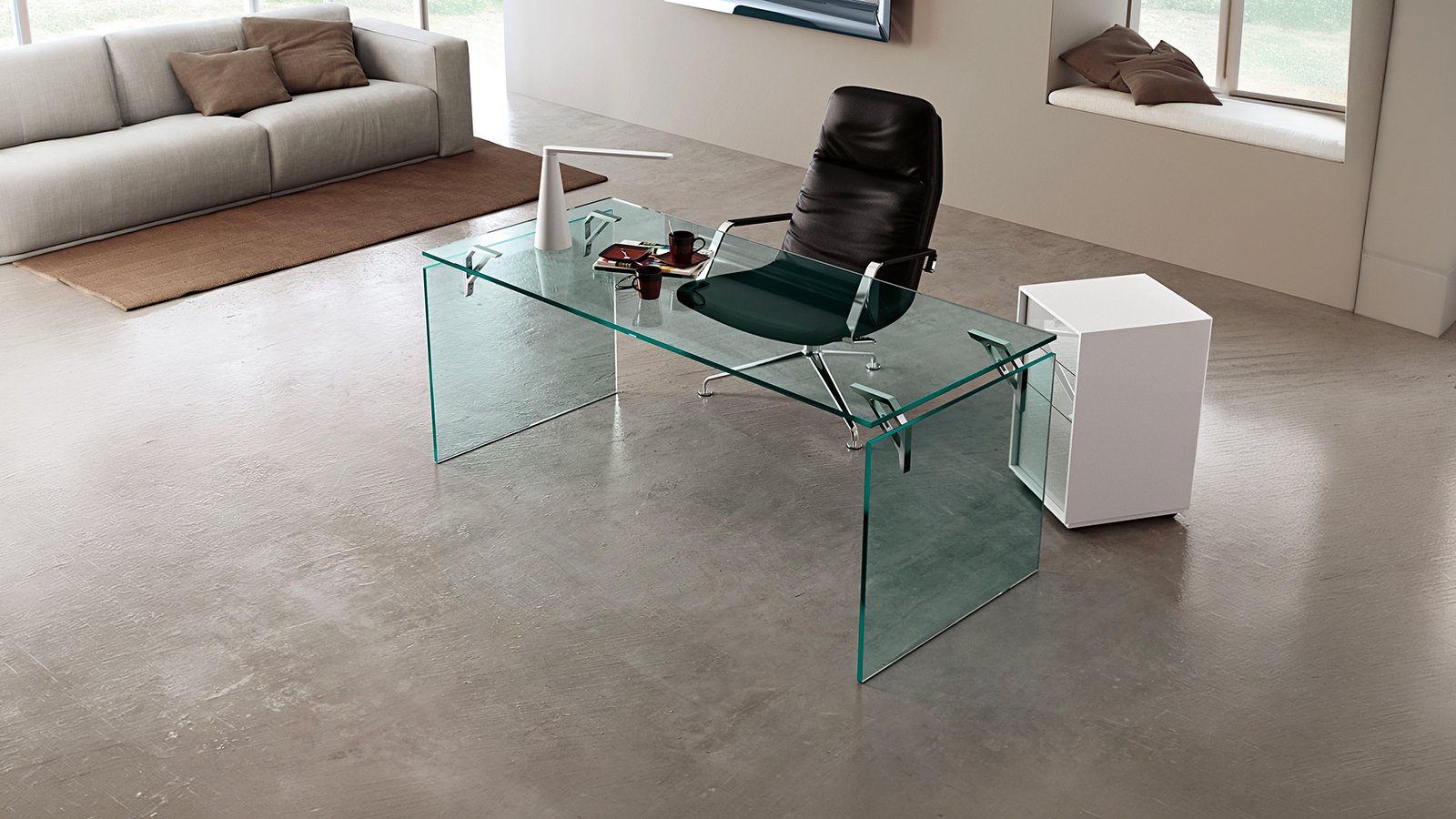
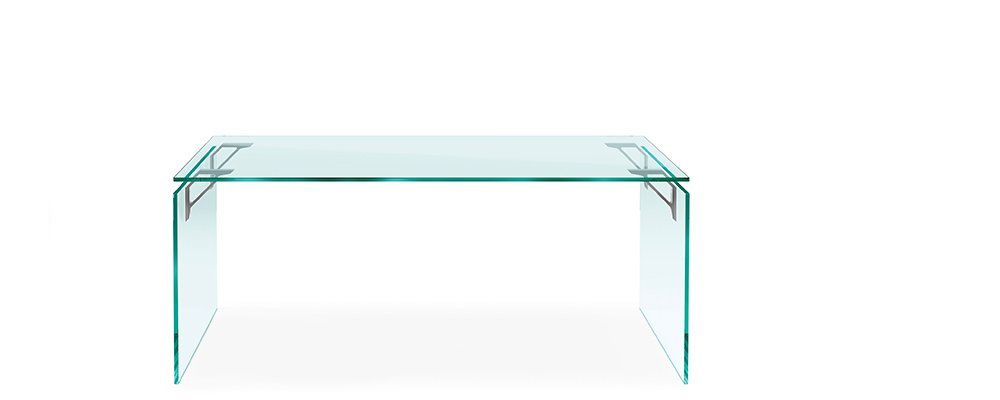
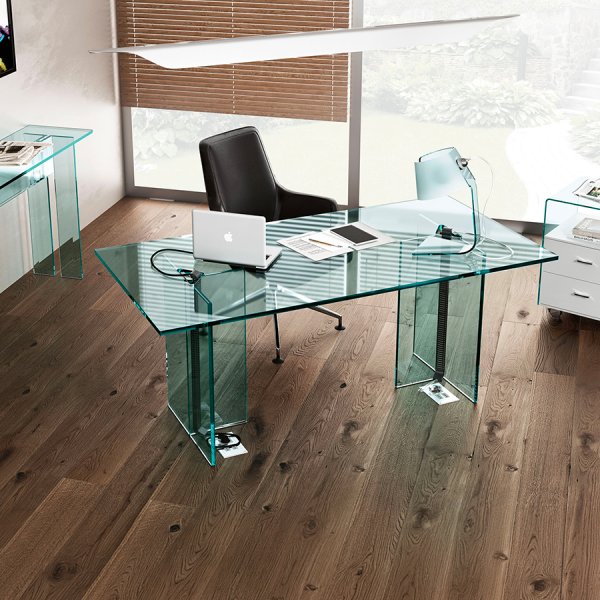
The material is tempered glass, 19/32 in thick, in three sheets: a top and two legs, joined at the corners by fixing supports of aluminum and steel. Fiam calls the piece demountable. For buyers comparing office desks in glass, one consequence of going long is worth knowing early: on the longer custom tops the legs move in from the ends, and a stretch of free glass stays open at either side.
Read the range from the largest down. First comes the made-to-order top, any length up to 94 1/2 in, any depth up to 47 1/4 in. Then the five standard sizes, beginning at 70 7/8 by 31 1/2 in and ending at 47 1/4 × 23 5/8 in, every one of them 28 3/4 in high. The two grades of glass, Standard and Extralight, close the list. La Mercanti asks two questions, in this order: how long is the longest wall, and how wide is the narrowest doorway on the way in?

Let us know which finishes you'd like to explore
Four on every standard size: Fiam's drawings show two under each end of the top, one toward the front and one toward the back. In the drawing for the largest made-to-order top there are six, three per leg, spaced no more than 23 5/8 in apart. Each is a triangular bracket of polished metal. Since they are the only opaque parts of the piece, the count is worth knowing before you see it from the visitor's chair.
Fiam states 220 lb on the top. Our advice is to write down what will sit there every day, screens, a desk lamp, a laptop dock, paperwork, and add it up before signing off. On a glass surface, anything heavy that never moves, a large printer or a row of binders, is better placed on a credenza next to it, leaving the top for the work of the day.
70 7/8 by 31 1/2 in, at the same 28 3/4 in height as the others, and 212 lb by the data sheet. It is the only standard size with that depth: the two below it are 27 9/16 in deep and the two smallest 23 5/8 in. That extra depth is what lets someone sit across from you while the monitor stays at a comfortable distance. Beyond it, sizes are made to order.
Three depths organize them. At 23 5/8 in deep: 47 1/4 and 51 3/16 in long. At 27 9/16 in: 55 1/8 and 63 in. At 31 1/2 in: 70 7/8 in only. All five stand 28 3/4 in high. We suggest fixing the depth first, from the monitor and from whether visitors sit opposite; the length then narrows to one or two candidates.
That it is tempered, 19/32 in thick (about 5/8 in), and available as Standard or Extralight. The sheet stops there, and so do we. In Fiam's photographs the cut edge of each pane shows a green-blue tone, and that is where the thickness reads from across a room. For a specifier, the phrase to carry into the schedule is the one Fiam prints: tempered glass desk.
Fiam lists Bright as demountable: a top and two legs of tempered glass, joined by metal fixings. Five steps to plan its arrival, from the elevator cab to the spot where it will stand.
Bright arrives as separate pieces: Fiam calls it demountable, and its photographs show three sheets of glass, a top and two legs. Check the elevator first, door width and cab depth, against the largest of those sheets, the top. Among the standard sizes it runs from 47 1/4 by 23 5/8 in up to 70 7/8 by 31 1/2 in.
The data sheet gives the weight of each complete standard size: 130 lb for the smallest, 212 lb for the largest, with 137, 163 and 174 lb for the three in between. Whoever books the elevator and the movers should have that figure in hand, along with the number of pieces, which is three.
Between the elevator and the office, every turn and every door frame counts. Measure them rather than assume them, and compare them with the length and depth of the top you have chosen. A demountable piece only helps if each sheet, taken on its own, can make it through the last doorway.
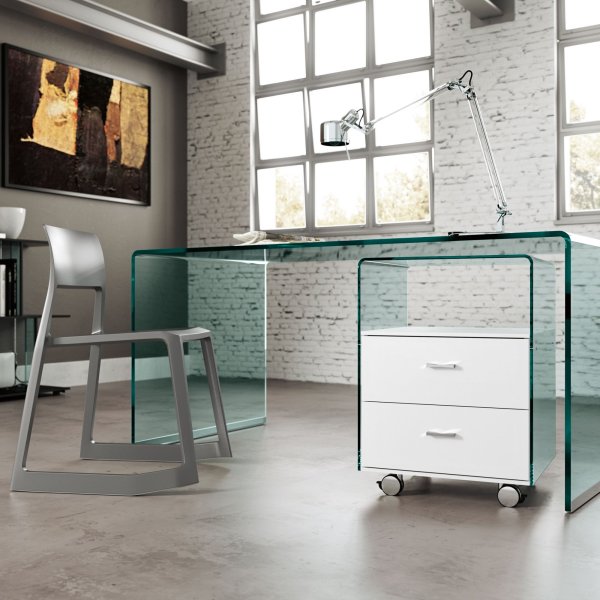
Decide where the desk will stand before anything arrives: the wall it faces, the route of the cords, the swing of the door. Under a clear top everything on the floor stays in view, so a pedestal, a wastebasket and the power cords are best placed on the plan at the same time as the desk.
Demountable counts twice: once on the way in, and again on the day the company changes floors or addresses. The same three sheets can leave by the route they came in on. We suggest filing the dimensions of that route with the office records, so that nobody has to measure it all over again.