Let's discuss your project
Trade terms for professionals and design studios
Let's discuss your project
Trade terms for professionals and design studios
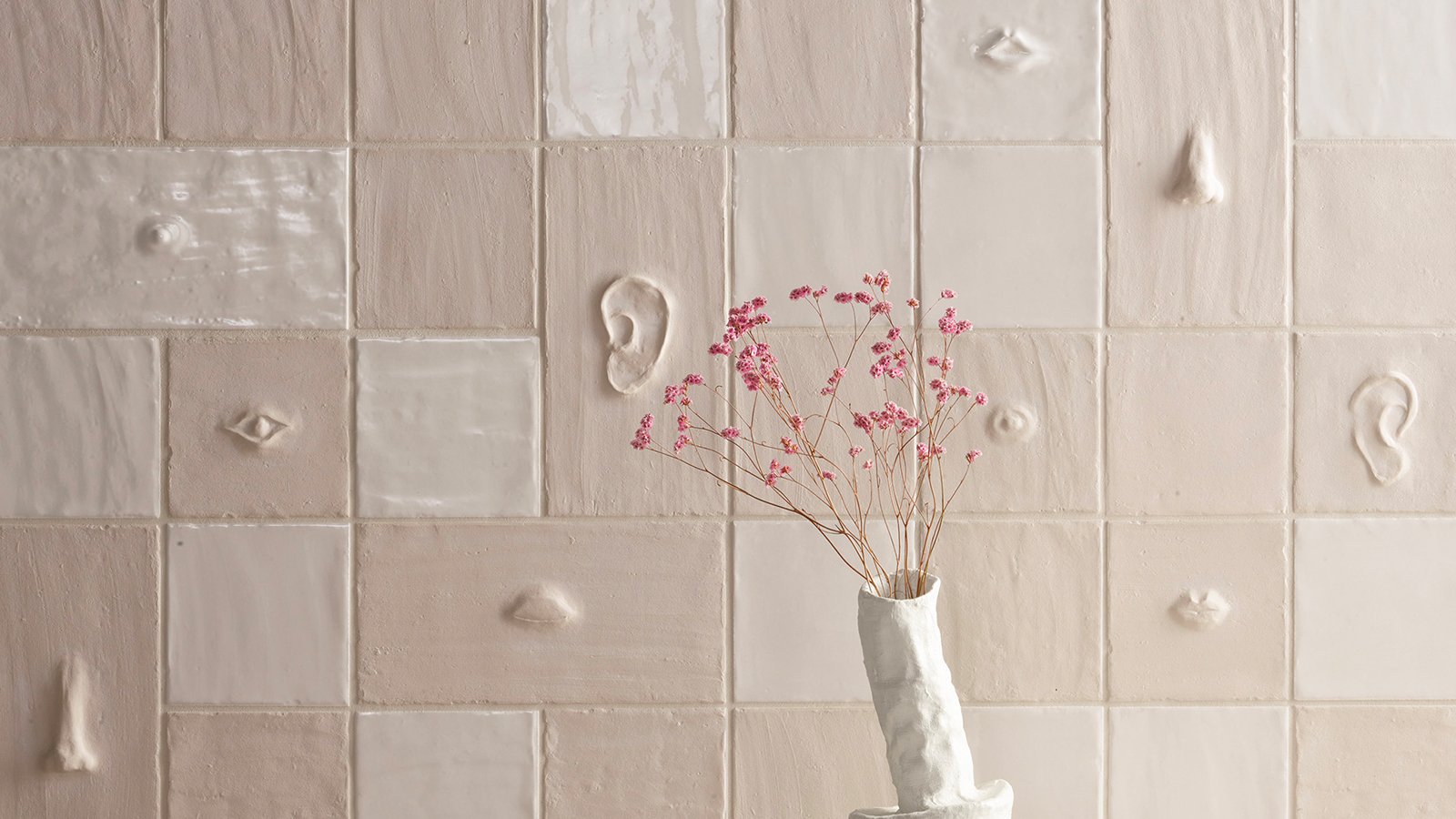
Work by Faye Toogood belongs to the collections of the Philadelphia Museum of Art and the Dallas Museum of Art, pieces that sit between functional object and sculpture. Faces & Figures, the first time she and Mutina have worked together, brings that same territory onto a wall. «The project started with us interrogating feel rather than form. Body meeting clay», she explains, and the collection turns that sculptural language into an architectural system.
The studio work behind it was physical: dozens of models and edges shaped by hand, cardboard studies, clay maquettes. Out of it came archetypes rather than figures, modules that repeat and lock together. Mutina produces them as designer ceramics with a deliberately uneven skin, wavy and faintly scratched, with cracks and roughness along the edges, on unrectified porcelain with a 3/8 in profile. In an executive powder room, a field of Noses on a Chalk ground sits at eye level.
The lineup is broader than it looks. Plain Tiles are the backdrop, in 6 × 6, 6 × 12 and 12 × 12 in, in Chalk, Sand, Clay and Mud, with a Matt and a Glossy version of each color. Figure adds two organic 8 × 12 in shapes, Matt only. The five relief subjects (Eyes, Ears, Mouths, Noses, Nipples) and the eight-element Face come in Chalk, while Body, a 3.8 × 7.3 × 3.5 in terracotta brick, is available in Chalk or Cotto. Floors take Matt indoors and out, Glossy only inside a home; every relief, Face and Body stays vertical. La Mercanti lists Matt and Glossy as separate lines on the order, so each finish lands in the right room.

Let us know which finishes you'd like to explore
Figure is an 8 × 12 in unglazed porcelain tile in two organic shapes that fit together, so a floor or wall shifts between figure and abstraction. It comes only in Matt, in Chalk, Sand, Clay or Mud.
Only indoors in a residence. Mutina rates the Glossy grounds for interior residential floors and for walls inside or outside, while the Matt grounds are the ones rated for exterior floors.
It depends on the grout. With a cementitious grout, Mutina recommends a buffered acid cleaner, citing Fila’s Deterdek Pro at a 1:5 dilution; after epoxy grout, an alkaline cleaner, for instance Fila CR10.
Yes, Mutina strongly recommends a dry layout before final installation. Setting the pieces out loose lets the installer place each element and align the tile with the way the grout joints divide the surface.
The Matt grounds carry a barefoot class C slip rating, the value that counts in wet barefoot areas. It applies to the Matt Plain Tiles and to Figure, which are the pieces rated for floors.
Mutina suggests six layouts for blending the three Plain Tiles sizes. Five steps from picking a ratio to ordering the right number of cartons.
Mutina offers six suggested layouts for blending Plain Tiles sizes. Pick one before drawing anything: each sets a fixed share for the 6 × 6, 6 × 12 and 12 × 12 in pieces.
Layout 1, for example, calls for 25% of 6 × 6 in, 50% of 6 × 12 in and 25% of 12 × 12 in. Layout 4 drops the smallest tile and runs 20% of 6 × 12 in with 80% of 12 × 12 in.
Once sizes are mixed, a 5/32 in grout joint is mandatory, not optional. Draw it into the plan from the start so the modules line up across the whole field.
A carton of 12 × 12 in covers 11.6 sq ft; cartons of 6 × 12 in and 6 × 6 in cover 7.3 sq ft each. Apply the chosen percentages to the area, then divide by those figures.
Lay the mixed sizes out loose first, as Mutina strongly recommends: the dry run positions every element and lines the field up with the grout joints before any thinset is spread.