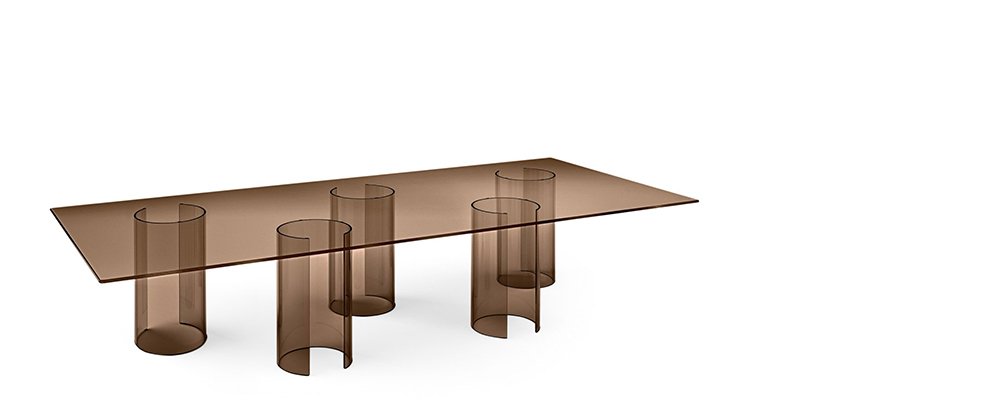
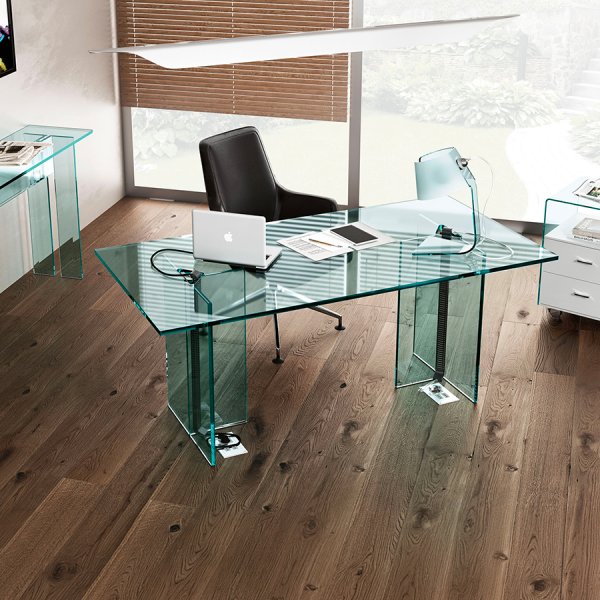
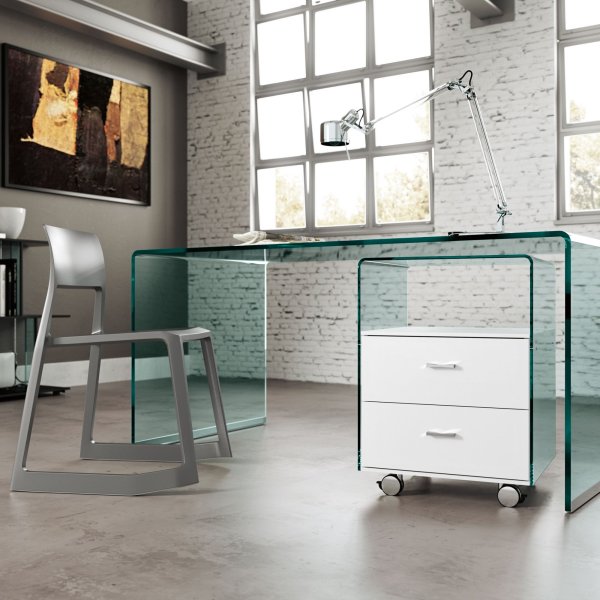
Luxor conference table by Fiam, with a park beyond the window wall

153 9/16 by 86 5/8 inches on eight glass cylinders: the largest Luxor Fiam draws

Fiam

Rodolfo Dordoni

Conference table only
Luxor An icon of Italian design Conference table only
$ 2,702

Already have something in mind?

Trade terms for professionals and design studios

Fiam's drawings stop at 153 9/16 by 86 5/8 inches. That is the largest Luxor top on the sheet, and it takes eight cylinders of curved glass, each 15 3/4 inches across, in glass 3/8 inch thick. In a large boardroom it is usually the size that comes up first, and the one that most needs the room checked. Luxor belongs with the glass conference tables that publish their limits: every size Fiam prints is the maximum for a given number of bases.

The same 153 9/16 by 86 5/8 inches exists twice. As a rectangle, or the oval drawn inside it, it stands on eight cylinders; as an ellipse, on seven. Above the legs lies a laminated top in smoked or bronze, or clear tempered glass, finished with a rounded, polished edge. The design is by Rodolfo Dordoni. We see Luxor in boardroom interiors where one table has to hold the whole length of the room.

From there the family steps down. Fiam offers Luxor as a table and as a conference table, in four shapes: rectangular or oval, elliptical, round and square. Rounds and squares top out at 86 5/8 inches on five bases; the smallest top of all is a square 31 1/2 inches a side, on two. Every shape can be made to measure, and the legs can be ordered at a custom height. Before the biggest top goes on an order, La Mercanti sets two chairs at either end of a 153 9/16-inch line on the client's floor and asks two people to hold a conversation across it.

Technical information based on data declared by the manufacturer.
  • Collection: Luxor
  • Manufacturer: Fiam
  • Design: Rodolfo Dordoni
  • Type: glass conference table; Fiam declares two versions, table and conference table
  • Top: smoked or bronze laminated glass, 5/16 + 5/16 in; or tempered glass, standard or extralight
  • Top edge: rounded and polished
  • Bases: curved glass cylinders, 3/8 in thick, Ø 15 3/4 in, 28 3/4 in tall
  • Number of bases: two or more; the drawings of the largest tops show eight
  • Base glass: Standard · Extralight · Smoked · Bronze · Nero95
  • Custom base height: 11 13/16 in minimum, 43 5/16 in maximum
  • Rectangular or oval tops, largest first: 153 9/16 × 86 5/8 in · 141 3/4 × 63 in · 118 1/8 × 47 1/4 in · 94 1/2 × 47 1/4 in · 70 7/8 × 35 7/16 in
  • Elliptical tops (maximum): from 78 3/4 × 39 3/8 in up to the 153 9/16-inch maximum shared with the rectangle, by way of 110 1/4 × 63 in, 141 3/4 × 70 7/8 in and the second rectangular size
  • Square tops, per side: 86 5/8 · 78 3/4 · 51 3/16 · 31 1/2 in
  • Round tops: Ø 39 3/8 · 63 · 78 3/4 · 86 5/8 in
  • Custom tops: yes; each drawn size is the maximum for its number of bases
  • Load on the top: 331 lb
  • Weight per base: 40 lb
  • Model: registered
La Mercanti USA Llc — your partner for Italian design and contract supply.
Los Angeles, CA, USA · +1 855 335 8079 · info@lamercanti.us
Supply, quotes, specifications and project support across the United States and North America.

Let us know which finishes you'd like to explore

$ 180

Credited in full toward your purchase

FAQ

What does 5/16 + 5/16 in mean for the smoked and bronze tops?

It is how Fiam writes the build of its two tinted tops: laminated glass, 5/16 + 5/16 in, in smoked or in bronze. The figure belongs to those two tints only; the clear top is a different glass, tempered, in Standard or Extralight. For a buyer the point is practical. Choosing a tint also means choosing the laminated build, so color and construction are settled in one decision.

How heavy is each base?

Fiam gives 40 lb for one base, a curved glass cylinder 15 3/4 in across and 28 3/4 in tall. Top and bases are separate pieces by nature, one surface and several cylinders, and each makes its own way into the building. Our advice is to find out early which way the top will come into the room: the cylinders, at that weight each, are the simpler part of the move.

Is there a clear version of the top?

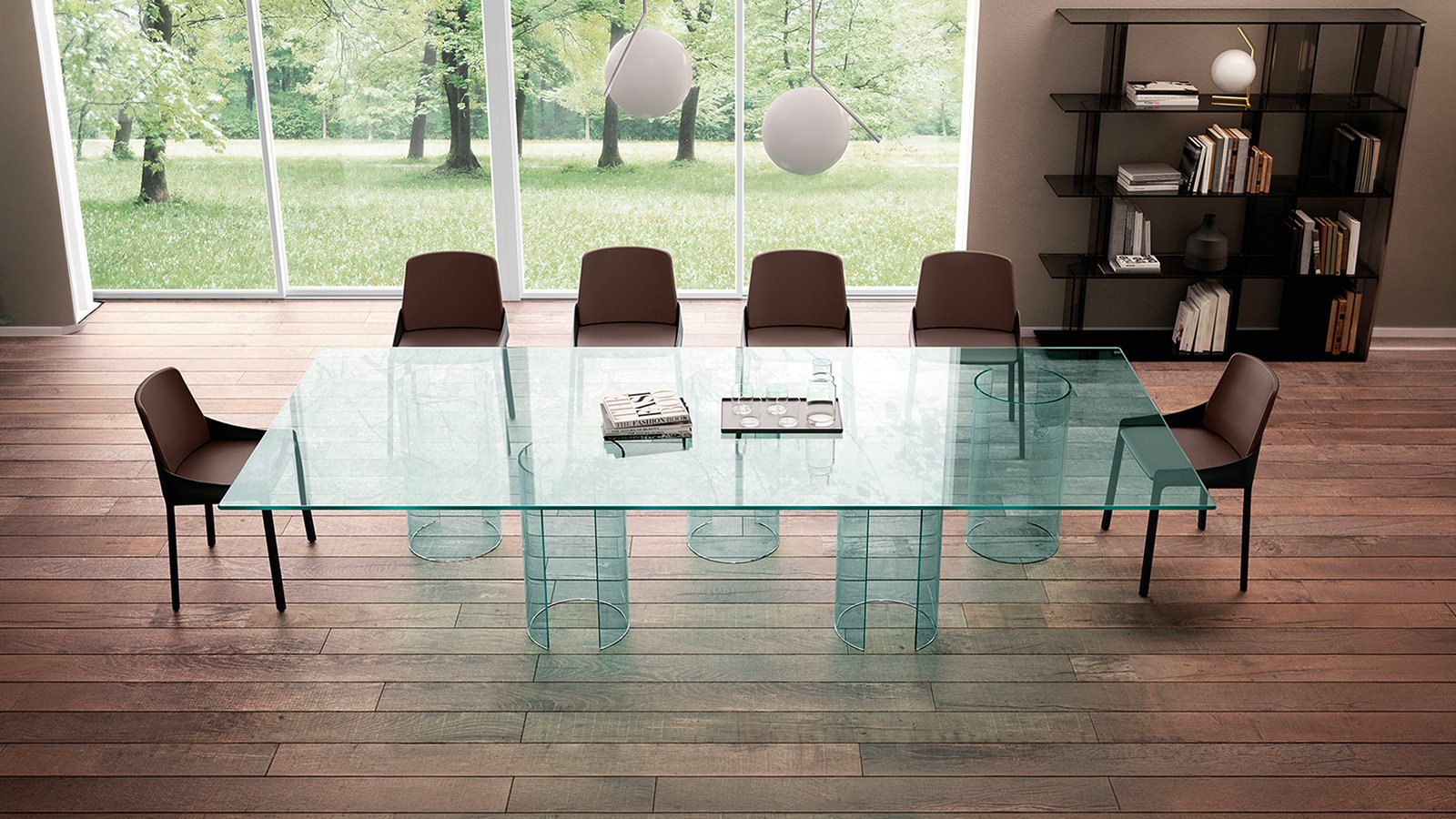
Yes. Alongside the two tinted tops Fiam offers a clear one in tempered glass, Standard or Extralight. It is the top in Fiam's photographs, where the cut edge shows a blue-green line. Tempered applies to those two grades only, just as laminated applies only to smoked and bronze. A clear top leaves every base on view from above, so the position of the legs becomes part of the design of the room.

Which finishes are the legs offered in?

Five. Fiam lists Standard, Extralight, smoked, bronze and Nero95 for the cylinders, one more than the four offered for the top, and Nero95 appears in the bases' list alone. The two lists are distinct in the documentation, so it pays to specify top and legs on separate lines. Under a clear top, whichever finish the legs are in will be seen from every chair.

Who designed it, and what does Fiam say about him?

Rodolfo Dordoni, architect and designer, born in Milan in 1954, who graduated in architecture there in 1979. That is how Fiam introduces him, adding that he has designed various pieces for the company, among them Luxor in two versions, table and conference table. For an architect writing a spec, the piece carries a named author on Fiam's documentation, next to its status as a registered model.

Seats first, legs second: laying out Luxor on a floor plan

Fiam places a generic chair around every Luxor top and calls the position of the bases purely indicative. Five steps to put seats and legs on the plan in the right order.

Begin with the seats

Luxor's custom-top drawings put a generic chair, 19 11/16 by 19 11/16 inches, all around each top. Start the same way: mark your own chairs on the floor plan before anything else, because they decide where the legs can go, not the other way round.

Trace each base as a C

In plan, a base is an open curve. Fiam shows it as a C, 15 3/4 by 14 9/16 inches, and the photographs confirm a vertical slit in every cylinder. Trace it that way on the plan, opening included, so the footprint you work with under the top is the real one.

Read the layout as a sketch

Under its drawings Fiam writes that the arrangement of the bases is purely indicative. What the sheet fixes is the relationship between how many bases there are and the largest top they go with; where each cylinder stands under that top is a matter for the plan.

Keep a free path for every chair

Under a clear top every leg is in plain view, and every chair has to slide in without meeting one. Our advice: shift the cylinders on the plan until each seat has a free approach, checking the long sides and the ends of the table one after the other.

Hold the count to the size

Moving the bases around the plan leaves their number alone. Fiam ties each size to a number of cylinders, from two under the smallest tops upward, so the plan should keep the count the sheet gives for that size while the positions change.

You May Also Like