
In 1966 Edward T. Hall gave the receptionist a number: ten feet. Closer than that to another person, even a stranger, "she will be sufficiently involved to be virtually compelled to converse," he wrote in The Hidden Dimension. Nobody in the lobby has said a word yet, and the floor plan has spoken first.
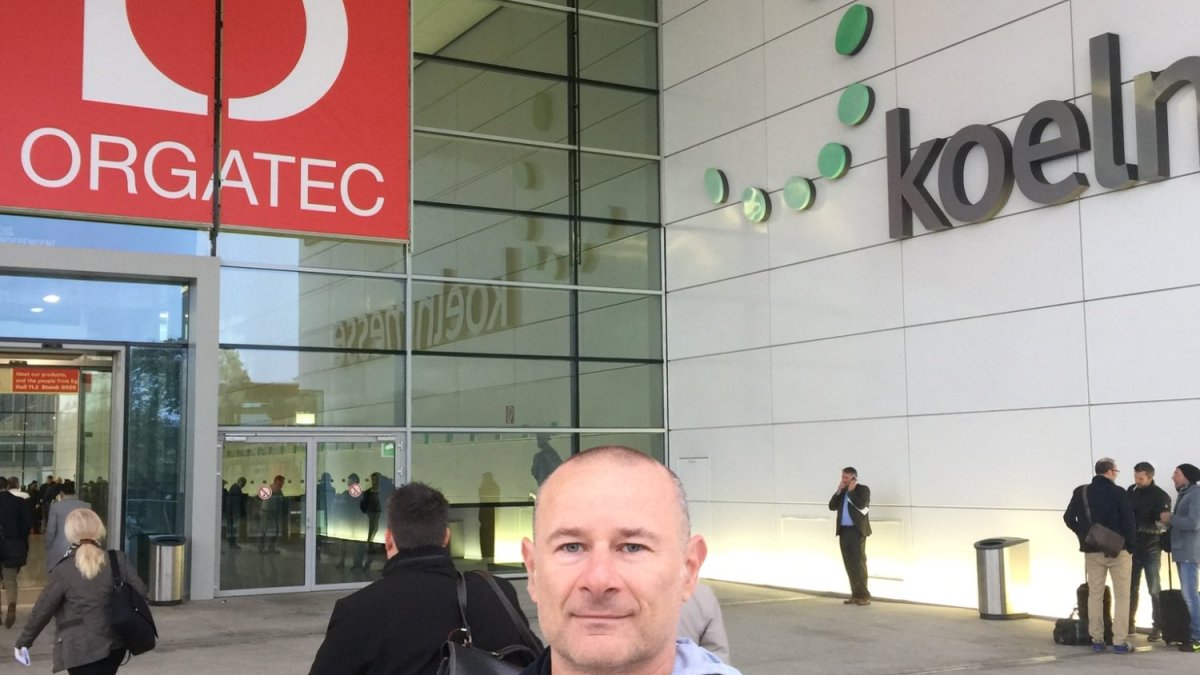
On October 27, ORGATEC opens its doors in Cologne, and this year's motto is "From rooms to relationships," with a subtitle about designing for a world that keeps changing. The motto reads as a before and after. Hall's receptionist suggests the after is built into the before: rooms are already relationships. The organizer writes that this edition shows how "purely functional settings can become spaces of genuine connection," and I will be in Cologne with a visitor's badge to see it. The distance at which furniture places two people is the first thing they negotiate, and nobody at the table negotiated it.
The feet in this essay are Hall's own, and they fit an American reader because of whom Hall observed. His account of the distances people keep, he explained, was compiled from observations and interviews with "non-contact, middle-class, healthy adults, mainly natives of the northeastern seaboard of the United States." He added that people from southern European cultures have very different proxemic patterns. I was born in one of those cultures. When I read his figures, I am reading about Americans of the Northeast, measured in the unit Americans use to lay out an office.
I will take the office in the order a guest does, from the door inward, and let a different study speak in each room.
The front desk sets the first distance
Hall maps four zones of distance around a person, and each has a near phase and a far one. His heading for the outer band of social distance reads "seven to twelve feet." What makes that band useful, he writes, is that it can "insulate or screen" people: at that range someone can go on working in another person's presence without seeming rude. Receptionists, he observed, are particularly vulnerable, since most employers expect double duty of them, answering questions and staying polite to callers, on top of typing. That is where the ten feet of the opening comes from.
I read that page as a brief for anyone drawing a lobby. Where the waiting chairs stand in relation to the counter decides whether the person at the desk chooses when to speak or has to host every arrival. Both can be right. A small firm that wants each guest greeted at once may set the seating close; an office where the front desk also carries real work may prefer to give it Hall's margin. That choice belongs at the start of the project, before anyone compares reception desks and counters by finish or size.
Among the themes of the Work Culture Festival held inside ORGATEC is "Empowered Experience," which the organizer describes as new working environments that boost motivation and satisfaction. In Cologne I will read it with the receptionist in mind.
Along the corridor, distance thins the conversation
Past the lobby, the guest walks by rows of workstations, where the most recent of the three studies belongs. Thomas J. Allen followed the path of technical information through R&D organizations and set out his findings in 1977 in Managing the Flow of Technology, an MIT Press book. His question was how likely two colleagues were to talk at least once a week, given how far apart they worked. Nobody, he noted, would be surprised that the odds shrink as the distance grows; the surprise is how quickly they shrink. A book he wrote with Günter Henn in 2007 returns to the point with a curve that slopes down as the distance between people increases.
Allen's evidence comes from R&D settings, and that is the boundary within which it should be read. Inside it, my conclusion is practical. If two teams must trade work every week, the walk between them deserves a tape measure before a single chair is ordered.
At the conference table, people ask for different seats
Robert Sommer's paper appeared in 1965 in Sociometry, under the title "Further Studies of Small Group Ecology." He watched pairs of students in two settings: a cafeteria, where talking to each other was encouraged, and a library, where it was not. At the cafeteria tables the pairs picked seats facing each other; in the library they kept apart.
Next came written questionnaires on where casual, cooperating, co-acting and competing groups would rather sit. Casual groups favored the corner of the table, cooperating groups adjacent chairs, co-acting groups seats far apart, competing groups the places straight across. Sommer also discusses the part eye contact plays in these arrangements. They are preferences gathered sixty years ago, which is reason enough to hold them lightly. They still change the first question to ask about conference tables: how many seats will put two people at a corner or next to each other, and how many will set them face to face over the top?
In the private office, the desk sets the register
The walk ends at the room of the person who decides. Two weeks ago I wrote here about why America looks to Italy for the executive desk; this time my subject is the chair facing it. Desks in the offices of important people, Hall notes, are big enough to keep a visitor out at the far end of social distance; a desk of ordinary size, too, leaves the guest chair eight or nine feet away from whoever sits behind it. Talk held that far out, business or social, turns more formal than it would be at closer range.
As I read Hall, the guest chair is where the host announces the kind of meeting it will be. I would keep a second answer in the same room: a small table where two chairs meet at a corner, which borrows Sommer's preference for casual talk. The person who gains is the one who uses the office every day, because a room that offers both registers lets its occupant choose.
The walk, in feet
8 or 9 feet: where a desk of ordinary size puts the guest chair, counted from whoever sits at the desk (Hall, 1966).
Under 10 feet: a receptionist this close to another person, even a stranger, is virtually compelled to converse (Hall, 1966).
7 to 12 feet: the outer band of Hall's social distance, where business and social talk grows more formal and people can keep working in each other's presence (Hall, 1966).
No number, a corner: the seat casual groups preferred at a table, while cooperating groups chose adjacent chairs and competing groups the seats across (Sommer, 1965).
No number, a curve: in R&D organizations, the odds of weekly communication fall as workplaces sit farther apart, at a rate Allen himself calls surprising (Allen, 1977).
What I take to Cologne
The organizer has chosen to center this edition on the human dimension, on how people relate to one another in workplace and contract settings. I will carry Hall's receptionist through every hall of the fair, looking at how far each chair sits from the next. Every floor plan introduces people before they meet.
Quick answers
What are the dates of ORGATEC 2026? It runs October 27 to 30, 2026, in Cologne, Germany, and its theme is "From rooms to relationships."
What did Edward T. Hall say about reception desks? Hall's 1966 book, The Hidden Dimension, observes that a receptionist seated closer than ten feet to another person, even a stranger, will be virtually compelled to converse, whereas seven to twelve feet lets people keep working near one another without seeming rude.
Whose distances did Hall describe? He drew them from observations and interviews with non-contact, middle-class, healthy adults, mainly natives of the northeastern seaboard of the United States, and he pointed out that people from southern European cultures have very different proxemic patterns.
Where do people prefer to sit at a table? Robert Sommer's 1965 questionnaires, published in Sociometry, found casual groups favoring the corner, cooperating groups adjacent seats, co-acting groups distant ones, and competing groups the seats across.
Does desk distance change how often colleagues talk? Among the R&D organizations that Thomas J. Allen examined for his 1977 book, the odds of weekly communication fell as the distance between colleagues grew, and Allen himself found the speed of that decline surprising.