
In 1852 HMS Resolute sailed into the Arctic with a British expedition searching for Sir John Franklin, and in time she was abandoned, trapped in the ice. In 1855 an American whaler, the George Henry, recovered her. Congress paid to refit her and sent her back to England as a gift of friendship to Queen Victoria. From her white oak and mahogany timbers William Evenden, at the Royal Naval Dockyard in Chatham, built a desk, and in 1880 the Queen gave it to President Rutherford B. Hayes.
The desk of the Oval Office, then, is English. It was first used in that room by John F. Kennedy, and Johnson, Nixon and Ford are the presidents who did without it. I start there because Americans already know what the desk of the person in charge is for, and because it helps explain two numbers that on paper should not sit together. In 2023 Canada alone supplied nearly half of the wood and metal office furniture the United States imports, China came second, and Italy's share is under three percent. Yet the requests that reach us through lamercanti.us are almost all about a single object: 93.6% concern a desk, 72.5% an executive desk. America buys its office furniture elsewhere. From Italy it asks for one room, the one where the furniture has to say who works in it.
The imported volume comes from Canada and China
Take the two tariff codes for office furniture, wood and metal, and read the 2023 figures that UN Comtrade publishes for American imports. Wooden office furniture came to 838 million dollars, of which 393 million from Canada, 168 million from China and 17 million from Italy. Metal office furniture came to 833 million dollars: 428 million from Canada, 133 million from China, 77 million from Mexico, 29 million from Italy. Combine the two codes and Canada accounts for about 49% of the office furniture America imported that year, Italy for roughly 2.8%. The numbers are UN Comtrade's; the divisions are mine. Seen from the Italian side, data from the Centro Studi FederlegnoArredo show that in 2023 the United States was the second foreign market for Italian office furniture, worth 71 million euros, behind France.
A caveat belongs here. Tariff codes do not separate the executive desk from other office furniture, and I know of no serious statistic on where the world's executive desks are made. The only pages I found claiming to know were retailers' websites.
The bulk of the trade goes elsewhere. The requests that come to us are after something else.
What America writes to us about
Since 2017, 1,142 requests have come in through the forms on lamercanti.us, and nine out of ten are about a desk. Across every foreign request that named a specific product in our catalog, 3,028 of them, the executive desk accounts for 42.6% and desks as a whole for 74.2%. Europe spreads its interest much wider: from Germany the executive desk is 18.6% of requests and desks in general 59.5%, from France 17.5% and 57.8%. Europeans ask us for the desk and for what surrounds it. America concentrates its question on one piece.
The easy explanation would be rank, as if the market that asks us most for the executive desk were the one most attached to hierarchy. Geert Hofstede's model, which measures how far a society accepts unequal power, points the other way. On that scale the United States scores 40 and France 68, with Italy at 50. Yet requests from our French site go to an executive desk 17.5% of the time, and requests through lamercanti.us 72.5% of the time. The market less at ease with unequal power is the one that asks us far more often for the desk of the person who decides. Rank, then, does not explain the request.
A word on how to read our own data. Among foreign requests, one product page gathers more than any other: Jera by Las Mobili, with 789 requests, 11.8% of everything that reached us from abroad. That figure tells us which page people wrote to us from. It does not tell us what they had typed to get there.
The room has an Italian name and a New York address
In the fifteenth century many houses and palaces set aside a room for study and reflection, and Italian gave it a name: studiolo. To have such a room, as the essay on the studiolo in the Italian Renaissance Learning Resources produced with the National Gallery of Art puts it, was to announce yourself as a person of learning and cultivation.
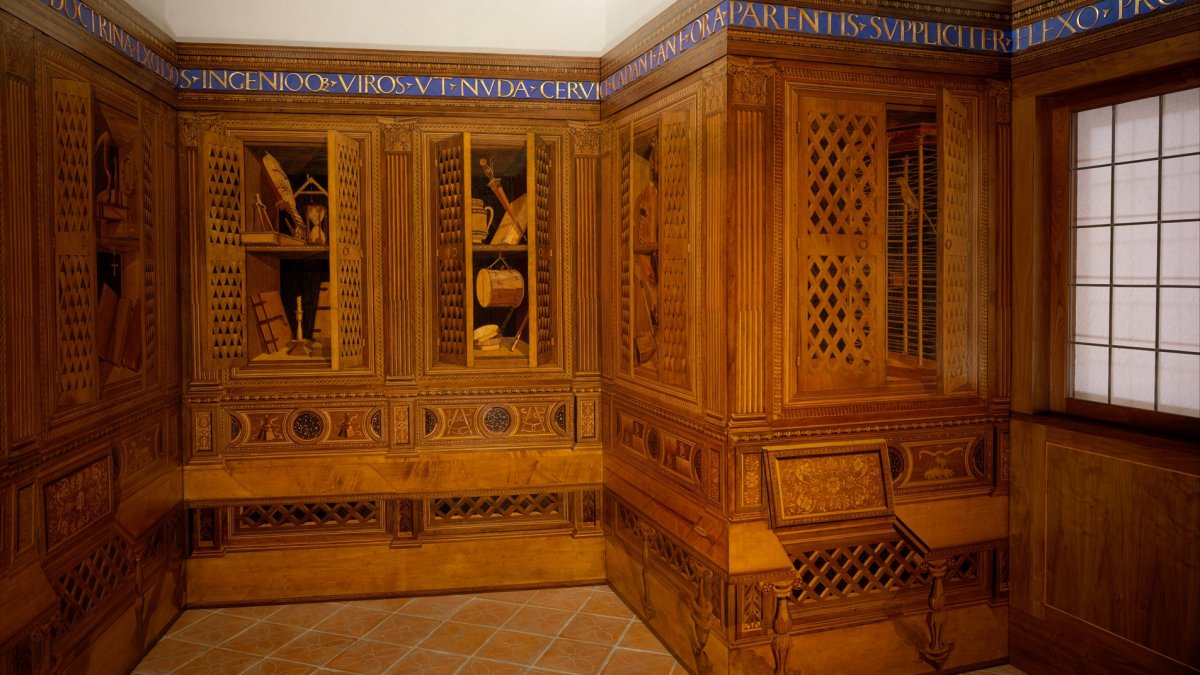
One of those rooms is in Manhattan. Federico da Montefeltro had it made for his palace in Gubbio around 1478 to 1482, to a design by Francesco di Giorgio Martini, in walnut, beech, rosewood, oak and fruitwoods. The Metropolitan Museum of Art acquired it in 1939 and lists it in Gallery 501: a room nearly 16 feet high, about 17 feet wide and 12 feet 7 inches deep, built to speak for the man who worked in it. Federico had another studiolo in the Ducal Palace of Urbino, which reopened to the public on May 30, 2025. The Italian art magazine Artribune described it then as the most intimate room of his apartment and, at the same time, the one that most represented his public figure. Its walls held the portraits of twenty-eight illustrious figures of antiquity and the Middle Ages.
Urbino is in the region where we work. What matters more is the idea behind both rooms: the room of the person in charge was conceived as a portrait of a mind more than as a seat of command, and the word we still use for it is Italian. When an executive anywhere in the United States writes to us for an executive desk, that is the tradition the request reaches, whether or not the writer has ever heard the word studiolo.
Visitors read the room before they read you
In 2002 Samuel Gosling and three colleagues published a paper with an apt title, A room with a cue, in the Journal of Personality and Social Psychology. They asked observers to size up people they had never met, using nothing but those people's offices and bedrooms. Working independently, the observers largely agreed with one another, their judgments showed some accuracy, and they drew on genuine cues in the rooms. In short, anyone who walks into your office forms an impression of you, and the next visitor tends to form much the same one.
For whoever sits at that desk, this is useful news. The room briefs every visitor the same way, including in the weeks you are on the road. Gosling's team measured perceived personality, not authority, which makes the finding more practical: people will read, with some accuracy, what kind of person you are. It pays to make sure that what they read is accurate.
The studiolo worked on the same principle. One room served two purposes: solitary concentration and the hours spent receiving people. An executive desk has the same double job. Late in the day it is where you go through a contract with nothing competing for your attention; the next morning the same surface greets a client, a partner or a candidate and tells them who they are dealing with before you speak.
The Resolute Desk carries a small lesson of its own here. In 1945 a panel carved with the Presidential Coat of Arms was fitted to its rear kneehole: the same desk, now marked by the office it served.
The whole argument fits on an index card
Office furniture imported by the United States, 2023, wood and metal
About 1.67 billion dollars in total, 47 million of it from Italy: roughly 2.8% (UN Comtrade, our division).
Largest suppliers in the same year
Canada, then China; Mexico third in metal. Italy sixth in wood, fifth in metal (UN Comtrade).
Requests received through lamercanti.us, 2017 to 2026
1,142: 93.6% for a desk, 72.5% for an executive desk.
The studiolo of Gubbio
Made around 1478 to 1482 for Federico da Montefeltro; at the Metropolitan Museum since 1939, Gallery 501.
Taken together, the card says that Italy's weight in the office furniture America imports is small, and that the demand that comes to us from America is almost entirely for one piece of furniture. America fills its floor plates elsewhere. From Italy it wants the portrait of the person who sits in the corner office.
What the next visitor will read
We do not manufacture desks. We select them from producers we know well and see them through to the office of the person who will use them, in Italy and in the United States. So before you compare top lengths among our Italian executive desks, or wonder how much deference a desk ought to command, settle a simpler matter: the next person who walks in will form a view of you before you speak, so what do you want that view to be? A carefully chosen wood and proportions that suit the room are already part of the case, and you are the first to see them every morning.
The Resolute carries a ship and a friendship between two nations. Your desk has to carry far less: one true sentence about you, chosen with the same care.
Quick answers
Where does the United States import its office furniture from?
According to UN Comtrade, in 2023 Canada was the largest supplier of both wooden and metal office furniture to the United States, followed by China; Mexico ranked third in metal. Italy supplied about 2.8% of the two categories combined (our calculation).
What do requests through lamercanti.us ask for?
Of the 1,142 requests received through the forms on lamercanti.us since 2017, 93.6% concern a desk and 72.5% an executive desk.
Are most executive desks made in Italy?
No statistic measures it. Tariff codes do not distinguish executive desks from other office furniture, so any claim about where most of them are made has no public data behind it.
What is a studiolo, and where can I see one in the US?
A studiolo is the room for study that many houses and palaces set aside in the fifteenth century; owning one meant presenting yourself as a person of learning. The studiolo Federico da Montefeltro commissioned for his palace in Gubbio has belonged to the Metropolitan Museum of Art in New York since 1939 and is listed in Gallery 501.
Where does the Resolute Desk come from?
It was built at the Royal Naval Dockyard in Chatham, England, by William Evenden from the white oak and mahogany timbers of HMS Resolute, a British ship recovered by an American whaler in 1855. Queen Victoria gave it to President Hayes in 1880, and it first entered the Oval Office with President Kennedy.
Does an office really tell visitors who you are?
Yes. Gosling and colleagues showed in 2002 that independent observers, looking only at a person's office, form similar impressions of the occupant, with some accuracy.