Already have something in mind?
Trade terms for professionals and design studios
Already have something in mind?
Trade terms for professionals and design studios
Two UL marks sit on the opening page of the Team Strike chapter, GREENGUARD and GREENGUARD Gold. They certify one thing: the low level of chemical emissions of the finished chair, what it gives off into the air of a closed room. For whoever writes task chairs for the workplace into a project the value is practical: the indoor-air line closes with a reference, not a sentence.
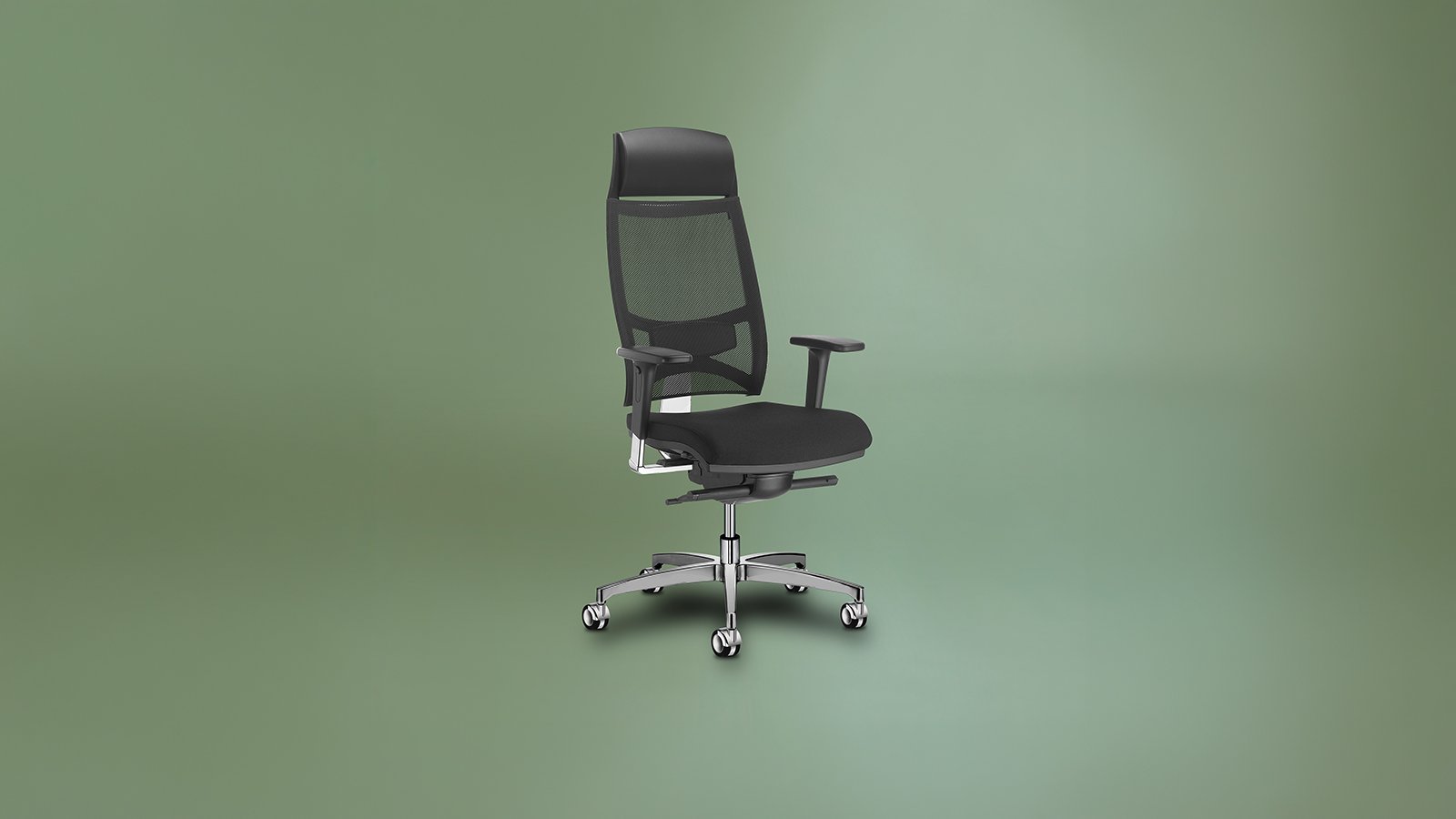
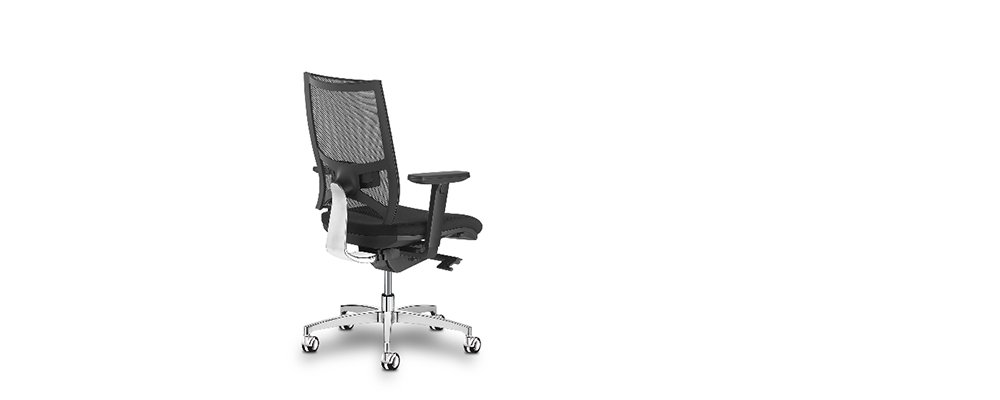
The chair under the marks is Sergio Bellin's drawing of 2008, still in Sitland's program: a synchronized mechanism that locks in five positions, antishock included, with a tilt tension tuned to whoever sits in it, a seat in cold-molded polyurethane built as the Comfort Air System, a lumbar pad that rides up and down. Sitland sums it up as an aid to movement.
Four versions, told apart by the headrest. Two carry it as standard, a soft black polyurethane cushion that travels up and down: the mesh-back Executive, the one version Sitland lists under UNI EN 1335:2020 type B, and the natural fit among Italian executive chairs, and the Executive with upholstered back. Two ship without it and take it as a pivoting, upholstered option: the mesh-back Manager and the upholstered Operative. La Mercanti hands the architect the certification reference together with the fabric sample, so the indoor-air line of the spec is closed on the same visit.

Let us know which finishes you'd like to explore
Sitland files the leather version under category A, a letter that means a split, not one skin. Where the body touches the chair the covering is SX genuine leather; the remaining parts are finished in NX coated fabric matched in color and finish, which is how Sitland words it. On the order the choice is one line, category A, covering both materials; a buyer who expects leather all round should know that the split exists before that line is written.
Depends on the version. On the two Executives, mesh-back and upholstered, the headrest is standard: a soft black polyurethane cushion set higher or lower above the backrest. On the Manager and on the upholstered Operative there is none as standard; Sitland offers it as an option shipped separately, upholstered like the seat, adjustable in height and pivoting, with a black or a white plastic structure. The difference shows when reclining: the cushion is where the head lands with the back locked. On the two versions without it, that support is a line to add before the order, not afterwards.
Four parts, none of them decorative. A synchronized mechanism that moves seat and back together and locks in five positions; a tilt tension matched to the body weight of the user; a Comfort Air seat; a lumbar support that rides up and down. Sitland puts the phrase above the chair as a heading, and the list is what stands under it: comfort, in the maker's own wording, is the sum of settings a sitter can reach, not a thicker pad. For whoever specifies the chair, each of the four is a line that can be checked on the order.
Only on request, and only with a fixed pairing. The Italian fire-reaction class for upholstered seating is reached on Team Strike when the seat is covered in Xtreme Plus (AB) or Secret (SC) and the backrest carries RY mesh; Sitland declares it for the mesh-back Executive and the Manager. The pairing is fixed: change the fabric or the mesh and the class is no longer declared, so the two codes travel together on the order line; the fabric sheets carry their own test references, facts about the cloth rather than the chair.
Three of the collections Sitland proposes. Main Line Flax by Camira blends 75 % virgin wool with 25 % flax, 50,000 Martindale or more, EU Ecolabel and Indoor Advantage Gold. Remix 3 by Kvadrat is 90 % virgin wool and 10 % nylon, 100,000 Martindale, EU Ecolabel. Synergy by Camira is 95 % virgin wool, 100,000 Martindale, the same two labels as Main Line Flax. The labels belong to the fabrics, not to the chair, and the three sit in different categories of Sitland's list, so the wool chosen moves the covering line of the order.
Sitland ships Team Strike on self-braking casters and a black nylon base, and offers four other casters and a polished base. Five steps to pick them by floor, with the diameters in inches.
Every Team Strike leaves Sitland on black self-braking casters of 2 in diameter, on a five-spoke base. Self-braking is the type Sitland fits as standard on all four versions, and the four other casters in the list replace it rather than add to it. So the first question on the order is the floor each chair will stand on: Sitland sorts the options by floor, textile or hard, before anything else.
For textile floors Sitland lists one option: free-rolling casters of 2 in diameter. They are the only casters in the list written for carpet; the three remaining options all carry the note for hard floors. On a plan with both surfaces the caster is written against the room, not against the version, since all four versions take the same five.
For hard floors Sitland lists rubber-tread self-braking casters in two diameters, 2 in and 2.6 in. Same type, same floor, two sizes: the diameter is the only choice here, and each size has its own line in Sitland's list. Hard floors is the label the maker uses, without a further split by material, so the buyer chooses the size, not the surface.
The fourth and fifth options are hollow rubber casters of 2.6 in, free-rolling, for hard floors, with the body in black or in chrome. The two differ in the finish of the body alone; type, diameter and floor are the same on both. The finish is a choice the buyer makes once, because it shows on every chair of the floor and is written on every line of the order.
The standard base is five-spoke black nylon with a steel cone inside, 27.6 in across, the same on all four versions. The option is a flat five-spoke base in polished die-cast aluminum of the same diameter, and the backrest support can be ordered polished as well. Base and casters are two separate lines on the order, each chosen on its own, and the diameter of the base stays 27.6 in either way.