Prefer a tailored configuration?
Trade terms for professionals and design studios
Prefer a tailored configuration?
Trade terms for professionals and design studios
On a typical office chair the height lever sits on one side and has to be found. Skate removes the search: the height adjustment fires when you press any point of the disc beneath the seat, front, left or right, a 360° control that Sitland patented for this chair. On the Active version the seat travels from 17 to 22 in; on Synchro, from 15¼ to 20¼ in. The gesture is the same whoever sits down, which is the reason it was designed that way: the brochure calls Skate simple and intuitive, and the disc is where that promise is kept.
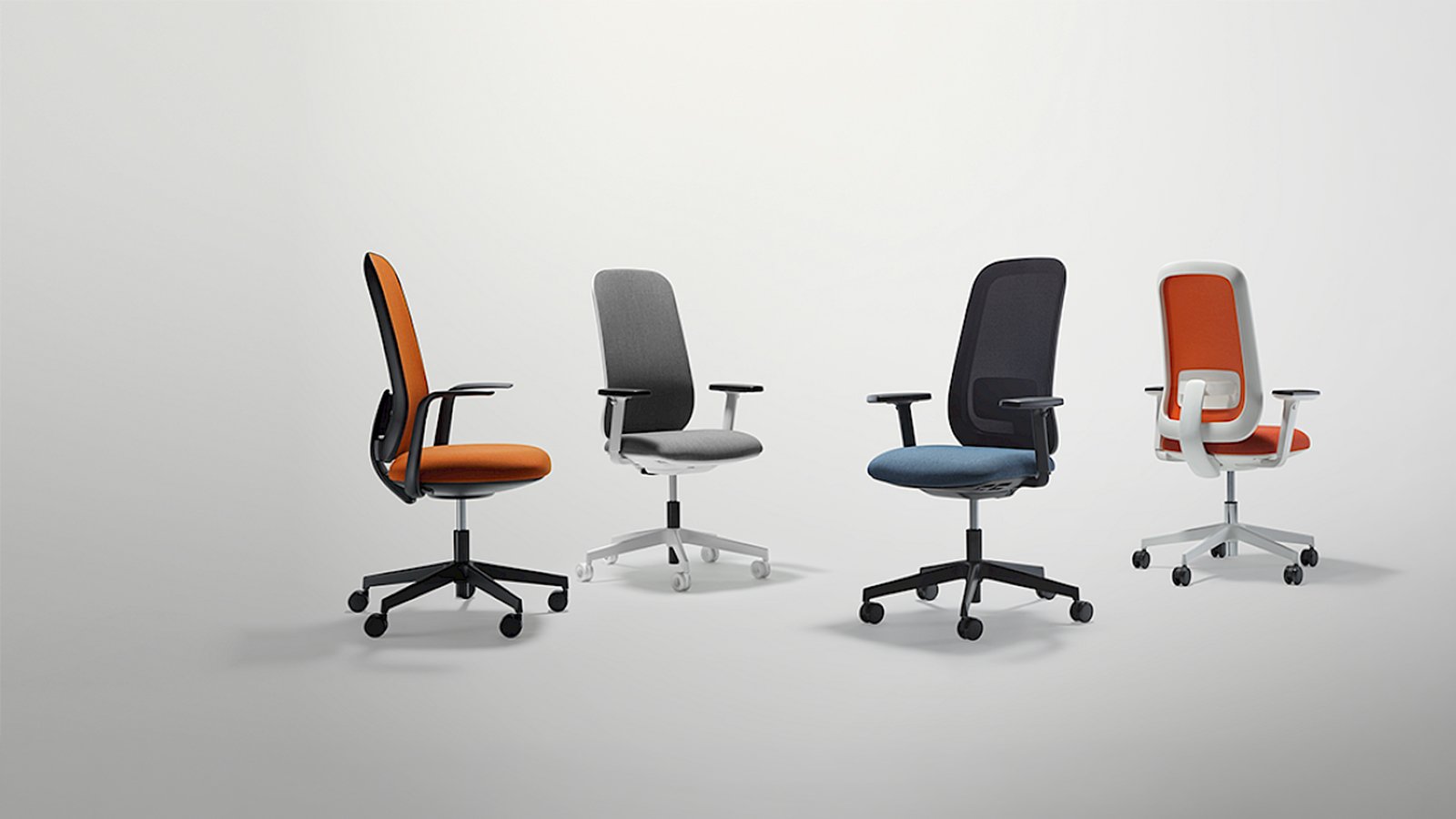
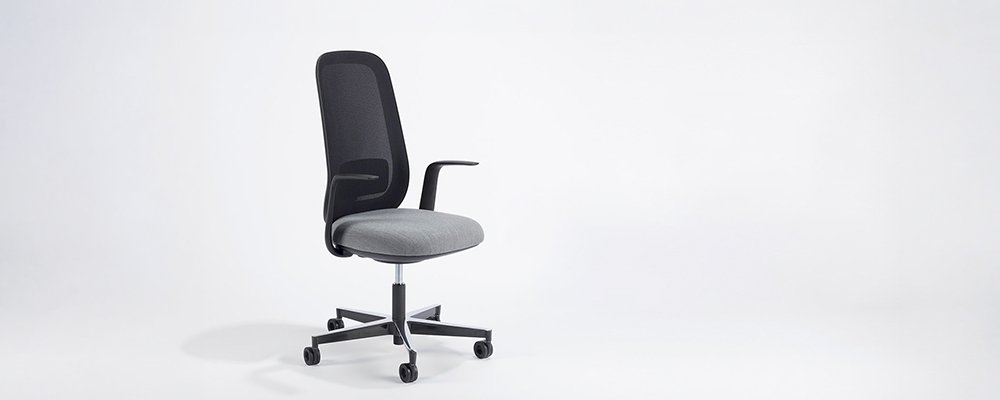
The chair above the disc is one of Sitland’s ergonomic task chairs, drawn for Sitland by a three-person design studio. Active rides on the DAT® patent, which lets seat and back rock with the body without tilt levers. Synchro uses a self-weighing synchronized mechanism with sliding seat depth and a four-position lock. Both carry a lumbar support with 4⅛ in of travel, adjustable while seated, and a polyamide back frame in mesh or fabric.
From there the options read like a spec sheet. Frames are black or white. Active armrests are offered as fixed, height-stepped or 3D; Synchro offers 1D, 2D and 4D, and both can ship armless. Bases are nylon or die-cast aluminum, 27½ in across, and the casters, 2½ in, are matched to carpet or hard floors. Sitland pictures it at the office and in a home study; the Active is its pick for teamwork areas and co-working, so a single open-plan workspace can run both. La Mercanti can ship each one fully assembled, so the chairs arrive ready to roll to the desk.

Let us know which finishes you'd like to explore
Through DAT®, Dynamic Adaptive Technology, which Sitland patented: seat and backrest rock freely with the body while keeping a sound posture, and the motion follows the user’s own movements and body weight. There are no tilt levers or tension knobs to set.
Yes. Sitland’s certification table lists GREENGUARD for the Skate collection, the UL Environment program for low chemical emissions indoors. The listing does not show GREENGUARD Gold for Skate, so specifications should call for GREENGUARD.
Three: 1D, which adjusts in height; 2D, which also adjusts in width, from 18⅛ to 20½ in between the arms; and 4D, which adds pivot left and right and depth. All three have a soft TPU pad 9½ in long.
Either. As standard it ships in one carton for assembly, at 18.5 cu ft; Sitland also offers it fully assembled, at 20.1 cu ft. Both versions, Active and Synchro, are offered with the same two packing options.
The backrest is 19¾ in wide and the chair 19⅛ in deep, with an overall height of 42⅛ to 47¼ in depending on the seat setting. The five-star base measures 27½ in across, in nylon or in die-cast aluminum.
Sitland offers four castor options for Skate, all 2½ in. The floor decides which one goes on, starting with whether it is carpeted.
Before ordering, note whether the chair will roll on carpet or on a hard surface such as wood, stone or resin. Sitland’s caster options are defined by those two floor types.
On textile floors, choose the free-rolling 2½ in casters. They are the option Sitland lists for carpeted floors, as distinct from the braked rubber casters meant for hard floors.
On a hard floor, choose the braked rubber casters, also 2½ in. Braked casters are the standard fit, and the rubber tread is the version Sitland pairs with hard surfaces.
For hard floors there is a third choice: the hollow rubber Moebius by Starck casters, free-rolling, in white or black. They suit a white frame as much as a black one.
All casters fit the 27½ in five-star base, in nylon or die-cast aluminum; Synchro adds a flat polished aluminum base. Base and casters are specified on the same order line.