What did you have in mind?
Trade terms for professionals and design studios
What did you have in mind?
Trade terms for professionals and design studios
A knob sets how deep the lumbar support of Core sits against your spine. Luxy adjusts this part in depth, which makes the amount of support a setting each person chooses instead of a curve the factory chose for everyone. The support is padded with hot-molded foam and covered to match the backrest color, mesh or upholstered, so it reads as part of the chair. On an ergonomic office chair that changes hands between shifts or teams, that knob earns its keep fast.
Core is a 2026 introduction, designed by Luxy R&D. The backrest sits on a glass-fiber-reinforced polyamide frame and travels up and down: set that first, then the depth. Underneath is a synchronized mechanism with a seat slider, on a five-star base. Its own images place Core at workstations on an open floor, side by side at long benches.
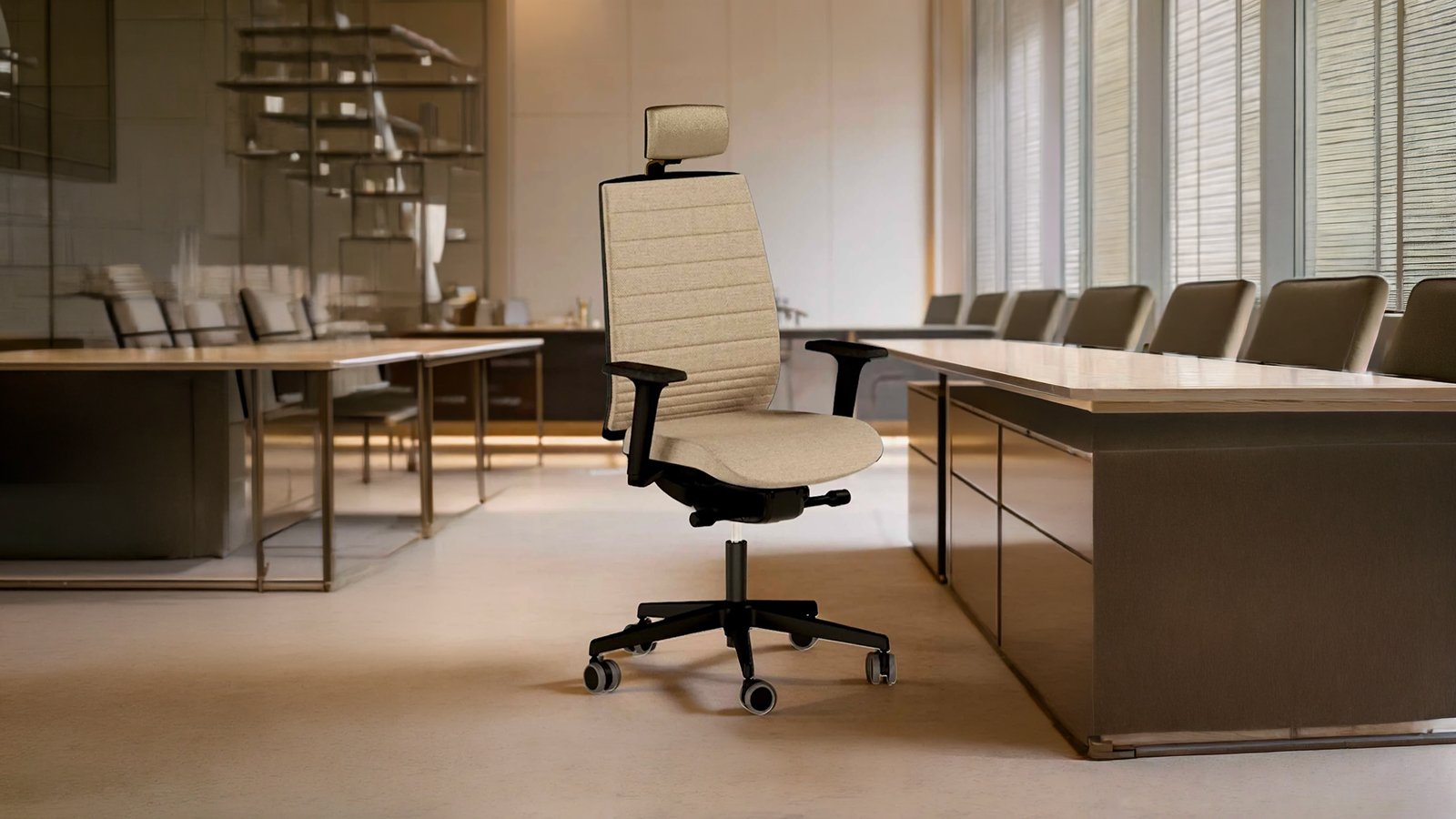
Sort the range by room. At the workstation: mesh back and padded seat, all mesh, or all upholstered, each with or without a headrest and arms. In the manager's office: the managerial build, upholstered, with a black structure, a chrome aluminum base and five-way or fixed arms, which Luxy describes as the one for executive offices. The adjustable lumbar is on every one of them. La Mercanti has the person who will use the chair turn the knob before the order is written, since depth of support is settled by a back, not by a spec sheet.

Let us know which finishes you'd like to explore
Chrome ones, with an open center. On the managerial build Luxy fits 2 1/2 in chrome casters with a central cavity, self-braking like the rest of the range, to go with the chrome aluminum base above them. The three workstation builds roll on rubber-tread casters in black or white, depending on the base. It is a small part, and it does much of the work of telling the manager's chair apart from the ones outside the door.
It does: 3.4 lb/cu ft, for a hot-molded, fire-retardant foam. Spec writers will see why that matters. Density says how much material is in the cushion, which is a different question from how soft it feels on day one, and it is the figure that lets you line Core up against another chair on paper. Luxy uses hot-molded foam in the headrest and the lumbar pad as well. The all-mesh build carries the seat on self-supporting mesh.
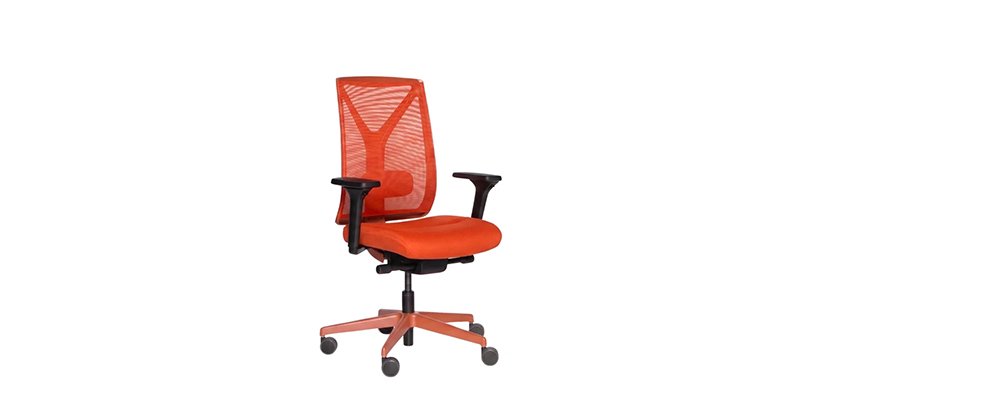
Mostly at the desk. In the Luxy images two chairs face each other across a black desk with plants, three black mesh ones line a desk by a window wall, and a row in copper sits at benching with monitors. The upholstered build appears in a paneled private office, and the managerial one at a wood conference table with a city view. Read together, the pictures show one design moving from the open floor to the corner office, which is the case for standardizing on it.
Core is made by Luxy S.p.A. Società Benefit, whose address is Strada Provinciale Almisano 6, Lonigo, in the province of Vicenza, Italy. The design credit reads Luxy R&D, meaning the chair was drawn by the manufacturer's own team, and it joined the range as a 2026 introduction. That shortens the chain of questions on a project: the company that drew the chair is the company that builds it, at one address in Lonigo.
Luxy's dimension drawings for the collection include a tall version with a footrest: 50 3/8 to 60 5/8 in overall, with the seat between 26 3/8 and 36 5/8 in, on the same 27 1/2 in square footprint as the desk chair. The accessories name two footrests for it, a die-cast aluminum ring 19 3/4 in across and an adjustable one with a connecting tube. If a project has standing-height counters, tell La Mercanti at the start, so the tall build is checked with Luxy alongside the rest of the order.
Core takes 1D or 4D arms and an optional headrest; the managerial build goes to 5D. This order saves redoing things: arms from the floor up, pad last, headrest once you sit the way you work.
Every adjustable armrest on Core moves in height; on the 1D arm that is the only setting, so get it right. Sit at your desk, drop your shoulders and bring the pads up until your forearms rest without lifting them. If the work surface height changes, this is the adjustment to revisit.
The 4D arm adds width and depth. Narrow the arms until your elbows hang under your shoulders, then slide the pads forward or back so they hold the forearm and still let the chair roll up to the desk edge. Two people of different build will not leave them in the same place, which is the reason to pick 4D for shared desks.
The fourth setting on the 4D arm is the angle of the pad. Turn it inward for keyboard work, straight for reading or a call. The pad itself is soft polypropylene and always black, whatever the frame color, so a mixed set of chairs keeps one look at arm level.
Where a headrest is fitted, it moves in height and through three tilt positions. Set the height so it meets the base of the skull when you lean back, then pick the tilt. It is padded, and Luxy offers every build with or without it, so it can be specified desk by desk.
The managerial build swaps the 4D arm for a 5D one in black: the same four settings plus a full 360° rotation. Luxy also offers that build with fixed arms, which appear in polished metal in the Luxy images. Choose 5D for someone who changes posture through the day, fixed for a cleaner line.