Let's discuss your project
Trade terms for professionals and design studios
Let's discuss your project
Trade terms for professionals and design studios
On most task chairs the back is fixed and the lumbar does the moving. Assia EV reverses the habit: Vaghi lists the medium mesh backrest as height-adjustable and reclining, elevabile e reclinabile in the Italian table, so the frame itself travels on the chair and tilts with the synchro, and the gray lumbar bar then climbs separately inside it. Among mesh task chairs that is two fits where there is usually one.
Vaghi R&D, the maker's in-house design office, drew what surrounds it: a seat, upholstered, that turns and lifts, armrests adjustable in height, a headrest that tilts on the build that carries one. Underneath, a synchro in two forms, one that adapts to the weight of the person sitting and one set by hand through tension adjustment, with an anti-return safety on both. Seat depth and lumbar depth are options; the mesh comes in three weaves.
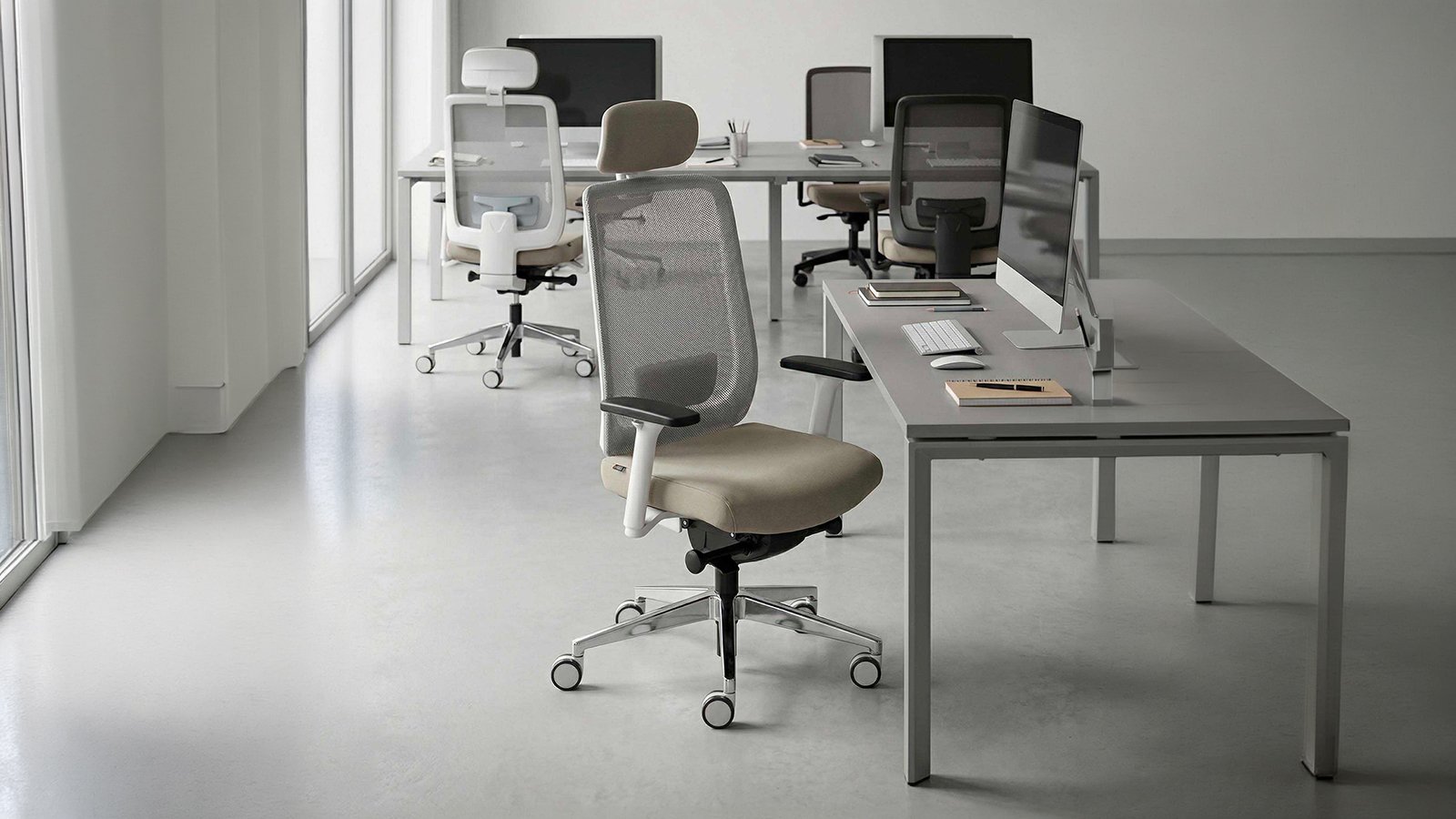
Vaghi files all of it under Operative, Task; the room of the person in charge has its own page, the executive suite, and that seating is listed there, not here. Ranked by overall height the three builds read in two rows: the armless chair and the armchair with armrests share the lower one, the armchair with headrest stands above them, white series or black series on each. La Mercanti sets the backrest for the tallest and the shortest person on the floor before the fabric is chosen, so the travel of the back is proved on real bodies.

Let us know which finishes you'd like to explore
Three builds, two heights. The chair without armrests and the armchair with armrests both stand 41.7 to 49.6 in overall, with the seat itself running 16.5 to 21.3 in from the floor. The armchair with headrest reads 49.6 to 57.5 in, the headrest being upholstered, height-adjustable and tilting. Armrests, where fitted, sit 23.6 to 32.3 in from the floor. The top figure is the one to hold against a low partition, the armrest figure the one to hold against the underside of the desk.
Vaghi runs Assia EV as two series. In the white series, EB, the plastics, the armrests and the casters are white, the polyamide base is white and painted aluminum is white, RAL 9003; in the black series, EN, the same parts are black, RAL 9017. The headrest structure follows the series too; polished aluminum is the one base shared by both. What stays gray in either case is the lumbar bar, RAL 7047. The series is written as the first two letters of the code, so a white chair with black casters is not something the order can produce.
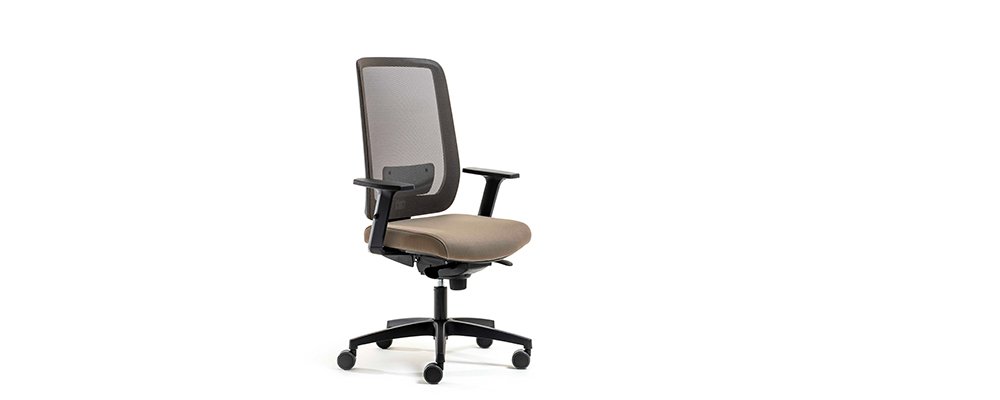
It is the build Vaghi marks with a 5: the medium mesh back, the upholstered seat that swivels and lifts, the same mechanisms, the same base and casters, and no armrests. It ships at 38.6 lb gross in 17.7 cu ft, the lightest of the three builds in the table, and its overall height is the same 41.7 to 49.6 in as the armchair with armrests, since the headrest is what adds height, not the arms. It takes the same series letters, white or black, and the same three meshes and seat categories as the other two.
The setting. Vaghi's weight-activated synchro, letter E in the code, tilts seat and backrest as one movement and, in the maker's words, adapts automatically to the weight of the user: there is no tension to dial in before the chair is ready. The alternative, letter S, is the synchro with tension adjustment, tuned by hand. Both carry the anti-return safety system, and both can be written for any of the three builds and either series; the T, which adds seat depth, is ordered in place of the S.
Yes, with the T mechanism. Vaghi describes it as the synchro mechanism with a device for adjusting the seat in depth, ordered in place of the S: the third letter of the code changes from S to T and the seat gains a forward-and-back movement on top of the height adjustment it already has on every build. The option lives in the mechanism letter, not in a separate line, and it leaves the rest of the code, series, build and base, exactly as it was written.
Back and seat of Assia EV are dressed separately: three meshes, each with its colors and abrasion rating; six seat categories with two faux leathers, two leathers and your own material. Five steps to pair them.
RE is the standard mesh of Assia EV: 100 % polyester, 430 g, rated 100,000 Martindale cycles, in seven colors from black through lead gray, antique bronze, light gray, blue and red to green. R1 is the weave in 100 % Trevira CS that carries the flame-retardant declaration, 405 g, 70,000 cycles, in five colors; RS is a three-dimensional flame-retardant mesh, 525 g, 70,000 cycles, in four.
The seat is specified by category, A to F. Leiria, Radio and Guatemala sit in A; Belem, Lagos, Oporto and the faux leather Rio in B; Norfolk and Zenith in C; 24/7+, Bogotà Melange and Wilson in D; E is natural leather, F full-grain leather. Each name carries its own weight, weave and abrasion figure in the Vaghi table, and the category is what goes on the line.
Martindale cycles are the figure to read across the categories: 150,000 for Leiria, 120,000 for Belem, 100,000 for Radio, Oporto, Guatemala and Rio, 90,000 for Zenith, 70,000 for Norfolk, 50,000 for Lagos, and 400,000 for 24/7+, the fabric Vaghi marks for use around the clock and the highest rating in the programme. The rating belongs to the fabric, not to the chair.
Guatemala and Rio are the two faux leathers, PVC-based with a polyester and cotton backing, 910 and 938 g, both at 100,000 cycles and both declared free of phthalates by Vaghi. The leathers are category E, a chrome-tanned bovine hide dyed with aniline, buffed and finished, and category F, full-grain bovine with its natural grain left visible, the thicker hide of the two in the Vaghi table.
The mesh code begins with 13, then the weave, RE, R1 or RS, then two characters for the color; the seat follows as its category letter or the name of the fabric. A customer's own material can be sent instead: Vaghi asks for its characteristics to assess whether it can be used, and the quantity per chair is 0.77 linear yd of 55 in wide fabric or 9.7 sq ft of leather.