What did you have in mind?
Trade terms for professionals and design studios
What did you have in mind?
Trade terms for professionals and design studios
Run a tape across Darcy from front to back and it reads 42.5 inches. That is the whole footprint, since Verzelloni's figures take in the cushions and the arms, rounded up. The catalog promises “wide, deep seats”; here the figure backs the words. Our view: depth like this is planned around, not discovered on install day. It is the first dimension we check when Darcy goes on a plan next to other Italian design sofas.
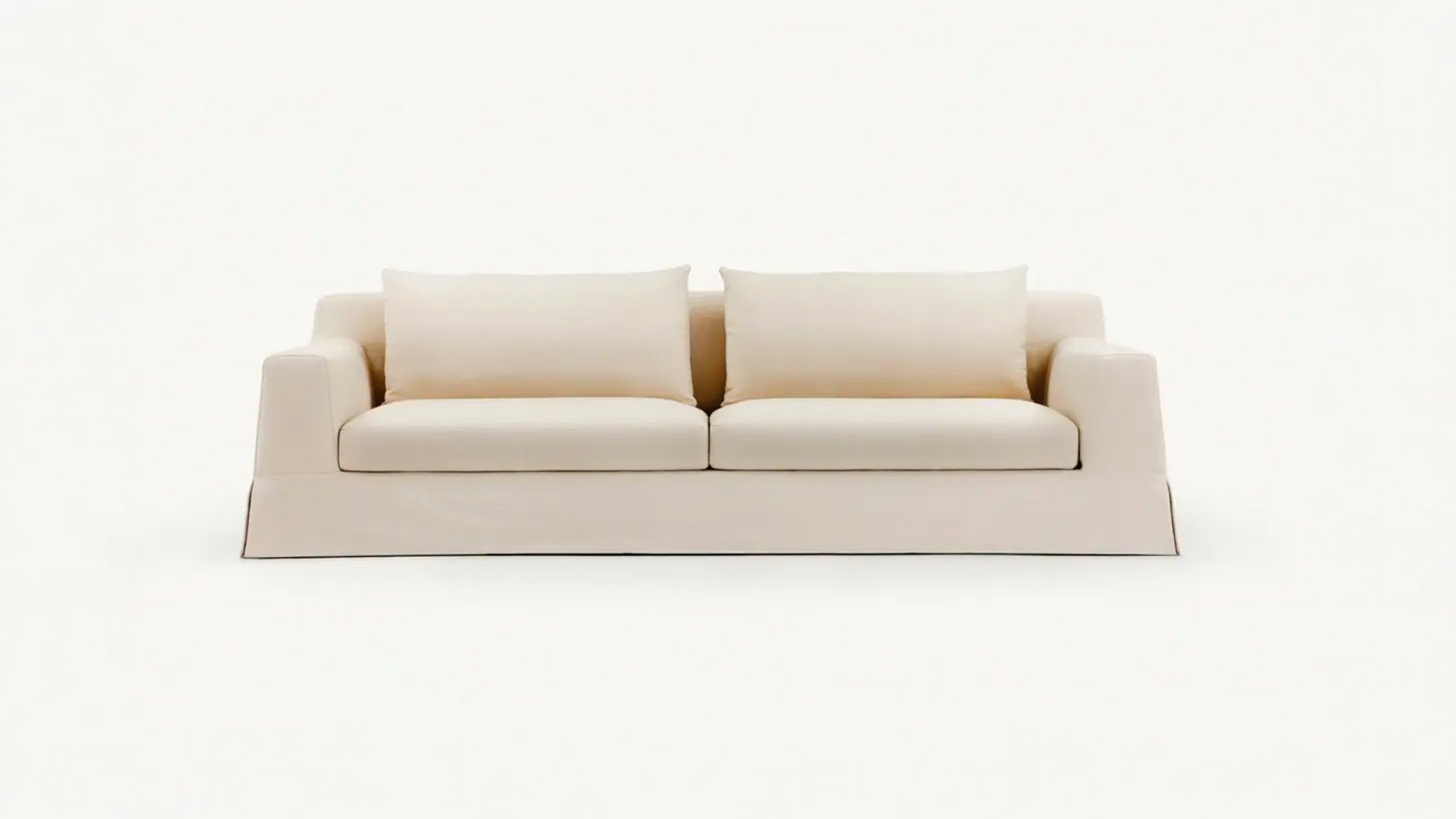
Above all that depth the back stays low, “a clear line” in Verzelloni's words, finished with rectangular cushions or with feather ones. The cover comes two ways: a skirt in doubled fabric that reaches the floor, or tight upholstery over a bronze-painted aluminum foot that follows the arm. CRD Verzelloni signed the design for the 2026 collection. We see it in the executive office suite, across the room from the desk, where a visitor is expected to stay a while.
Read the family by how people sit. Upright, shoulders to the cushions: a finished sofa, or Darcy Up, whose high back Verzelloni credits with more comfort and support, built only in sofa and pouf form. Turned sideways to talk: a run of center pieces, corners and side units, or an asymmetric piece where the seat grows deeper still. Feet up: a chaise longue, a dormeuse, a pouf pulled close. La Mercanti has the client sit all the way back and checks where the knees end up.

Let us know which finishes you'd like to explore
Width, first of all. A side unit, with a single arm, comes 63.8, 76.0, 88.2 or 99.2 in wide; the corner side unit is listed at 74.0, 86.2, 98.4 and 109.4 in, the same four widths as the finished sofas. Both come left or right; check the hand against the technical drawing, never against a memory of a photo. On a plan, label every piece with its full name and its hand: two units with similar names and different widths are exactly where a sectional goes wrong.
For all of them, in fabric. Verzelloni lists a replacement cover for every element, sofa, pouf and cushion of Darcy, which works because the fabric slipcover comes off completely. In a lounge that sees daily use, the frame stays put and only the cover is renewed, in a new color if the room has changed. Leather is the exception: it does not come off completely, and no spare cover is listed for it.
Three things. First, enough goods: the documentation states the fabric each piece takes, figured on a bolt 55.1 in wide with no repeat; narrower goods or a large repeat, a stripe or a bold print, need more, and Verzelloni works that quantity out itself. Second, the face side marked. Third, for a pattern, which way is up. COM covers fabric; a leather Darcy uses the maker's own hides.
A second, plain layer. Every filling in Darcy is pre-covered in white cloth, a cotton fabric according to the technical sheet, before the outer cover goes on. So when the slipcover goes out for cleaning, what stays in the room is tidy white upholstery rather than bare foam or loose fiber. Below that sits a frame of solid wood and plywood, padded with polyurethane foam of differentiated density. It is the part nobody sees, and the part worth asking about first.
At the back and in the range. Darcy Up has the high back that, according to Verzelloni, “guarantees greater comfort and support,” with back cushions in polyester fiber divided into internal chambers, one type only. It is made only as finished sofas, in the same four widths, and as poufs, skirted or tight. For a sectional with corners, chaise longues or dormeuses, the plan goes back to Darcy.
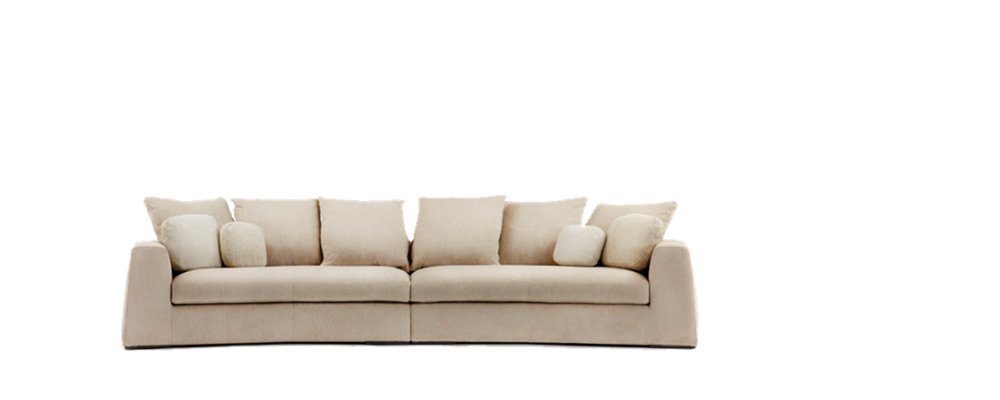
The backs of Darcy are loose cushions, and a bolster can sit behind them. Five steps to put them in order, from the cylinder at the very back to the smallest feather cushion.
On Darcy the bolster sits behind the back cushions, not in front of them. It measures 4.7 in across and 25.6 in long, and Verzelloni puts it there “to modulate comfort and support.” Place it before arranging anything else, then judge the backs against it, sitting down rather than standing over the sofa.
The back comes in two builds. Type A uses rectangular cushions of polyester fiber, divided into internal chambers that keep the filling even, and stands 32.7 in high. Type B uses feather cushions and reaches 36.2 in. Settle the type before the fabric, because it changes both the look and the height of the line.
Type B cushions come in a quantity Verzelloni sets for each module, so the count follows the piece you order, not taste. Two sizes exist, 24.8 × 24.8 in and 20.9 × 20.9 in, both in feather. Ask for the count of each module before drawing the back elevation of a long run.
Verzelloni also lists an 18.1 × 18.1 in cushion in feather among the Darcy cushions. The documentation assigns it no particular role, which leaves the choice to whoever styles the room; in the catalog photographs, smaller and paler cushions sit along the seat in front of the backs.
Cushions do not have to match the body. Verzelloni distinguishes the structure from the cushioning, seat and back, so each can take its own fabric. Order them together with everything else: for pieces added later, the same dye lot as those already delivered is not guaranteed.