
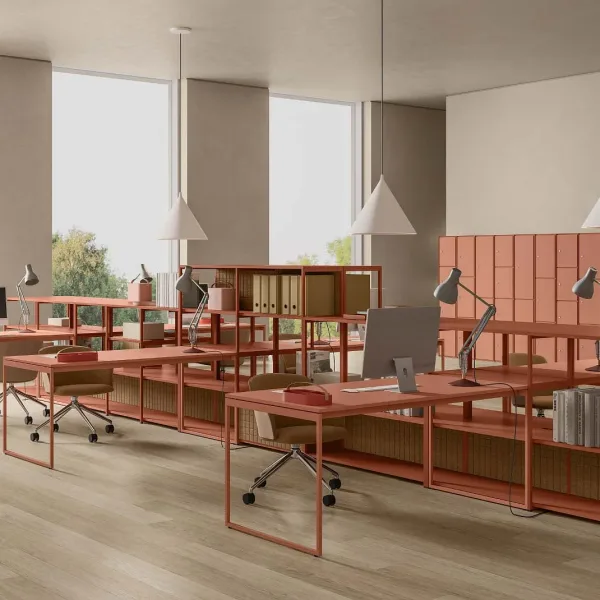
Line System
$ 10,710
Nobody photographs the storage — everybody depends on it. Dieffebi builds that quiet infrastructure in steel: containers, bookcases and desks from a factory in San Vendemiano, Italy, that has spent over forty years on metal and runs every phase in-house, from prototypes to finishes. The difference is that this infrastructure is drawn by designers — 967arch, Leonardo Talarico, Elisa Ossino Studio, Altherr Désile Park — and built on declared pillars: modularity («infinite solutions»), customization, smart working. ISO 9001 and 14001 certify the system; products are designed for disassembly.
La Mercanti plans Dieffebi storage into US projects together with the desks — one scheme, one delivery.
Because it decides how a floor works: what is reachable, what is locked, where paper stops travelling. Dieffebi's modular steel systems are drawn into the plan like walls — and they outlast the furniture around them.
A real roster: 967arch signed the Chiave di Volta bookcase, Leonardo Talarico the floating Nia bench, with Elisa Ossino Studio and Altherr Désile Park among the studios — steel with an author.
Storage done right disappears — into smooth days. Five steps.
What must live at the desk, on the floor, in the archive: three different answers.
Steel runs define corridors and zones — plan them together.
Low units keep sightlines; tall units make walls where you need them.
Painted steel can whisper or signal — decide which, floor-wide.
A saved configuration keeps next year's floor identical to this one.