Let's discuss your project
Trade terms for professionals and design studios
Let's discuss your project
Trade terms for professionals and design studios
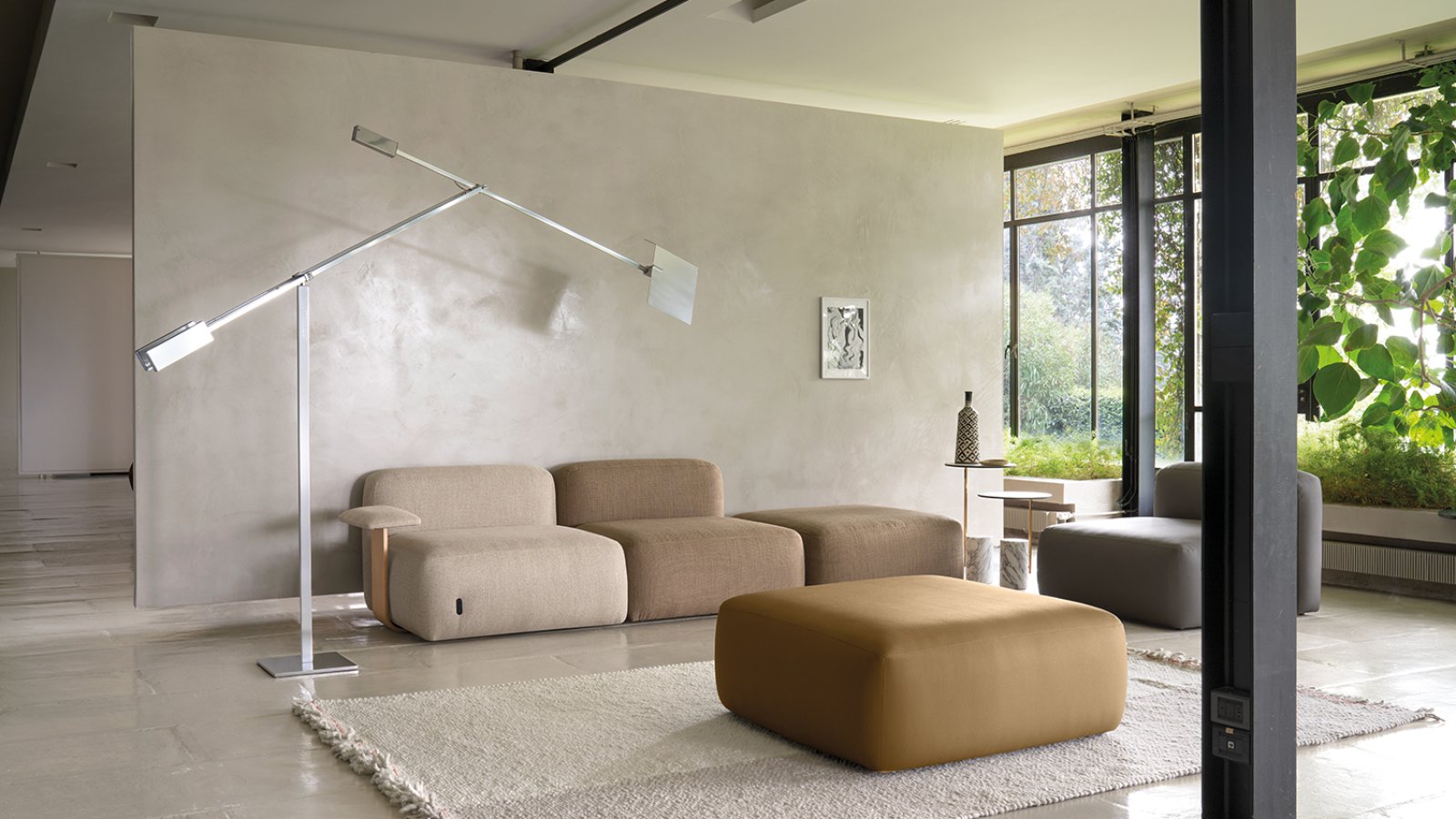
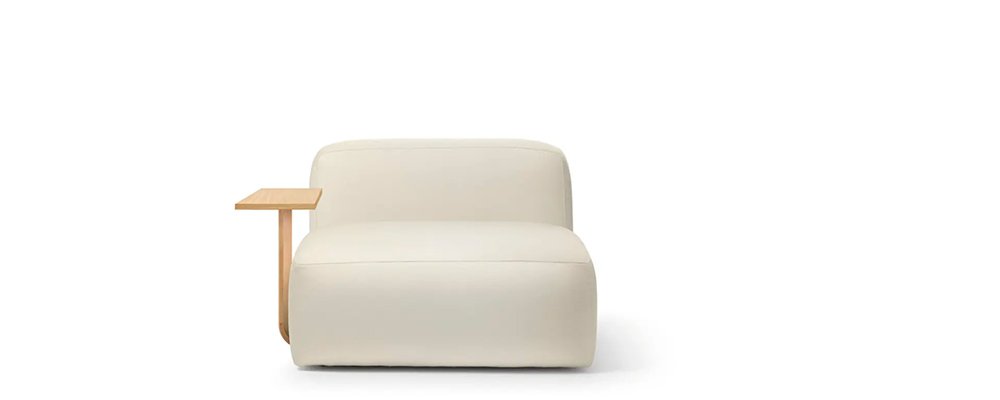
Most modular systems ask you to learn a catalog. One Hundred asks you to remember one number. The seat with backrest is 39 3/8 inches wide and deep; the ottoman is the same square; even the upholstered armrest runs the full 39 3/8 inches front to back. Lay a lobby out on that grid and the plan draws itself: so many squares, so many seats, with the ottomans slotting in wherever a backrest is not needed.
Within the guest seating for the lobby we offer from Quinti, this is the system with the softest profile and the widest seat, 31 1/2 inches deep, with a seat height of 15 inches and a back that stops at 26 3/4 inches. The frame is load-bearing plywood, the padding is non-deformable polyurethane in variable densities over elastic straps, and the feet adjust to the floor. A row ends either with the 7 7/8-inch upholstered armrest, which Quinti ships only inside a composition, or with the painted wood armrest, 9 7/8 by 19 3/4 inches, whose pad comes in wood or fabric. In a front desk area the same squares can be set along a wall or floated in the middle of the room, because every face is upholstered.
The rest of the price list is short: a lumbar cushion of 32 1/4 by 5 1/8 by 15 inches, PICKR wiring with two 5 V USB ports, an edition padded with foams that carry the Italian 1IM fire approval, and covers from categories 2 through 8 and IM, with Crepè the only fabric ruled out; Quinti sells the same squares for hospitality and for the home. La Mercanti draws the lobby on a 39 3/8-inch grid before quoting, so the count of modules is settled before the fabric conversation starts.

Let us know which finishes you'd like to explore
Quinti states that its products are designed to be disassembled once their useful life is over, so that frame, foam and cover can be separated and sent to reuse, recycling or energy recovery. For a facilities team that means the module is not landfilled as one object.
One: Crepè, which Quinti marks as not feasible on this system. All the other fabrics and leathers in categories 2, 3, 5, 6, 7, 8 and IM can be specified, including the recycled polyesters and the full-grain hides.
Yes. The seat module and the ottoman are fully upholstered on every side, there is no unfinished back panel, and the end pieces are upholstered too. A composition can be read from any direction, which is what makes it usable as an island between the entrance and the desk.
A non-deformable polyurethane in variable densities, laid over a load-bearing plywood frame with elastic straps underneath. The variable density is what lets the edge stay firm while the center gives, and the straps keep the cushion from resting on a hard board.
Quinti lists the cushion X086CUS, 32 1/4 inches wide, 5 1/8 inches thick and 15 inches high. It rests against the backrest of the seat module and adds support at the lower back without changing the height of the piece; it is ordered separately, one per seat where needed.
The care rules Quinti publishes for the fabrics, leathers, wood and metal parts of the One Hundred system, in the order a cleaning crew needs them.
Before anything else, know whether the One Hundred modules in the room are in fabric or in leather: the two follow different rules, and a composition can mix a leather seat with a fabric ottoman.
For fabrics Quinti refers to the care and washing instructions printed in the fabric section of its color chart, which change from one textile to another. Keep sharp objects away from the covers, because woven fabrics can be cut or torn.
Leather is cleaned with a damp white cloth soaked in water alone. If a leather care product is used, it must be tested on a hidden area and left for 24 hours before judging the result, following the product maker’s instructions.
Painted wood is wiped with a soft cloth and warm water and dried immediately; spills are removed right away so the wood does not absorb them. Wood changes color over time with light and use, and it must not be exposed to direct heat sources.
The metal feet take a soft damp cloth with warm water and, for stubborn marks, a little mild liquid soap, then a dry cloth. No chlorine, no bleach, no abrasive pastes or sponges. Coffee, cola and fruit juice can leave permanent stains on the metal and are wiped off immediately.