
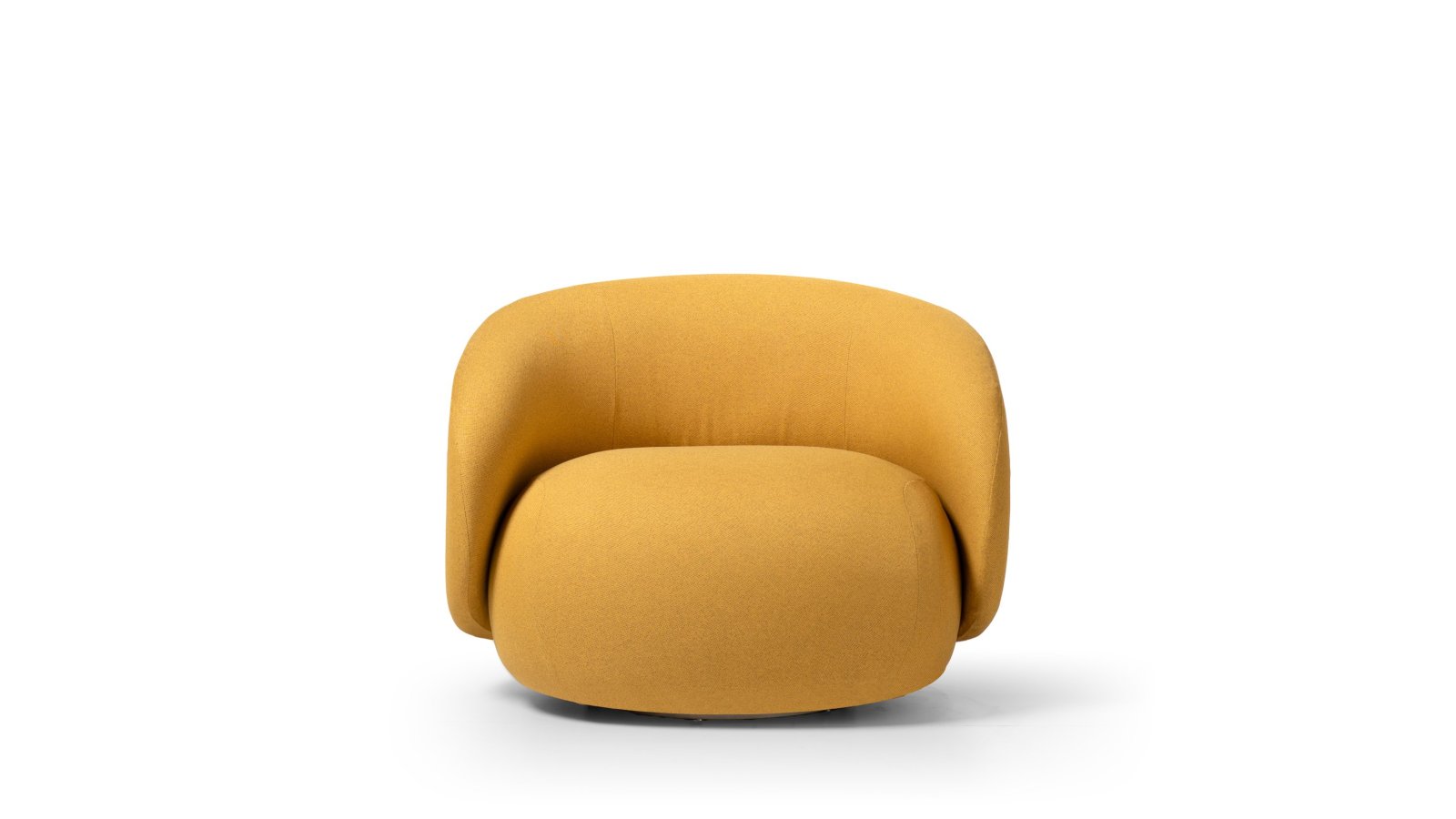
Made entirely of concrete, 23 5/8 inches square and 33 pounds: the Hill table by Quinti
Let's discuss your project
Trade terms for professionals and design studios
Most lounge tables are a top on legs. The one in the Hill collection is a single material from the floor up: base and top in natural concrete, 23 5/8 inches square, 14 5/8 inches high, 33 pounds on the scale. Quinti says it in four words, made entirely of concrete, and the weight is the part that matters in a lobby: a 33-pound table is not nudged out of line by a knee or a vacuum cleaner, so the composition drawn on the plan is still the composition a year later. The top stops below the 15 3/4-inch seat of the armchairs, where a cup and a phone land without anyone leaning forward.
The chairs around it carry the same retro line, drawn by Atelier Borella, and are sold as guest armchairs for lobbies: a 31 1/2-inch square standing 28 3/4 high, or 38 5/8 by 35 3/8 and 29 7/8 high with armrests; a two-seater of 60 1/4 inches; an ottoman on the smaller square, 15 3/4 inches high. Inside each of them a metal skeleton, cold-foamed polyurethane around it, elastic straps under the seat cushion, adjustable chrome feet below; a double stitch on leather, no stitch at all on fabric. At the entrance and front desk the group reads as a single rounded mass, whichever cover is chosen.
Weighed in order, the family runs from the writing table, 2 pounds of black metal frame under a Ø 11 3/4-inch painted wood top in Moka, walnut, open-pore black or natural, to the ottoman at 26 pounds, the concrete table at 33, the armchair at 42 and the two-seater at 84; the 360° swivel plate, which turns the armchair and does not bring it back, and the version on 1IM-approved fire-retardant foams are ordered on top. Covers come from categories 2, 3 and 5, 7 and 8, and from IM. Quinti files the set under hospitality, which on this side of the Atlantic means the lobby, the seats outside a conference room and the coffee corner. La Mercanti confirms where the concrete table will stand, marked on the plan, before the order goes in.
- Collection: Hill, lounge seating with tables (Lounge Collection)
- Manufacturer: Quinti Sedute Srl, Cesa (Arezzo), Italy
- Design: Atelier Borella
- Type: fully upholstered armchair, two-seater sofa and ottoman, with a concrete table and a writing table
- Armchair QX0520001: no armrests, fully upholstered, on adjustable feet; 31 1/2 × 31 1/2 in, 28 3/4 in high; seat 25 1/4 in deep and 15 3/4 in off the floor; 42 lb; 21.2 cu ft
- Armchair with armrests QX052000S: same construction and same feet as the armchair above; 38 5/8 in wide, 35 3/8 in deep, 29 7/8 in high; 10.6 cu ft
- Ottoman QX052000P: fully upholstered, same footprint as the armchair, 15 3/4 in high; 26 lb; 12.4 cu ft
- Two-seater sofa QX0520002: fully upholstered, 60 1/4 × 31 1/2 in, 27 1/2 in high; seat 25 5/8 in deep and 15 in off the floor; 84 lb; 35.3 cu ft
- Writing table QX0520T00: side table for the armchair, black metal frame, painted wood top Ø 11 3/4 in, 23 5/8 in high; 2 lb
- Top finishes: NP open-pore black, RT Moka, NC walnut, RN natural
- Table QX052000T: base and top in natural concrete, 23 5/8 × 23 5/8 in, 14 5/8 in high; 33 lb; 8.8 cu ft
- Swivel plate XX052GIR0: 360° swivel support for the armchair, without return; accessory
- Frame: inner metal skeleton
- Padding: high-density cold-foamed polyurethane
- Seat cushion: reinforced with elastic straps
- Feet: adjustable, chrome-plated
- Stitching: double in leather; none in fabric
- Fire-safe version: fire-retardant foams approved 1IM
- Declared tests: 1IM approval; CAM compliance (Italian public procurement criteria)
- Upholstery: categories 2, 3, 5, 7, 8 and IM; Crepè and category 6 leather not available
- Manufacturer’s category: Hospitality, Lounge Collection
- Origin: Made in Italy
Let us know which finishes you'd like to explore
FAQ
What does CAM mean on a Hill spec sheet?
Only that Quinti’s table of tests marks Hill as CAM compliant, and we repeat the line as the manufacturer prints it. CAM is an Italian acronym, and Hill was documented against it in its home market; that is the fact, and it is the maker’s declaration, not a U.S. certification. For an American buyer the useful part is that the declaration exists and comes from the source: on a spec sheet the line is copied as it stands, acronym included, rather than translated into a U.S. standard the collection was never tested against.
Are there Quinti covers that cannot go on Hill?
Two, and Quinti prints them as not feasible: the Crepè fabric and the category 6 leather. Everything else in the collection’s chart is open to it, from the recycled polyesters to the full-grain hides in categories 7 and 8. The practical reading is simple: if a project standardizes on Crepè for its task chairs, the lounge pieces will have to take another cloth, and the sooner that is known the fewer samples travel.
How many Martindale cycles do the Hill fabrics reach?
From 30,000 to beyond 100,000, depending on the cloth. The Ecopelle stops at 30,000; Cocoon, a viscose-cotton-linen blend, at 35,000; Bouclet at 50,000; Chili at 60,000; Zero at 70,000; Laser, Melange, Jet and Glamour at 80,000; Era and Lana at 100,000, with the Ecopelle Soul above that mark. The figures are the manufacturer’s; the reading is ours: for a lobby seat occupied all day we shortlist from 80,000 upward, and leave the lower counts to the chairs where a visitor sits for ten minutes.
Which leathers are listed for Hill, and how thick are they?
Two families. In category 7, Premium and Elegance: full-grain cowhide of 0.05 to 0.06 in, tested to EN 1021-1 and 1021-2. In category 8, Pelle Seta: full-grain cowhide tanned with aniline, thicker at 0.07 to 0.08 in, with the same tests. Both are sewn with the double stitch Quinti reserves for leather, and both are classed as delicate in the care instructions; the figures above are the whole of what the manufacturer declares, and the sample in the hand decides the rest.
Can a hot cup rest on the wood top of the Hill writing table?
No. Quinti’s care instructions say the painted wood top does not take high temperatures placed on it directly, and a cup straight off the machine is exactly that. The rest of the routine is short: a soft cloth with lukewarm water, dried at once, and any liquid or residue removed as soon as it lands. The manufacturer also warns, in advance, that the color of the wood may change over time; it is printed before the sale, which is how we pass it on.
How to clean the chrome feet and black metal frame of Hill without marking them
The metal care instructions Quinti publishes for Hill, applied to its adjustable chrome feet and to the black frame of the writing table: what to use, what to avoid, and what stains for good.
Start Hill off with warm water
A soft cloth, damp with warm water, is the whole routine for the chrome feet on Hill most days. Quinti gives the same instruction for every metal part, so the black metal frame of the writing table is wiped the same way, and with the same cloth.
Diluted soap on stubborn marks
When a mark does not come off with water, the manufacturer allows a little liquid soap diluted in the water, nothing stronger. The mark is worked with the cloth and not with a pad, because the pad is on the list of things Quinti forbids, and the soap stays in the water rather than going on the metal neat.
Dry at once, chamois or cloth
The step most crews skip is the one Quinti writes in full: dry immediately, chamois or soft rag. Immediately is the word that matters, and it is the manufacturer’s: the drying is part of the cleaning, not a separate chore for later, and the cloth that does it is as soft as the one that washed.
Keep the blacklist away
Quinti names what never touches its metal: products meant for steel, chlorine and bleach, harsh detergents, abrasive pastes, scouring pads, rough sponges. A janitorial cart usually carries at least two of these, which is the reason the list is worth reading before the first clean rather than after it.
Read the coffee, cola and juice line
The last line of the instructions is the one that costs the most when ignored: coffee, cola and juice can leave marks on the metal that do not come out. The manufacturer does not say how long a spill may sit before it marks, so the safe reading is the shortest one, and in a lobby where the drinks stand a hand’s width from the chrome feet that line is the reason the routine above exists at all.