Already have something in mind?
Trade terms for professionals and design studios
Already have something in mind?
Trade terms for professionals and design studios
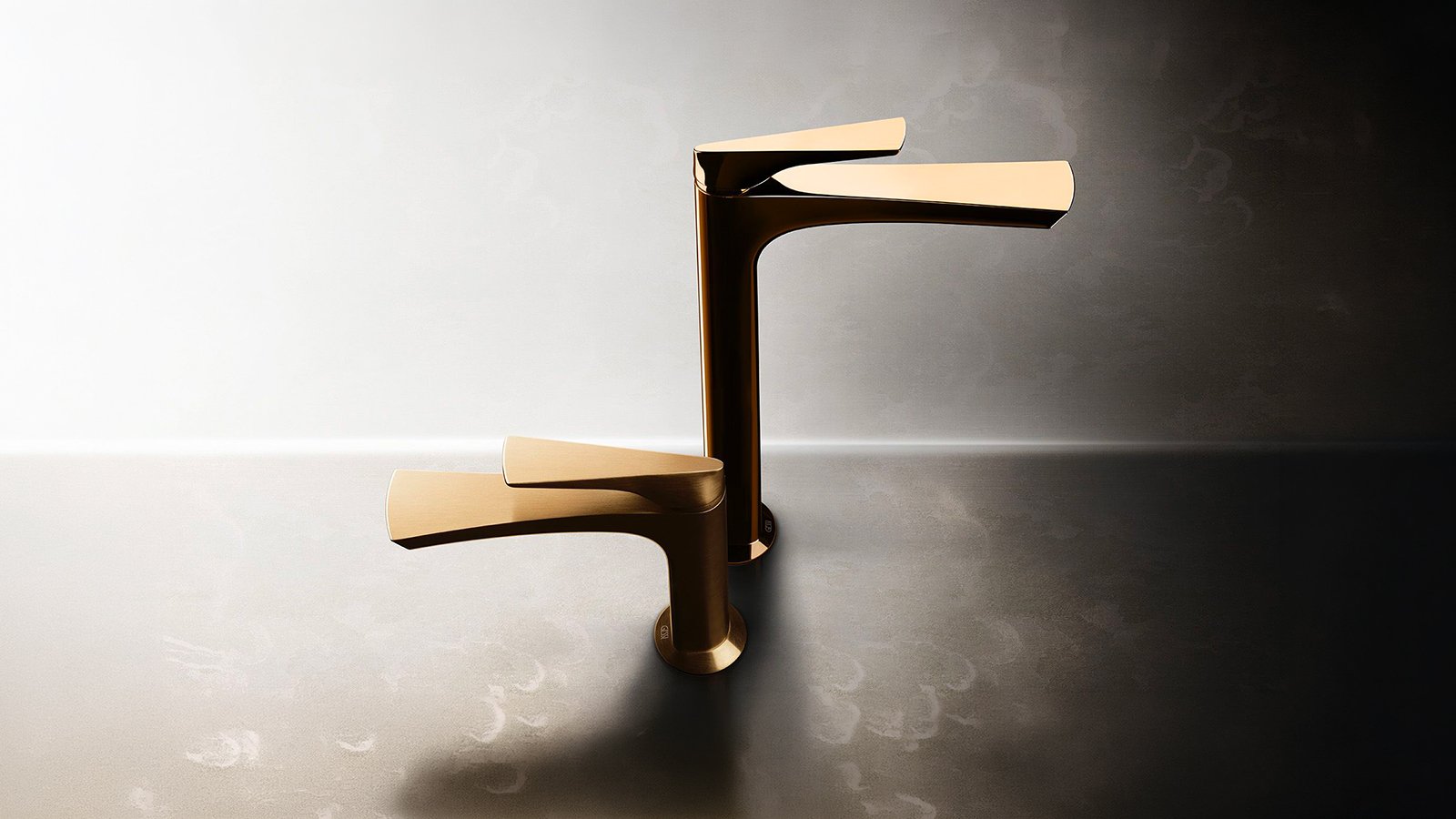
Gessi has a phrase for the freestanding Ventaglio faucet: “the poetry of absence”. The catalogue defines it as a synthesis reached with the fewest elements possible, and calls the result the beauty of minimalism. A slender silhouette rises from the floor beside the basin. We see it as the bravest piece in the line, because it commits early: its spot is fixed on the floor plan before anyone picks a finish. Among faucets pared to essentials, it asks the most of the plan.
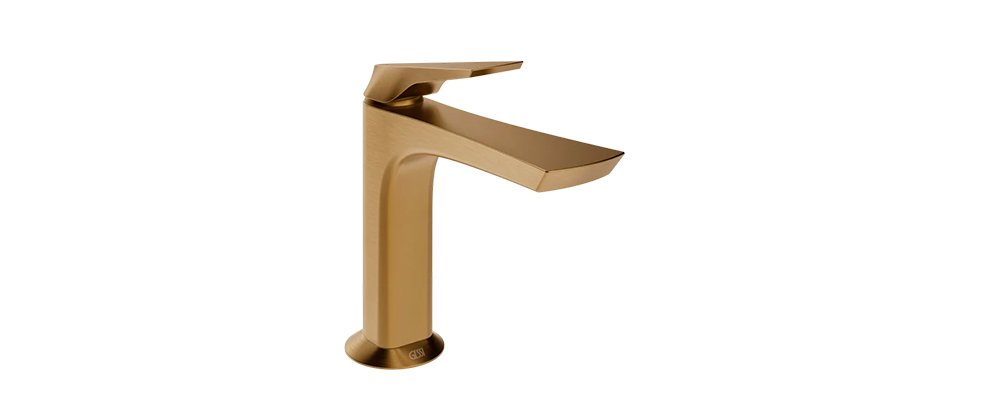
Reduction does not mean blank. The body keeps the line’s signature: a tapered lever, a mouth that opens in stages over a cone-shaped base, parts that unfold like a fan. Michael Vincent Uy drew it: architect, interior decorator, Filipino, with MVUY as his Milan studio. In a C-suite powder room, one upright faucet does the talking.
From the floor up, the family is easy to place. Built by Gessi at Serravalle Sesia, it adds a floor-mount tub filler; at counter height, low and tall lavatory faucets and an electronic control set apart; on the wall, a wall lever, lavatory and tub spouts, shower valves and thermostatics; overhead, a custom-height ceiling spout, an electronic ceiling faucet and private wellness rain heads. Bidet, glass shower hardware, accessories and ceramics complete it. With the client, La Mercanti pencils onto the floor plan the exact spot where the faucet will rise.

Let us know which finishes you'd like to explore
Through Italy first. Gessi’s catalogue says the fan was in use there from the 1200s and had its first great moment in the Renaissance. Then a wedding: in 1533 Catherine de’ Medici married Henry of Valois and brought the fan with her to France. For an American client, that is the provenance behind the name, a European chapter sitting next to the Asian one.
According to the catalogue, yes. In the eighteenth century the fan reached its peak as a coded language, and the Victorian era revived it as a code of courtship. Ventaglio keeps the gesture rather than any code: its elements open progressively, the way a fan does. That is the part of the story the faucet actually carries into a bathroom.
Uy is a Filipino architect and interior decorator who founded the MVUY studio in Milan. Gessi says that, as in all his projects, the studio balances history and the contemporary, refined detail and spatial harmony, hints of the Orient and Western design know-how. Those four pairs make a handy checklist when the faucet has to meet a sink, a wall and a vanity.
In Spain, and above all in the south, where the climate kept the fan in daily use. The catalogue notes that the bailaoras carried it into flamenco. It is the moment the fan turns into movement in front of an audience, and movement is precisely what Gessi borrowed for Ventaglio: parts that open one after another.
They do. The catalogue describes them as inspired by Zen aesthetics, silence and quiet. The holders for soap, tumbler and dispenser, plus the toilet brush, mount on the wall in black or stand on the counter in white or black. A towel ring, towel bars of 11.8 and 17.7 in, a hook for robes and a room diffuser follow. In that spirit, specify fewer pieces, not more.
Past the faucets, Ventaglio lists vessel sinks in steel, ceramic and Cristalplant®, toilet and bidet for wall mounting in three ceramics, and a control plate. Five steps to a complete bath.
Start with the tall Ventaglio lavatory faucet. Gessi designed it to pair with sinks that bring out an Eastern aesthetic; its height stretches the line, ending in a slim, square spout with sharp edges. It comes in every finish of the Gessi catalog, so the sink can be chosen around it rather than the other way round.
The total look lists vessel sinks in steel, round at Ø 15.7 in or rectangular at 23.6x13.8 in, a ceramic sink at 15.7x15 in, and Cristalplant® sinks for the countertop or standing on the floor. Pick the material first, then the outline, keeping the faucet’s reach in view.
Toilet and bidet, both hung on the wall, complete the set, each offered in three ceramics: Europe white, matte white and matte black. Choosing the same ceramic as the sink keeps the room calm; matte black against a pale floor makes the fixtures a feature.
The control plate belongs to the same total look. Draw it on the toilet wall elevation together with the bowl, at the height the installer will need, so that plate, ceramics and faucets line up as one composition rather than three separate orders.
A dedicated bidet faucet sits on the wall-hung bidet. Then the accessories: soap dish, tumbler, dispenser and toilet brush holder, toilet paper holder, towel ring and bars, robe hook. Keep the count low and let the ceramics and the vessel sink carry the room.