Tell us your requirements
Trade terms for professionals and design studios
Tell us your requirements
Trade terms for professionals and design studios
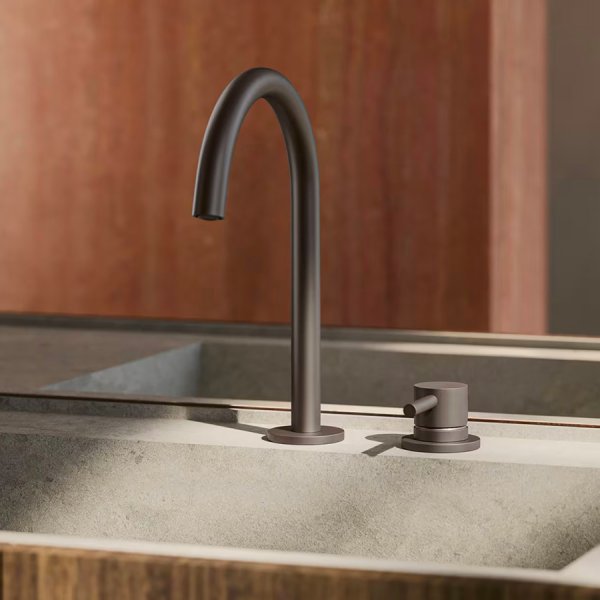
The sink is where a faucet earns its keep: filling stockpots, rinsing greens, chasing the last crumbs toward the drain. For that work Fantini makes AF/21 as a single-hole kitchen faucet whose spout swivels and whose spray pulls out on its hose. There are two of them, one with a single spray and one with two, and both keep the vocabulary of the series, in which, as Fantini puts it, faucets become “discs and cylinders.”
The figures are short. The single-spray model reaches 8.7 in over the bowl, the dual-spray 8.5 in; either one carries a limiter set at 2.1 gpm, measured at 43.5 psi, and connects through flexible supply hoses. One lever does everything: lift it for flow, move it left or right for temperature. Fantini’s catalog shows the faucet in brushed stainless steel, tall and upright against gray concrete. Of all the faucets with a designer’s signature, this is one plainly meant to be worked.
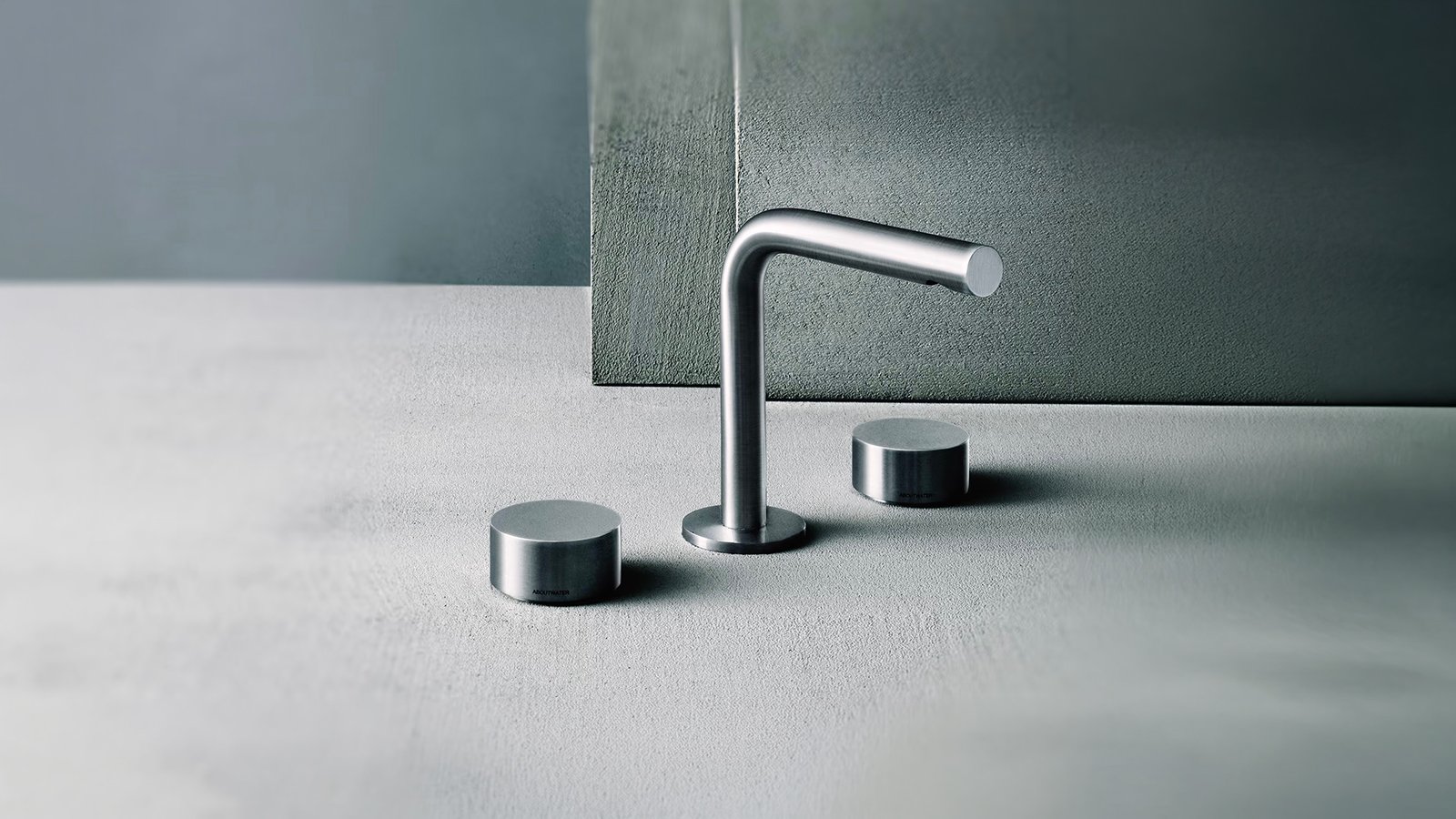
The series belongs to Aboutwater Boffi-Fantini, design Naoto Fukasawa, and Fantini builds it in Pella, on Italy’s Lake Orta. The kitchen is one end of it. The other is the executive and guest baths: lavatory faucets for the deck, the wall or the floor, a bidet faucet, in-wall shower valves under a rain head, and tub fillers for the wall, the deck or the floor. La Mercanti asks how the sink is used (one bowl or two, pots to fill, produce to rinse) before suggesting one spray or two.

Let us know which finishes you'd like to explore
The comparison is Fantini’s own. Describing the series, the company says its faucets become discs and cylinders, and that the discs are reminiscent of the controls of a stereo. Anyone who has turned a volume knob knows the motion already: thumb and two fingers on a low round shape, a small rotation, a precise result. In a guest bath that is the practical value of the idea. Nobody needs to be shown how the handle works, because the hand has done it before.
The drain is ordered separately, and that holds for every lavatory, bidet and kitchen faucet in the series. Fantini offers two for the lavatory: one with a push pop-up stopper and one that is free-flowing, both universal, meaning they fit bowls with or without an overflow. A bottle trap and a pair of filter stops with shut-off round out the list. The upside is control: you match the drain to the vessel you actually chose, and it shows up on the schedule as a line of its own.
Naoto Fukasawa added a marble handle to the series in two stones, Carrara White and Marquinia Black. You will find it on the wall-mount lavatory faucet with progressive cartridge, on the three-hole lavatory sets (standard and tall), on the two-handle wall-mount set, on the in-wall shower mixers with two and three outlets, on the thermostatic valve, on the stop valve, and on the in-wall and deck-mount tub sets. Single-hole deck faucets, the bidet and both kitchen models carry the metal handle.
Two companies. Aboutwater is a partnership between Boffi and Fantini, formed, in their own words, after “observing each other” and realizing they had a lot in common. Its stated purpose is a collection of faucets and shower systems of modern, elegant design, with each series drawn by an internationally known designer; AF/21 is the one by Naoto Fukasawa. For the buyer it explains the double signature: the collection is shared, the product is made by Fantini.
The metal itself. Four of the five finishes sit on brass; the fifth, Brushed Stainless Steel, is made in AISI 316/316L stainless steel. Fantini calls steel an excellent material: long-lasting because of its strength, highly resistant to corrosion from external agents, recyclable, and easy to keep clean and hygienic. The company counts its 316 and 316L products among its hallmarks. In practice, what you see on the surface is what the piece is made of.
AF/21 fills a tub three ways, and each asks for different rough-in work. Five steps to settle the position, the hole count, the handshower and the drain before the plumber starts.
AF/21 reaches a tub from three places: an in-wall set, a deck-mount set on the rim, or a floor-mount filler on a column. Look at the tub first. One built against a wall, one with a deck wide enough to drill, and a freestanding one each point to a different answer.
The in-wall set has two handles on quarter-turn ceramic valves and a rotary diverter with two outlets. With it come the FIT handshower, a wall supply fitted with a holder, and a 59 in PVC hose. Order it with a spout that reaches 8.5 in, or as handles and handshower only.
On the rim the set needs five holes with its 6.1 in spout, or four in the version without one. Here the diverter is a push button, again with two outlets, and the FIT handshower is part of the set. The inlets are 3/4″, so tell the plumber early.
Beside a freestanding tub the filler stands on a column, with a 9.8 in spout, a single handle, a push-button diverter and the FIT handshower on its holder with a 59 in hose. It arrives as two parts, the visible one and the built-in one, on 1/2″ inlets.
Fantini lists a tub drain column to go with the series, and a version that also delivers water through the overflow. It sits among the complements of the series, next to the lavatory drains, the bottle trap and the steel flush plates. Put it on the same list as the tub set.