What did you have in mind?
Trade terms for professionals and design studios
What did you have in mind?
Trade terms for professionals and design studios
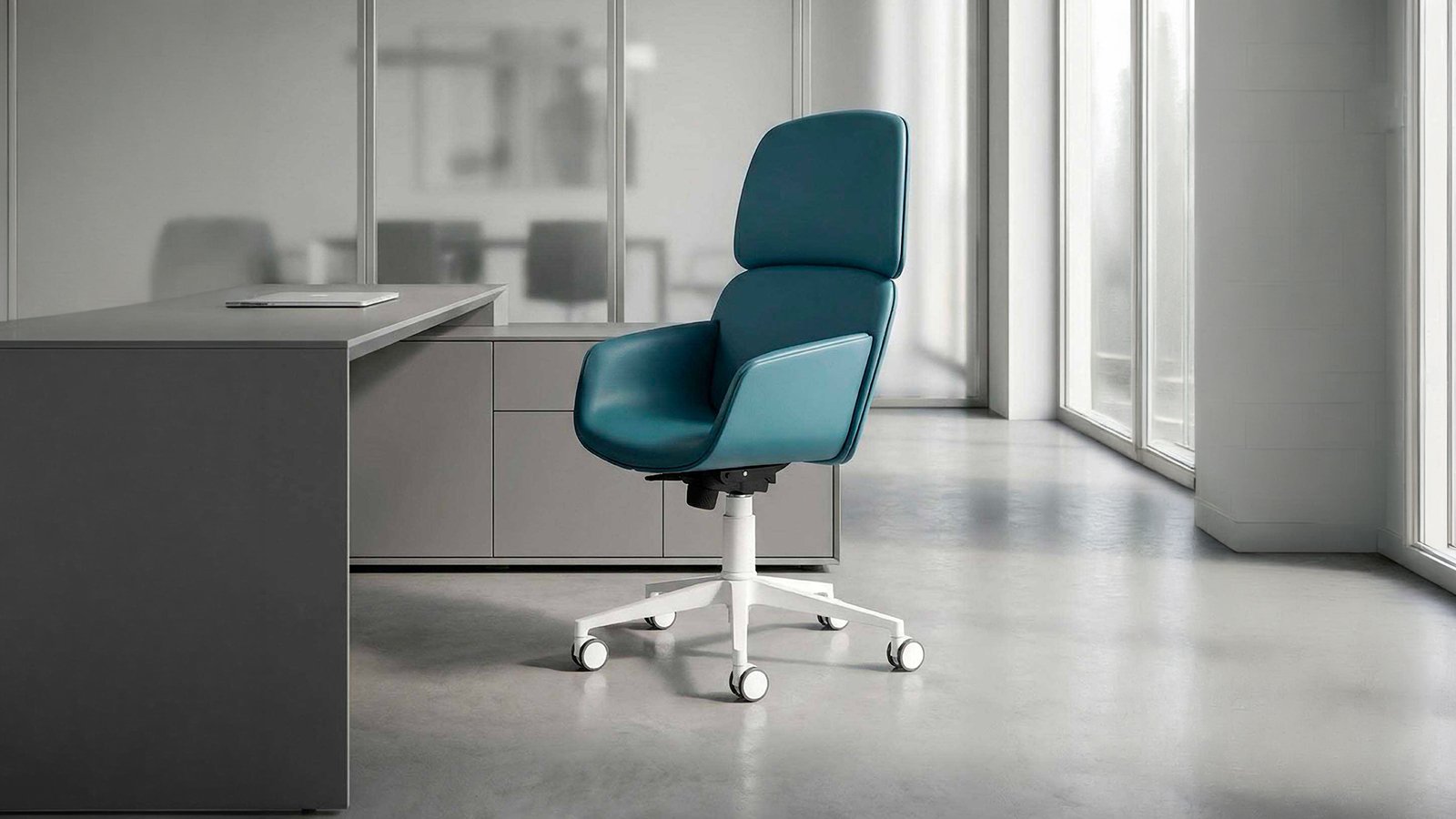
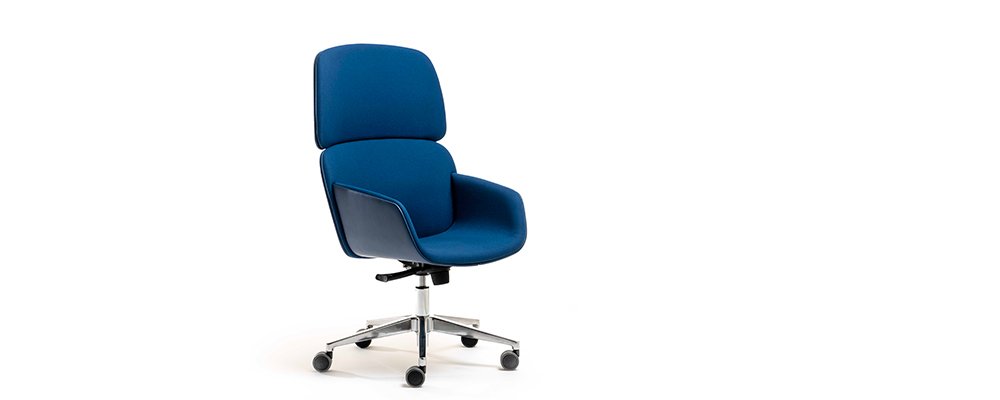
Vaghi gives the five-star Libera Soft Executive two movements and names both of them: a standard tilting mechanism on a central pivot, and a seat that goes up and down. The first is felt leaning back on a call, the second before the first email of the day; both are learned in a minute, sitting down. It belongs with the executive chairs from Italy that keep the mechanism plain and put the care into the shell.
That shell is padded and includes the arms, so the armrests rise with the seat; the headrest comes as standard, and the upholstery can be one color or two. Under it, an aluminum base on rubber casters, in white, in black, or polished with a chromed column. Behind the desk of a private corner office this is the version that moves; Vaghi also builds a four-star sibling that swivels on felt glides at a fixed height and does not recline.
Vaghi photographs the other Libera lines room by room. A white meeting room is filled with the upholstered multipurpose Libera Soft on casters, which with its writing tablet is also written for classrooms; the polypropylene Libera turns up in a company cafeteria, and the beam bench lines a waiting area beside a small table. Orlandini Design drew the collection in 2019. La Mercanti asks the executive to judge the tilt leaning back, not on a data sheet, before the finish is chosen.

Let us know which finishes you'd like to explore
Libera Soft can, and Vaghi writes it plainly: the writing tablet and the linking device make the chair a fit for classrooms and meeting rooms. Both go on the sled versions. The tablet is removable, in polypropylene, with an anti-panic joint and a metal support, built either for right-handed or for left-handed users; the linking elements come in pairs and keep the rows straight. Take the tablets off and the sled chairs stack up to six high, so the room can be cleared at the end of a session.
Yes. The LS8G version stands on a four-star aluminum base with polypropylene tips and felt glides, in black or polished. It swivels, but it neither rises nor reclines: the seat stays at one height and the armchair stays where it is set down. The shell, the arms and the headrest are the same as on the caster version, so two rooms can share one look with two different bases.
The catalogue names the laboratory: CATAS. Vaghi declares the executive armchair to EN 1335, EN 16139, EN 1728 and EN 1022, and marks the tests as carried out by CATAS; the padded multipurpose Libera Soft carries the same note for EN 16139, EN 1728 and EN 1022. These are European standards, so on a US specification they go in exactly as Vaghi prints them, with the laboratory named beside them, which is the form a reviewer can check against the source.
Nine, each with a proper name: Leiria, Radio, Belem, Lagos, Oporto, Norfolk, Zenith, Bogotà Melange and Wilson. Alongside them Vaghi lists four leathers and vinyls: Guatemala, Rio, Natural Leather and Grain Leather. On the executive armchair a two-tone order uses two coverings, and a client's own material is accepted once Vaghi has checked feasibility and quantity. Put the name on the order, not a description of the color: the name is what identifies the cloth.
The catalogue opens with “elegance meets functionality” and speaks of a chair for people seeking comfort and style in a professional setting. The product description adds a design and ergonomics that “convey safety and protection”, and calls the structure ergonomic and enveloping. None of these are technical claims. They describe the impression of an armchair that wraps the person sitting in it, which is what a padded shell with built-in arms and a headrest is meant to do.
The Libera beam bench turns the polypropylene shell into rows for a lobby or a waiting room. Five steps through modules, tables, legs and shells, with every figure as Vaghi declares it.
Vaghi builds the Libera bench on a beam in modules of two, three and four seats, or one, two and three seats with a table. A two-seat module is 40.9 in long, a three-seat one 61.4 in and a four-seat one 81.9 in; every bench is 24.8 in deep and 31.3 in high, with the seat at 17.1 in. Plan the room in modules first, and the seat count follows.
The table is a square top in HPL, anthracite gray. A module with a table is as long as a module with one more seat: one seat plus table matches a two-seater, two plus table a three-seater. So the decision about where people put down a cup or a folder can be taken late, on the plan, without changing the length of the row.
Each module stands on legs with adjustable feet, in three versions: a V leg in black polyamide, or a T leg in metal, silver or chromed. In Vaghi's own waiting-room photographs the benches stand on silver legs next to glazed walls, while the black V leg appears under a row of black shells with a black table. Match the leg to the floor and the frames already in the room.
The LP bench leaves the polypropylene shell bare, in the six colors of the family: white, anthracite gray, taupe, avio blue, olive green and red brown. The LS bench adds an upholstered seat cushion on the same shell, so a row can be hard-wearing and plain, or softer for longer waits, with one beam and one set of legs either way.
On request the leg comes ready for fixing to the floor, in black, with a minimum order of four modules. Vaghi can also build a five-seat module, or four seats with a table, by adding a leg in the middle of the beam. Both are made on request, so they belong in the first draft of the plan, not in a late change.