You've found the piece. Now the project.
Trade terms for professionals and design studios
You've found the piece. Now the project.
Trade terms for professionals and design studios
There is a line on Mascheroni's technical sheet that is easy to read past. Under the drawing of the Congress 135, beside the symbol for the cushions, it gives three possibilities: soft, medium or firm. The padding is non-deformable foam rubber in every case, set on a solid wood frame that bears the load; what you decide is how the seat and the three back cushions answer when you sit down. On a leather executive chair that is a specification, exactly as the hide is.
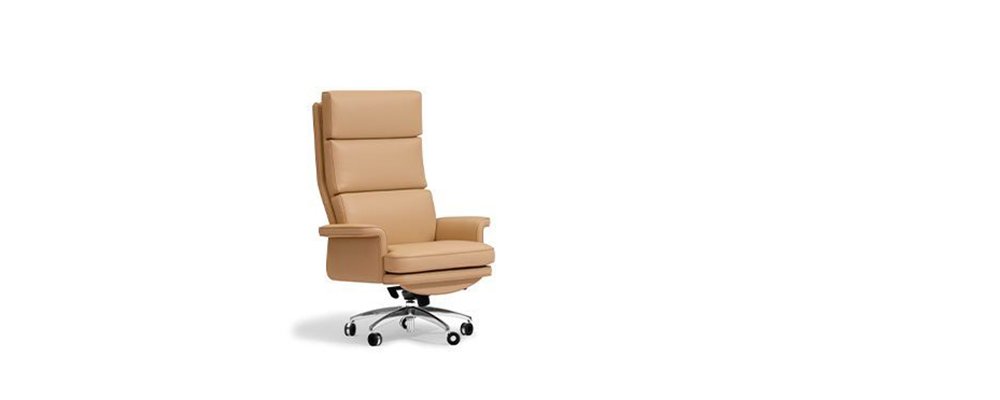
Everything else, the maker has already settled. It swivels, it tilts with an adjustable action, and the seat height is set from a control lever under the seat. Underneath sits a five-star base on casters, in steel or in wood. For the cover, Mascheroni Leather Colour System is the single source, and everything in it is natural bovine leather. Behind the desk of an executive suite the tall back does the visual work; the cushion grade works quietly, for the one person who sits there.
The family follows the floor plan. The 135 and the slightly shorter Congress 127 are the two presidential chairs, for the corner office. The Congress Conference has a lower back and goes around the boardroom table. The Congress V is the fixed guest chair, placed across the desk from it. La Mercanti asks who will sit in it and for how many hours before the cushion grade is set, because firm reads differently at hour one and at hour six.

Let us know which finishes you'd like to explore
Nothing under about 1.4 millimeters (about 1/16 in). Mascheroni says the leathers commonly used in its industry, chosen because they cost less and are simpler to work, run about 1.1 to 1.2 millimeters thick, and that those common leathers are not part of its sample range. Its thinnest leather is the starting point; the heavier categories go up from there, harder to work, the company notes, yet they give the product a long life. On a chair you intend to keep, thickness is a better first question than color.
Both are what Mascheroni calls its presidential versions; the difference is size. The 135 stands 52 3/8 to 55 1/8 in tall, the 127 from 47 1/4 to 50 in, so 5 1/8 in of back separate them. The 135 is also wider, 34 5/8 in against 33 1/2, and its seat is 20 1/2 in deep where the 127 has 19 3/4. Seat height is identical, 18 1/2 to 21 1/4 in. A taller sitter or a larger room points to the 135; in front of a low window line or a credenza, the 127 keeps the same look at a lower profile.
Mascheroni does. The company describes itself as one of the few that directs and controls the entire production cycle directly, from the selection of raw materials through production to its personalized services. Components are made mostly by hand, with the help of latest-generation machinery, and everything is then assembled completely by hand. For an American buyer ordering from across an ocean, that has a practical meaning: one company answers for the frame, the padding, the leather and the assembly.
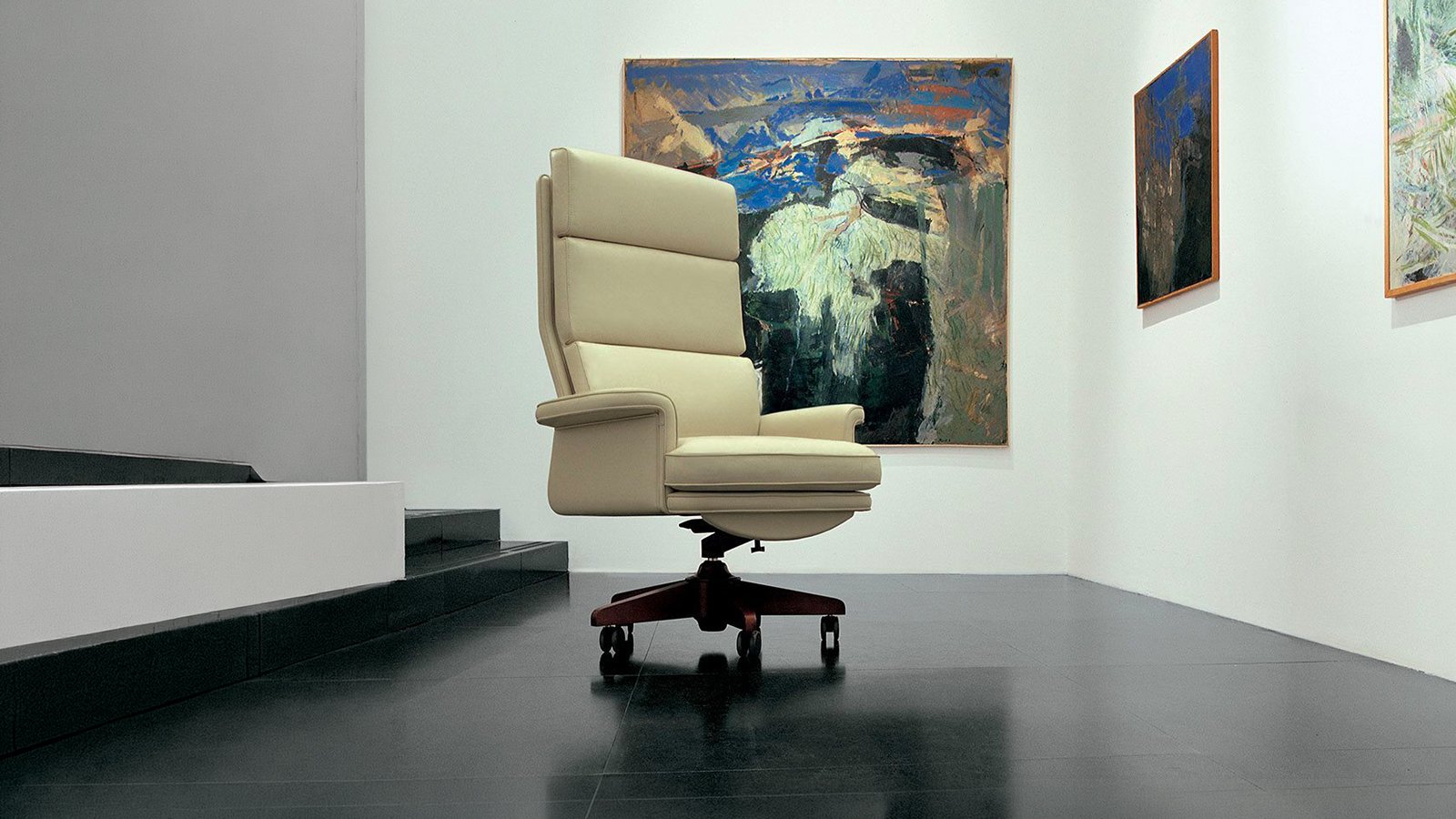
Rooms with a past. In the Mascheroni images the Congress 135 stands in a white room hung with paintings, on a polished black floor. The Congress 127 is shot in a library with herringbone parquet; the Conference appears around an oval table under arches and again in a historic room with a mosaic floor; the Congress V sits beside a stone wall. The reading is not hard: the maker sets these chairs next to art, books and architecture, and trusts the leather to hold its own.
Mascheroni states that it makes special and personalized products for a demanding clientele, so the conversation can be opened. On the Congress, the choices the maker declares are four: the model (135, 127, Conference or V), the base in wood or steel on the three swivel chairs, the cushions in soft, medium or firm, and the leather, picked within Mascheroni Leather Colour System. La Mercanti starts from those four and takes any request beyond them to Mascheroni as a question, one item at a time.
Five measurements tell you whether the room is ready for a Congress 135: the width, the depth, the wall behind the desk, the underside of the desktop and the path of the sun. Every figure is given in inches.
The Congress 135 is 34 5/8 in wide, arm to arm. Measure the gap it has to work in, between a credenza and a wall or between two pedestals, and remember that the chair swivels: it needs that width at every angle, not just when it faces the desk.
Front to back, the chair takes 30 3/4 in. Add the space you need to push back and stand up, plus room for the tilt, since the back reclines with an adjustable action. Measure from the edge of the desk to whatever is behind you; that distance is the one that decides.
The back tops out between 52 3/8 and 55 1/8 in from the floor, depending on where the seat height is set. Mark both heights with tape on the wall behind the desk. A window sill, a framed piece or a shelf at that level will line up with the top edge of the chair in every meeting.
The arms move with the seat, from 25 1/4 to 28 in off the floor. Measure the clearance under the desktop, including any drawer or rail, and compare. If the arms clear it, the chair tucks in when you leave the room; if they meet it, you know before the order and not after.
Mascheroni advises against exposing leather directly to sunlight or other strong light sources, which fade it and age it early, and says to keep this in mind when deciding where furniture goes. Watch the room for a day and note where the sun falls at desk level. Shades or a small shift of the desk are easy fixes at this stage.