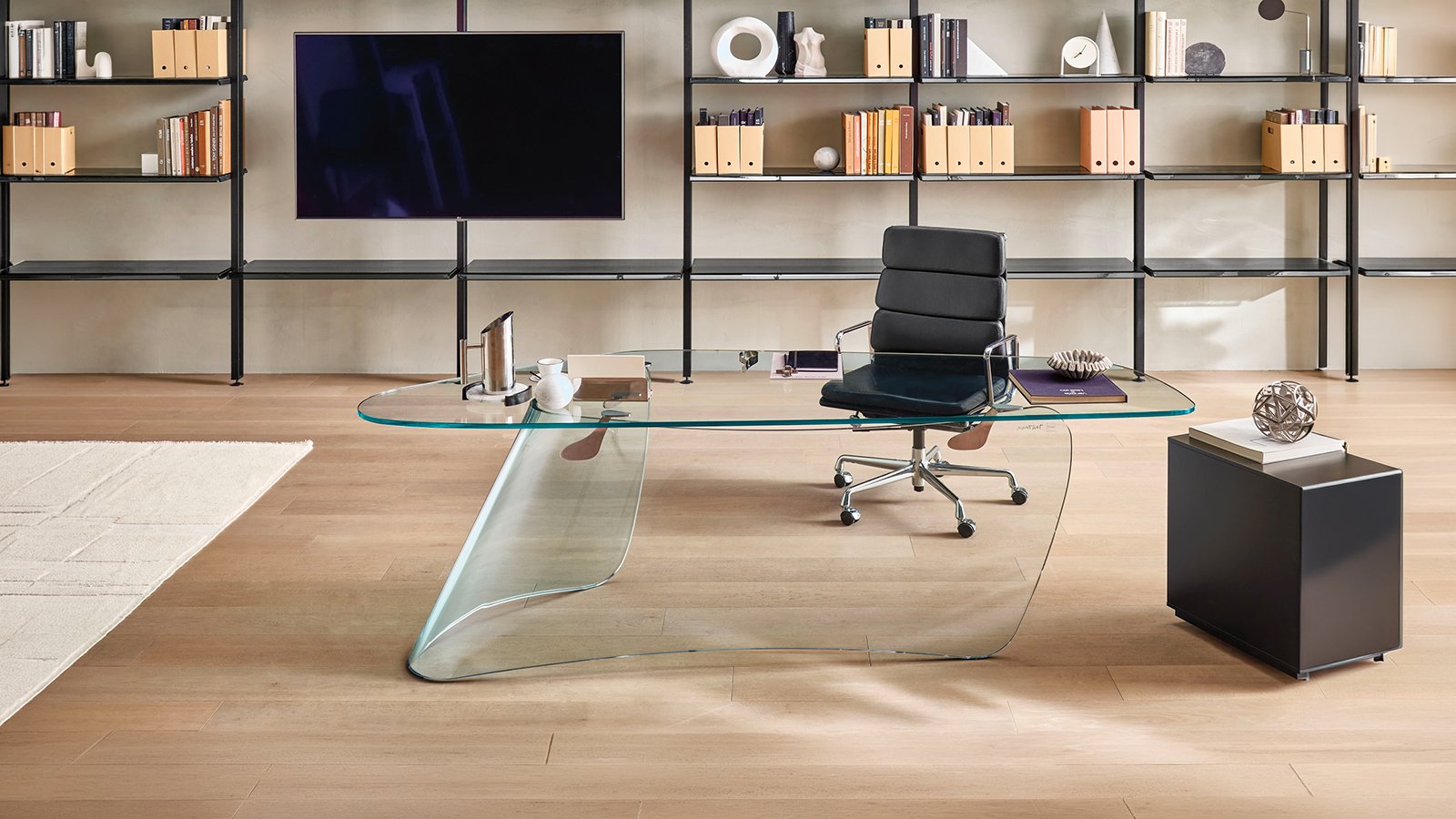
Light hardwood floor, a black shelving wall and Graph by Fiam seen three-quarter on

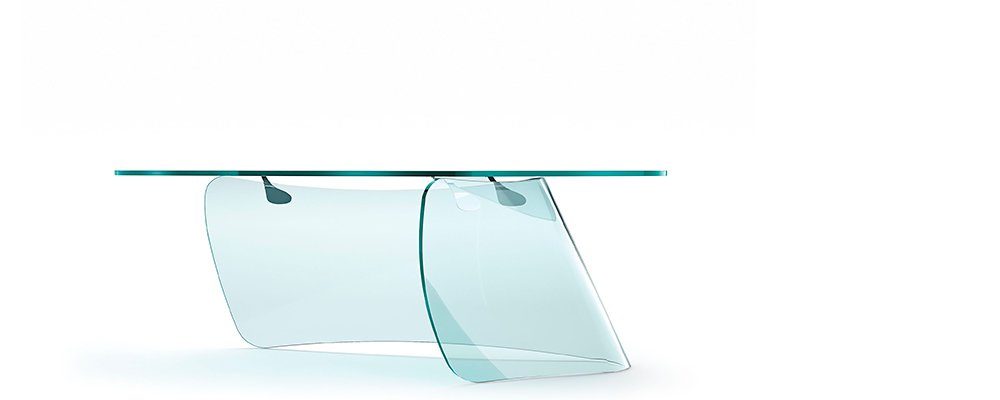
Glass, then stainless steel, in plain sight: the connecting plates of Graph by Fiam

Fiam
Executive desk only
Graph An icon of Italian design Executive desk only
$ 17,663

What did you have in mind?

Trade terms for professionals and design studios

On Graph the metal is easy to count. Fiam names two materials for the whole desk, glass and stainless steel, and the steel is all in the connecting plates that join the base to the top. Because the top is clear, they stay in view from the doorway, from the guest chair and from above: elongated, almost teardrop-shaped in the photographs, dark against the glass. Xavier Lust drew the desk for Fiam. Anyone building a shortlist of designer desks for executives will notice how small the steel is, and how central.

Everything else is glass, and Fiam is precise about which glass goes where. The base is curved glass, 3/4 in thick, drawn as a ribbon folded back on itself with one end leaning; the top is transparent tempered glass at 19/32 in, a flat sheet joined to the base by the plates. On most all-glass office desks the eye goes to the legs. Here it goes to the joint.

Two sizes, both standing 29 1/8 in tall: 86 5/8 in long and 31 1/2 in deep, or 98 7/16 by 35 13/16 in, the larger being deeper as well as longer, in Standard or Extralight glass. We see Graph in a corner office where the door hardware and the lamps were chosen with care, because the plates will share the room with them. La Mercanti holds a stainless steel swatch up to the client's door pulls and desk lamp before the glass comes into the conversation.

Technical information based on data declared by the manufacturer.
  • Name: Graph
  • Manufacturer: Fiam
  • Design: Xavier Lust
  • Type: glass desk
  • Dimensions (W × D × H): 86 5/8 × 31 1/2 × 29 1/8 in · 98 7/16 × 35 13/16 × 29 1/8 in
  • Base: curved glass, 3/4 in thick
  • Top: transparent glass, tempered, 19/32 in
  • Joining base and top: stainless steel connecting plates
  • Glass options: Standard or Extralight
  • Load capacity on top: 220 lb
  • Weight stated by Fiam: 276 lb (86 5/8 in size) · 311 lb (98 7/16 in size)
  • Model: registered
La Mercanti USA Llc — your partner for Italian design and contract supply.
Los Angeles, CA, USA · +1 855 335 8079 · info@lamercanti.us
Supply, quotes, specifications and project support across the United States and North America.

Let us know which finishes you'd like to explore

$ 180

Credited in full toward your purchase

FAQ

Which part of Graph does Fiam call tempered?

The top, and only the top. Fiam's sheet describes it as transparent glass, 19/32 in thick, tempered; the base is described as curved glass, 3/4 in, and the word is not attached to it. That distinction belongs in the specification exactly as Fiam writes it. A purchase order or a furniture schedule that calls the whole desk tempered says more than the maker does, and on a project with a reviewer that is the line that gets sent back.

What happens at the leaning end of the base?

In Fiam's side drawing and in the photographs on white, one end of the curved base is inclined rather than upright. Fiam's drawing records the shape exactly as it is. What it changes is the profile: seen from the side, the desk reads differently from each end. In a corner office we would decide which profile faces the door before settling anything else about the position.

How should the stated depths be read on a top with rounded ends?

As maximums. The plan drawing shows a free form with every corner rounded, deeper at one end than at the other, so 31 1/2 in on the smaller desk and 35 13/16 in on the larger one is the widest point, not a depth that runs the whole length. For planning, use the full rectangle as the footprint; for the room, remember that one end gives the visitor less glass to reach across.

What does Fiam mean by the “visible tension” in Xavier Lust's work?

Fiam says that what sets his pieces apart is the visible tension he gives to objects, together with curves inspired by his process of deforming metal surfaces. That is all the maker writes, and we keep to it. On Graph, the place we would look for that tension is the curved base, tight at one end and leaning at the other; a buyer who wants a desk with presence should place it where that base can be seen whole.

Is Graph one desk, or a family of pieces?

One desk. Fiam describes Graph as a desk, offered in two sizes, with two glass options, and that is the complete picture. For a project this keeps the decisions few and clear: length, glass, position. The rest of the office, from storage to guest seating, can be chosen freely around it, and we often find that freedom easier to work with than a matching suite.

Sizing Graph for the office, starting where the door swings open

Graph is made in two sizes, and the larger one gains depth as well as length. Five steps to settle the choice in the office itself, from the arc of the door to an outline taped on the floor.

Trace the door's arc

Before comparing the two sizes of Graph, open the office door as far as it goes and note where its edge sweeps the floor. That arc is space nobody can furnish. The smaller footprint is 86 5/8 in by 31 1/2 in, the larger 98 7/16 in by 35 13/16 in, and whichever you pick has to sit clear of the swing with room left to walk past.

Grow in two directions

Going up a size adds to both dimensions at once: from 86 5/8 to 98 7/16 in along the desk, and from 31 1/2 to 35 13/16 in across it. The wall behind the chair is rarely the problem. The walkway in front of the desk, between its edge and the door, is where the larger version has to prove it fits.

Leave the height out of it

Both sizes stand 29 1/8 in tall, so height plays no part in the decision. The chair, its armrests and any cabinet you plan to line up with the desk stay the same whichever length you settle on; what changes is floor area, and only floor area.

Find where the chair goes

In Fiam's room photograph the chair stands where nothing sits under the top: the base occupies one part of the plan and leaves the other clear. Allow for that chair pulled well back on its side, beyond the depth of the desk, and check that it still clears the arc you traced at the door.

Tape the outline down

With painter's tape, mark the smaller rectangle on the floor, then the larger one around it. Because the corners of the top are rounded, the tape shows the most the desk can occupy. Walk in from the door, sit, stand, walk around. The extra length of the bigger size needs a room that can carry it, and the tape will tell you.