Already have something in mind?
Trade terms for professionals and design studios
Already have something in mind?
Trade terms for professionals and design studios
Of the test references Lapalma prints for CROSS, one is written for an American reader: ANSI/BIFMA X5.4-2020, clause 14.5. Two European entries sit beside it, EN 16139:2013 at level 2, “Extreme”, and EN 1728:2012, points 6.4, 6.5 and 6.8, all covering both indoor heights. On a US hospitality or workplace project, the stool enters the specification under a standard cited by number. For a client comparing designer bar and counter stools, it is a line that settles questions early.
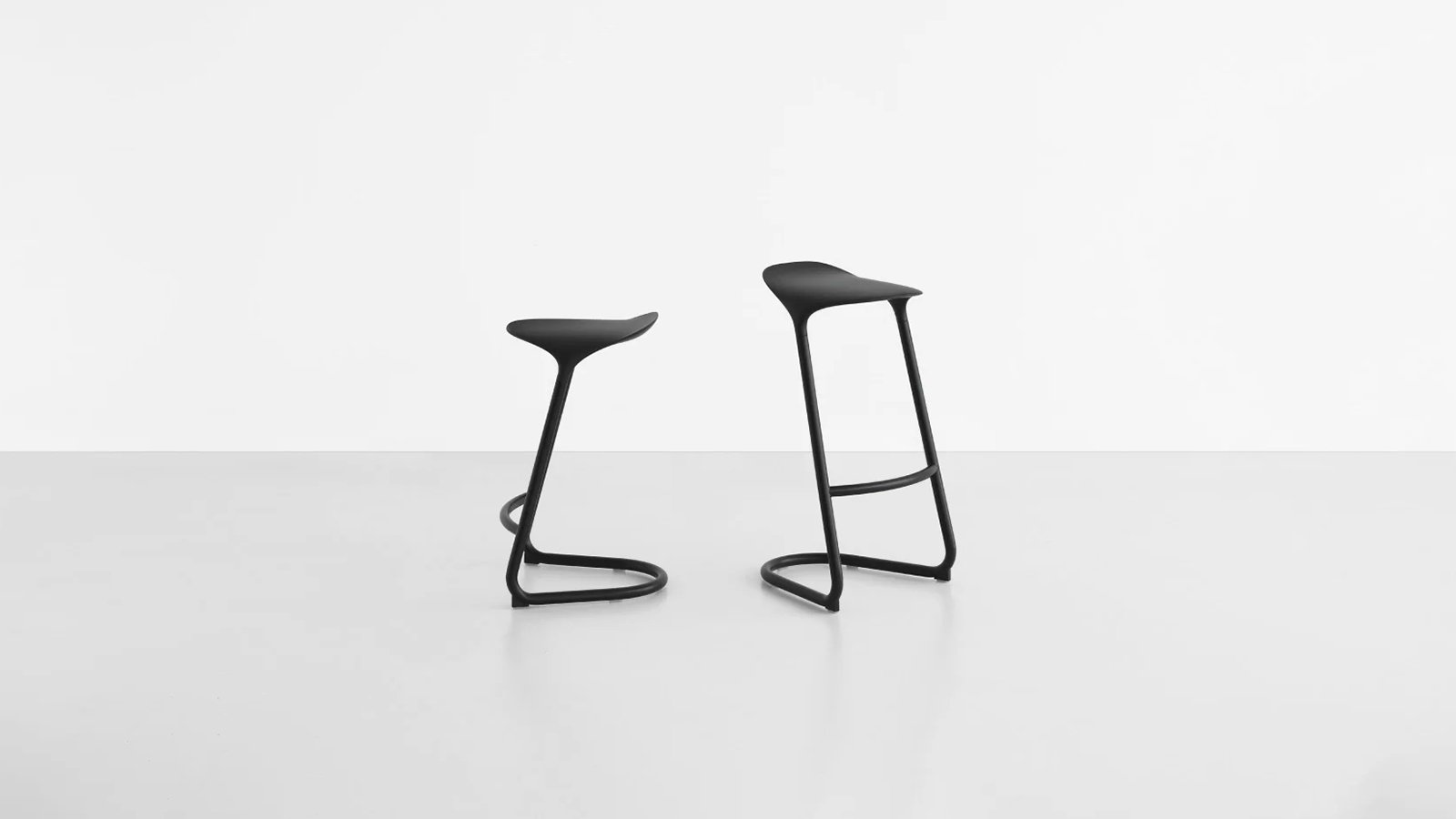
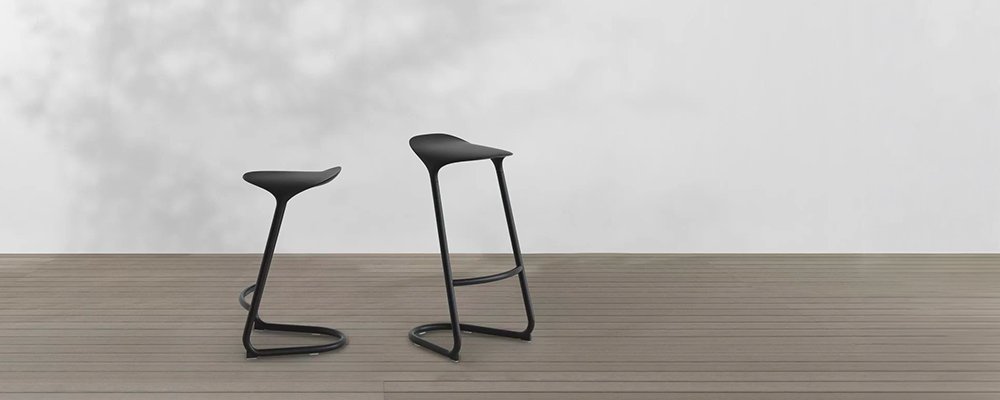
The design is by Mario Ferrarini, from 2022. Structurally it is a cantilever: a powder-coated steel tube runs down from beneath the seat and, in the drawing, curls into a runner on the floor, with a footrest bar spanning the two uprights. Anti-tip glides are welded on at the front, finished in the frame color; polyethylene feet sit under the runner. The seat is molded integral polyurethane with a rigid core, soft to the touch by Lapalma's account.
Two heights are offered, the S451 at counter level and the taller S452 at the bar, each with an outdoor version built on stainless steel. Where we picture it: a hotel bar, a coffee point on an office floor, a lounge off the lobby, with Italian designer chairs at the tables nearby. La Mercanti sits down with the client's spec writer and finds the place in their own template where the test line for CROSS belongs.

Let us know which finishes you'd like to explore
The outdoor pair, ES451 and ES452. Lapalma builds their frame in AISI 304 stainless steel tube, powder-coated, and keeps everything else as on the indoor stools: the same integral polyurethane seat with its rigid insert, the same welded anti-tip glides and polyethylene feet, the same dimensions and the same colors. A bar inside and a bar on the terrace can carry one design and one palette.
For ES451 and ES452, Lapalma lists one accessory: a waterproof cover, which in the drawing slips over the seat and the upper part of the frame. We suggest it for stools left outside for long stretches, between seasons or through a quiet week at a resort, and we put it on the same order line as the stools, so one count serves both.
The instructions keep it simple: a damp cloth, or neutral cleaner in a weak dilution, used the same way on the frame and on the seat. Products with alcohol, bleach or solvents stay off, and so does anything abrasive. In a hotel or a busy café it is worth handing that list to housekeeping on day one, because the habits of the cleaning crew decide how the finish looks a few years in.
On the frame. Lapalma's instructions say to lift or move the stool by its structure, never by the seat alone. The frame is the part the instructions name, so that is where the hands go. For a venue that is cleared and reset every night, one short line in the closing checklist keeps the habit the same from shift to shift.
Lapalma asks that the indoor S451 and S452 be kept out of the weather and away from heat sources over 104 °F. In practice, that is a note for the layout drawing: mark any point where the temperature climbs above that figure and keep the stools clear of it. For a spot in the open air, the stainless steel outdoor pair is the version built for the job.
Two seat heights, one footprint, one palette: five steps for deciding which CROSS goes at a counter and which at a bar, based on Lapalma's drawings and on the way we survey a room.
CROSS comes as the S451, whose seat sits 25 5/8 in from the floor, 27 1/8 in overall, and as the S452, seat 31 1/2 in up and 33 1/8 in overall. The first is the counter version, the second the bar version, and those two seat figures are the whole decision.
Before anyone looks at colors, we measure the real height of each counter, island and bar top in the project, at the edge where guests will sit. Furniture names promise a height; the tape gives the real one, and a single room can hold two different tops.
Low or tall, each stool takes the same 17 3/4 by 16 1/2 in of floor. The spacing worked out for the counter therefore holds at the bar as well, and a plan that uses both heights needs a single module, repeated along every run.
Both versions share the same color names for frame and seat, from black to pistacchio. Where a counter and a bar face the same room, one pairing for both lets the change in height read as intention, and the two runs still look like a single family.
Outside, the codes become ES451 and ES452: same dimensions, frame in stainless steel. Survey the patio bar exactly like the one inside: measure the top, pick the matching seat height, then carry the result across to the outdoor code.