What did you have in mind?
Trade terms for professionals and design studios
What did you have in mind?
Trade terms for professionals and design studios
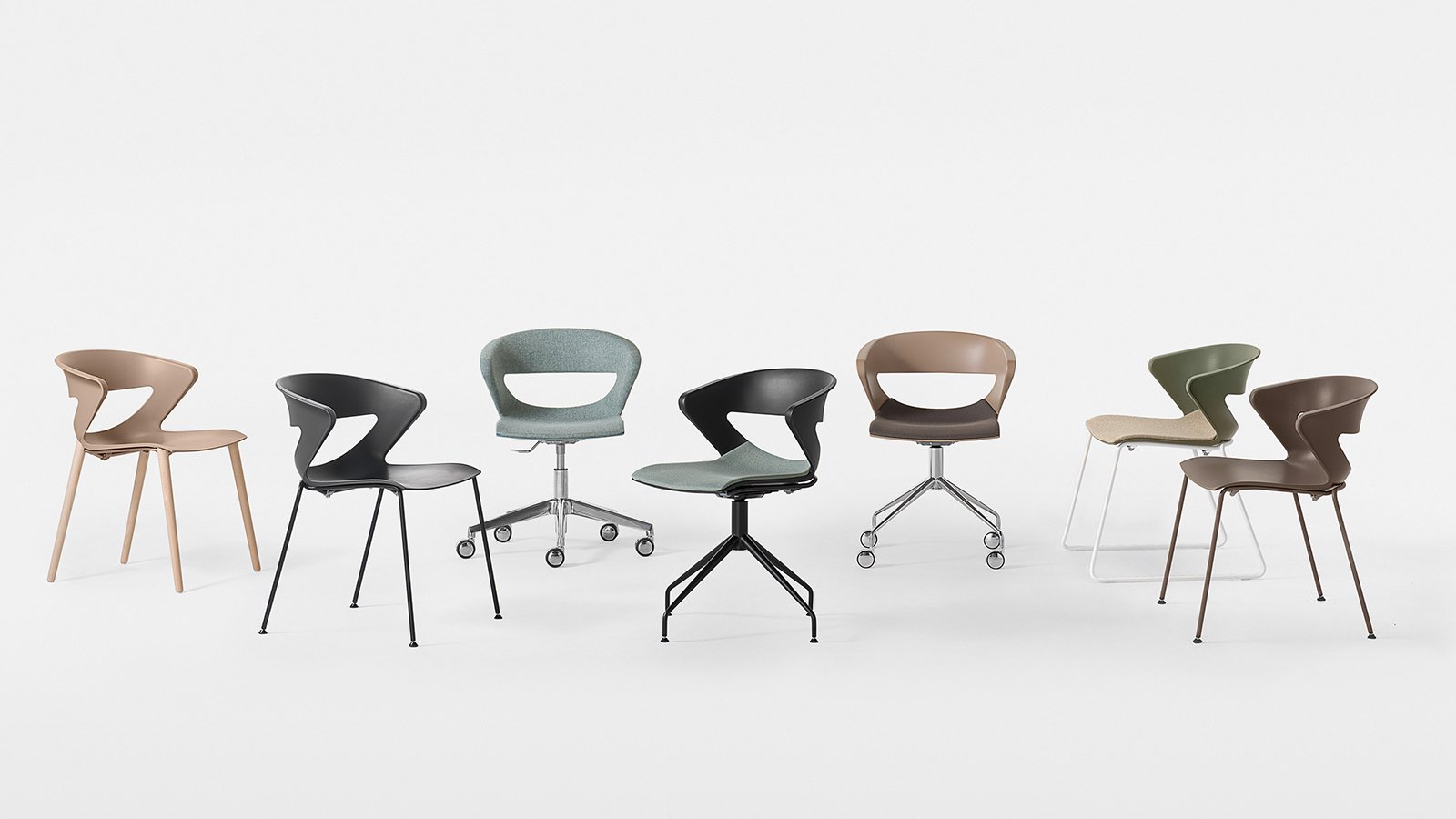
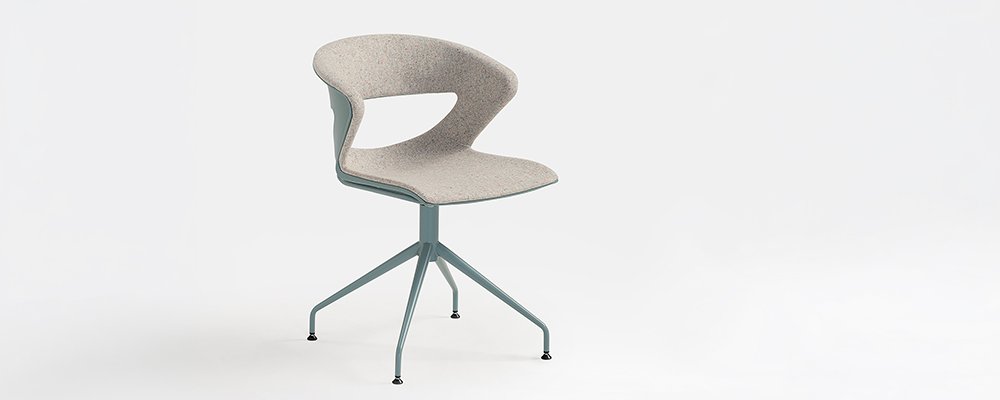
Under the fabric of Kicca Plus there is no plastic shell. Kastel builds this one another way: fire-retardant polyurethane, cold-foamed over a metal frame that is molded into it. The result is the upholstered armchair of the family, where the standard Kicca is a polypropylene shell that may or may not carry padding. Kicca Plus comes two ways, with smooth upholstery or as Kicca Plus Soft, and in one color or two, one for the inside and one for the outside. It measures 20.9 × 22.4 in., stands 30.7 in. tall and seats you at 18.1 in. Bases: four legs, sled, maple legs, round base, five-star, four-foot swivel with or without casters.
The chair we’d pull up to a conference table is the standard four-leg Kicca: 21.7 in. square, 29.9 in. high, 18.1 in. to the seat. That’s the reason this page lives under conference chairs, though plenty of them end up as guest chairs across from somebody’s desk. Its shell is one piece of polypropylene that clips onto a steel frame and comes in eleven colors; the frame itself comes in ten finishes. With no padding, a stack of eight stands on the floor; the cart carries ten.
Think of the rest room by room. Executive office: maple legs over a steel structure, or the cross sled, which is also available in a painted bronze. Reception and waiting: four legs or sled, with a padded seat or a padded seat and back. Training room: chairs ganged in rows with the KC19 connector. Manager’s desk: a five-star swivel that rolls on casters and adjusts by gas lift, or one of the four-foot swivels. Cafeteria or company restaurant: the bare shell, or Kicca One, the one-piece chair in polypropylene with glass-fiber reinforcement. La Mercanti specifies the armchair’s upholstery and base line by line.

Let us know which finishes you'd like to explore
Yes, provided they carry the KC18 underseat cover, an ivory part Kastel makes so padded chairs can nest. With a padded seat the count is four per stack, on the floor or on the cart. Add a padded back and the floor stack drops to three while the cart still takes four. That applies to four-leg and sled models.
Both are fixed steel bases; what separates them on paper is the finish list. The regular sled comes in white, black, aluminum gray and chrome. The cross sled offers those four and adds three the sled doesn’t have: taupe, turquoise and a painted bronze.
The four-leg chair is 21.7 in. wide and 21.7 in. deep, 29.9 in. tall overall, with the seat 18.1 in. off the floor. Those are the chair’s own dimensions; give La Mercanti the table size and we’ll tell you how many fit along each side.
Yes to both. Kastel reports a UV test under ASTM G 154 for Kicca One, and it produces versions of the chair in recycled polypropylene. If either point matters for your project, say so at the start, because both belong to Kicca One and not to the standard Kicca shell.
Because they’re self-braking. The casters Kastel supplies roll only while someone is seated; take the weight off and they hold. It’s deliberate: an empty chair stays where it was parked instead of drifting away from the desk. La Mercanti flags this at handover so nobody reports it as a defect.
Coffee on a fabric seat is a matter of minutes. Five steps from Kastel’s care instructions, from blotting the spill to sanitizing with 70% ethyl alcohol.
Kastel’s instruction is to remove liquids promptly, using a soft cloth or a damp sponge. Don’t wait for the spill to dry into the fabric: the cloth comes first, and everything else on this list comes after it.
Routine care is dry: Kastel asks for the seat fabric to be vacuumed regularly. No liquid is involved at this stage; water and disinfectant belong to the steps that follow, and only when they’re needed.
Before any sanitizer touches the visible part of the seat, try it on a corner nobody sees. Kastel recommends that step for every product you plan to use. Look at the spot once it has dried, then decide whether to go ahead.
Fabrics can be sanitized on the surface with a solution of water and 70% ethyl alcohol, or with a ready-to-use commercial disinfectant. Kastel describes it as a surface treatment, and the test from the previous step applies to whichever product you pick.
Solvents and abrasive cleaners are off the list for every part of the chair. Two habits help as well: don’t sit down in damp clothes, and keep the chairs out of direct sunlight and away from radiators.