Let's discuss your project
Trade terms for professionals and design studios
Let's discuss your project
Trade terms for professionals and design studios
On KISO, power is part of the structure. Tomoya Tabuchi gave the family one metal tube between the legs and three jobs for it: it carries the flip-top, houses the mechanism that rotates it and, when specified, brings power to the table, with an outlet on one side and USB-A and USB-C ports on the other. That is the reason it sits in our furniture for collaboration: a room shared by different teams through the day needs its ports where the work happens.
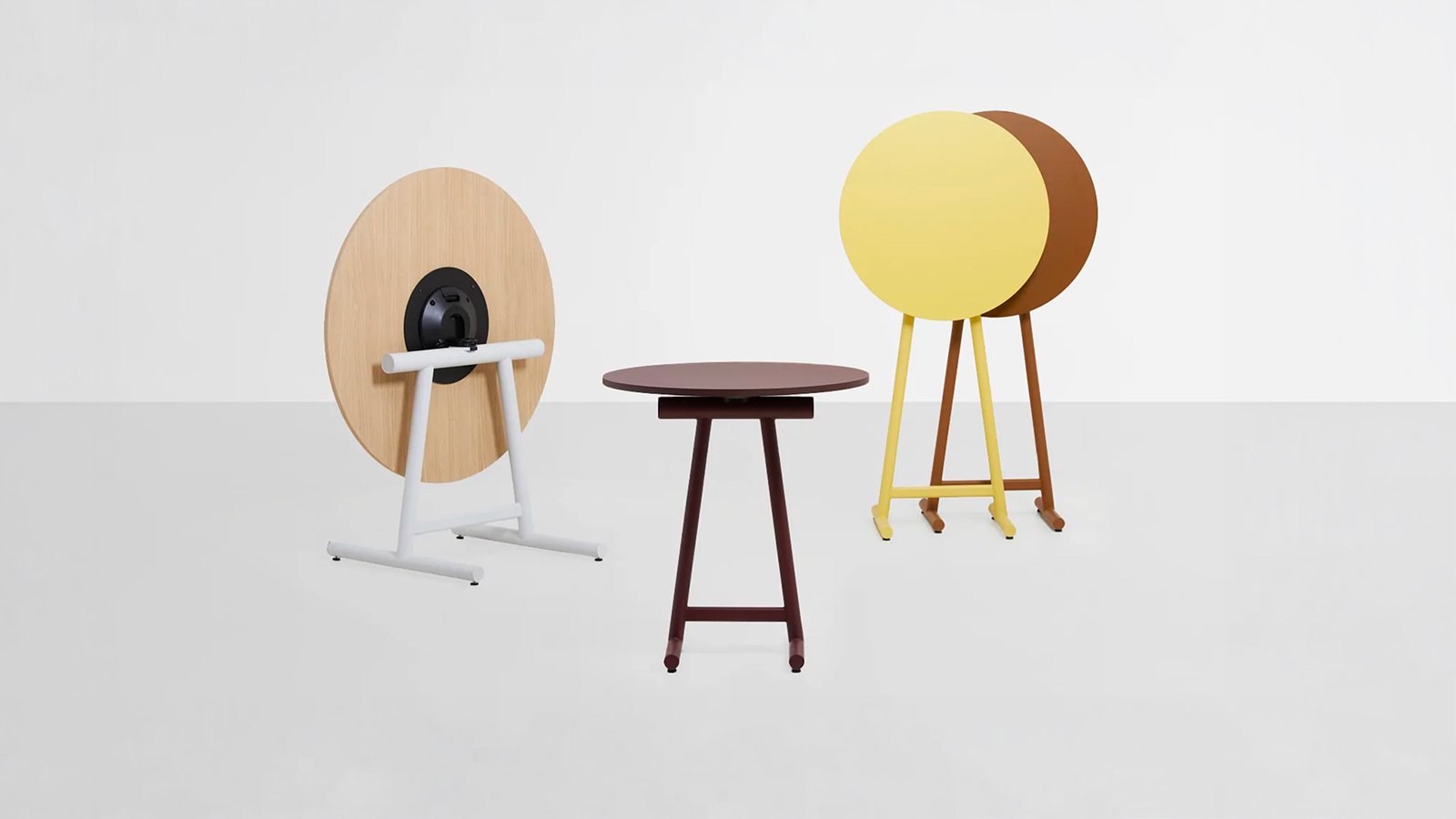
Power is one of two options, and Lapalma offers each variant with casters, with integrated power access, or with both. The gesture is the same everywhere: one movement stands the top on edge, the table claims less floor, and folded units slot together. Steel frames are powder-coated, and the surface can be oak, lacquered wood, HPL or Fenix.
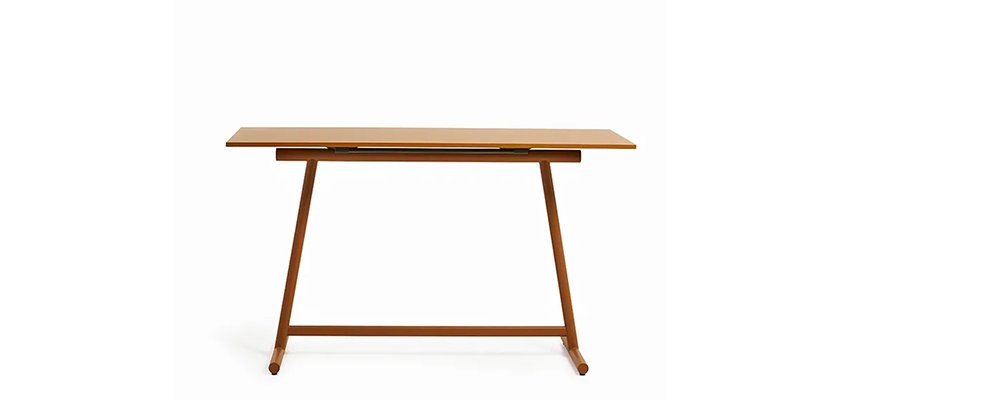
The tube runs through all three variants: a half-moon, a large round in two diameters, and a high rectangular table at standing height. We picture them in conference and meeting rooms that switch from a client presentation to a working session within the same day. La Mercanti marks the wall and floor outlets on the client's plan before suggesting how many tables get power.

Let us know which finishes you'd like to explore
Lapalma lists a 3/8 in HPL with a black core, in two colors, among the top finishes. Our reading, not the sheet's: in a black-core panel the core usually shows at the edge as a thin dark line, whatever the surface color. It is a graphic detail worth deciding on purpose, since on KISO the top stays in view whether the table is open or folded upright.
Two of the three. Lapalma lists an optional tabletop linking system for the half-moon and the high rectangular, and it is written into the specification as an option. If a room needs a long continuous surface, plan it with those two variants.
A sector 66 7/8 by 31 1/2 in with a 90° arc, standing 29 1/8 in high, which is ordinary seated height. Closed, with the top turned upright, it reaches 47 1/4 in. In the drawing the outer edge is convex and the inner edge concave, so we draw the chairs on the plan before choosing it.
The blanched oak: Lapalma offers it in a single shade, next to two lacquered woods, open-pore and plain, each in 16 colors. One shade makes the choice simple. We suggest it where KISO shares a space with existing light wood, and a lacquer where the top should pick up the frame color.
All three. Each variant comes with casters, with integrated power access, or with both, and the large round sheet adds that it is also available on casters. When lifting or moving a table, the sheet asks to hold it by the structure. Our advice: casters where a room changes layout several times a week, glides where the tables mostly stay put.
Three shapes, two working heights, three closed heights. Five steps that turn the Lapalma drawings into a decision about which KISO variant goes where, before anything is ordered.
KISO works at two heights. The half-moon and the large round stand 29 1/8 in high, the usual height for chairs; the high rectangular reaches 41 3/8 in, which we read as a surface for people on their feet. Start by asking which kind of meeting the room hosts most.
In the drawing on the sheet the half-moon is a sector with a 90° arc: a convex outer edge, a concave inner edge and two straight sides. Draw chairs along both curves on the plan before choosing it.
The large round comes in two diameters, 35 3/8 and 39 3/8 in, both at seated height. The smaller one fits a corner or a short conversation; the larger one leaves more room for laptops. That reading is ours: count the chairs the plan allows around each circle.
The high rectangular is 26 3/4 in deep and 63 or 70 7/8 in long. The longer one gives a few more inches of edge to lean on for each person; the shorter one fits between a door and a window. Measure the stretch of floor where it will stand open before picking.
Every variant is taller closed than open: 47 1/4 in for the half-moon, 48 7/8 in for the round, 57 1/8 in for the high rectangular. Walk the wall where the tables will wait and check shelves, artwork and window sills against those three figures.