
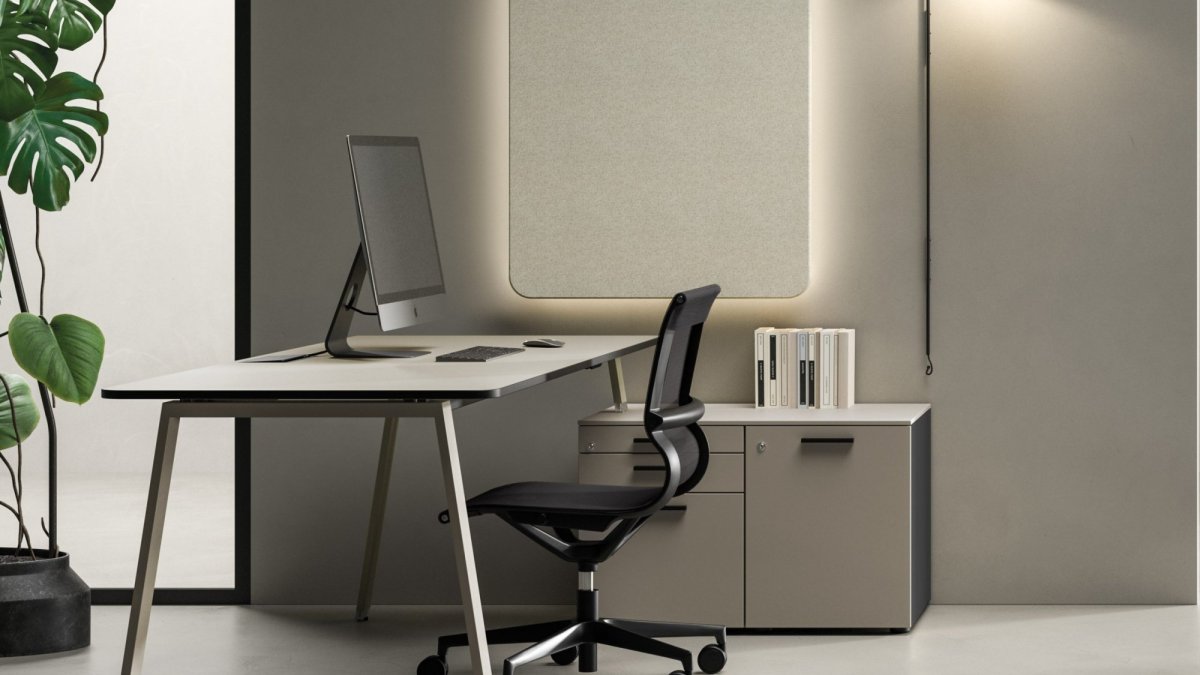
OSHA's guide to computer workstations contains a piece of advice I have never read in a furniture catalog. If a desk is too low, it says, raise it on stable risers, such as boards or concrete blocks under the legs. If it is too high, cut the legs off. Nobody who installs furniture for a living would phrase it that way. Still, the advice is honest about something catalogs rarely say out loud: the height that suits one person can be wrong for the next, and in the United States no federal rule fixes a number for the desks employees work at. The fit is left to the employer, and to the chair.
The only fixed number is European
For the desk itself, the reference we can quote is a European standard, EN 527-1:2011. It sets the top of a fixed-height office desk at 740 mm, plus or minus 20, which works out to 29.1 inches with a tolerance from about 28.3 to 29.9. The standard explains where that figure comes from. Its dimensions are drawn around the European office population, from the 5th percentile woman to the 95th percentile man, a stature range of roughly 4 ft 11 in to 6 ft 3 in.
American rules take another route. In a letter of interpretation dated February 1987, OSHA stated that it has no standards for the design of video display workstations. The 2010 ADA Standards do give a range, 28 to 34 inches above the floor, yet it applies to work surfaces provided for people other than employees, and only to at least 5 percent of them. For surfaces used only by staff, the Access Board's advisory points elsewhere: under the ADA, and Section 504 of the Rehabilitation Act where it applies, employees with disabilities are entitled to reasonable accommodations, which can mean procuring or adjusting desks on an as-needed basis. A 29-inch desk falls inside the ADA range. Whether it suits a given employee is a separate question, answered case by case.
A century ago, Americans were the tall ones
The NCD Risk Factor Collaboration published a century of national height estimates in eLife in 2016. An American man born in 1896 averaged about 5 ft 7.4 in, taller than a Dutchman (5 ft 6.7 in) or an Italian (5 ft 4.8 in) of the same year. For people born in 1996 the order has flipped: Dutch men average close to 6 ft, Italian men about 5 ft 10 in, American men 5 ft 9.7 in. Over those hundred years American men gained about 2.4 inches, Italian and Dutch men more than 5.
A desk sized for the European office population, then, was not drawn for smaller people than the ones on your payroll; among those born in 1996, the average Italian man stands a shade taller than the average American. The average matters less than the spread inside one office, and that spread pulls in two directions. For the shorter end, OSHA's answer is to raise the chair and, if needed, add a footrest. The taller end needs room for the legs. EN 527-1 asks for at least 31.5 inches of clear depth under the top and, on a fixed desk, 33.5 inches of width, and it limits the front edge of a fixed top to 2¾ inches of thickness. OSHA's guideline for leg clearance is 20 to 28 inches.
Some people sit beyond what a standard desk covers. We once had a client, a very tall man, who changed desks after trying one. In the end the manufacturer built him a desk to measure.
What a wrong height does, and what it costs
OSHA puts the problem in one sentence: desk surfaces that are too high or too low may lead to awkward postures, such as extended arms to reach the keyboard and raised shoulders. The Bureau of Labor Statistics counted 502,380 workplace musculoskeletal disorders that caused at least one day away from work across 2021 and 2022, an annualized rate of 25.3 per 10,000 full-time workers. That count spans every industry, warehouses and hospitals included, so it proves nothing about desks in particular. It does explain why workstation fit deserves more attention than a comfort detail gets.
The legal side runs through the OSH Act. With no ergonomics standard in place, OSHA can cite ergonomic hazards under Section 5(a)(1), the General Duty Clause, which requires a workplace free from recognized serious hazards. It weighs four questions: whether a hazard exists, whether it is recognized, whether it is causing or likely to cause serious physical harm, and whether a feasible means exists to reduce it. OSHA also says it will not focus enforcement on employers making good-faith efforts to reduce ergonomic hazards. A written record of how each workstation was adjusted to the person using it can help document that effort; how much weight it carries is a question for counsel.
The floor is not on the spec sheet
A spec sheet states the height of the desk. It knows nothing about the floor underneath. On our installations the top usually finishes 1¼ to 2 inches away from the catalog figure, which at the upper end is more than the ±20 mm EN 527-1 allows a fixed desk. The site error we run into is simple to prevent: a top that was never leveled, with the glides left as they came out of the box. If you write specifications, ask for the height measured after installation, with the top leveled, next to the catalog value.
Executive desks are a case apart. Their height changes from one model to the next, so read it off that model's sheet before choosing the chair.
Sit-stand helps the people who use it
For desks that adjust, EN 527-1 asks for a range of at least 25.6 to 33.5 inches for seated work, 25.6 to 49.2 inches for sit-stand use and 37.4 to 49.2 inches for standing only. Where several people share one surface in the same week, that range makes sense. What it delivers depends on how it is used. A 2018 Cochrane review found that sit-stand desks reduced sitting at work by about 100 minutes per workday over the first three months and by 57 minutes between three and twelve months, compared with sit desks, on evidence it rated low quality and with nothing beyond a year. Back in 2006, Wilks and colleagues reported in Applied Ergonomics that users liked their sit-stand worktables but used the standing function less than expected. The SMArT Work trial, published in the BMJ in 2018, measured 83 fewer minutes of sitting per workday at twelve months among hospital office staff, with seminars, feedback and coaching built around the desks. If you are buying sit-stand for a whole floor, put that support in the budget as well.
Start with the people
When we plan a floor of office workstations, we begin with who will sit there and whether each seat belongs to one person or to several. The desk comes next, then the task and ergonomic chairs, because on a fixed desk it is the chair that brings each person to the right height. The last adjustment happens on installation day, with a level on the top and a hand on the glides.
That is where the right height is actually set.
Quick answers
What is the standard height of an office desk? Under the European standard EN 527-1:2011, a fixed-height office desk is 740 mm, about 29.1 inches, with a tolerance of plus or minus 20 mm. There is no US federal rule setting desk height for employee workstations.
What desk height does the ADA require? The 2010 ADA Standards set work surfaces at 28 to 34 inches above the floor. The requirement covers at least 5 percent of work surfaces provided for people other than employees; for employees with disabilities, the ADA calls for reasonable accommodation as needed.
Does OSHA have a rule on desk height? No. OSHA has no standard for computer workstations and addresses ergonomic hazards under the General Duty Clause. Its guidance suggests raising the chair, adding a footrest or providing height-adjustable desks.
How much legroom does a desk need? EN 527-1 asks for at least 31.5 inches of clear depth and, for a fixed desk, 33.5 inches of width. OSHA suggests 20 to 28 inches of leg clearance under the top.
Why is an installed desk not the height in the catalog? The floor and the glides change it. On our installations the top usually ends up 1¼ to 2 inches off the catalog height, which is why it should be leveled and the glides adjusted on site.