
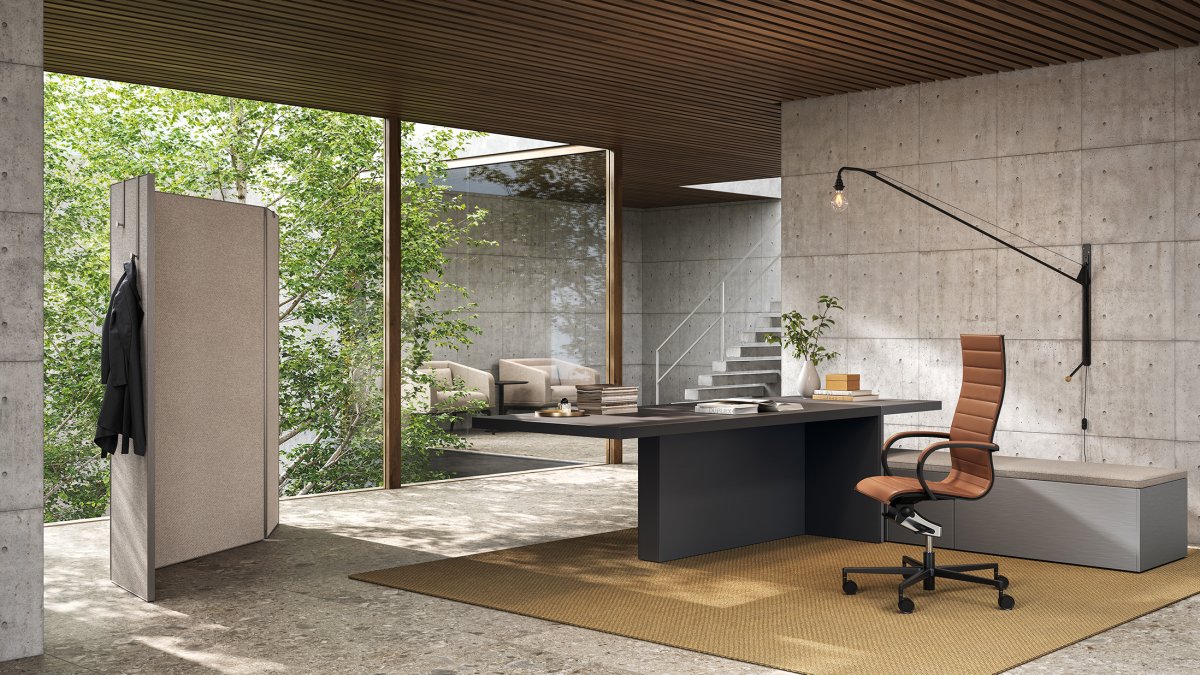
The corner office may have lost its walls, but it never lost its desk. In American companies the executive desk still does what the org chart cannot: it shows, in one glance, how the person at the top wants to lead. Italian manufacturers have been furnishing that glance for a century, and their executive collections divide into four families — modern, design, contemporary and classic. Picking the right one is less about taste than about message. Here is the field guide.
Four families, four leadership styles
The modern desk says clarity: clean lines, engineered surfaces, nothing performing. It suits leaders who want the work, not the furniture, to do the talking. The design desk is a signed piece — a named designer's statement — for owners who want visitors to remember the room. The contemporary desk is the diplomat: warm veneers, balanced proportions, authority without theater. The classic desk — walnut, inlays, leather — says continuity and patrimony, and in finance, law and family businesses it still says it better than anything else. None of the four is right in the abstract. Each is right for a different kind of leadership.
Ask what the office actually does all day
Before choosing a family, audit the room's real week. Client-facing office? It is a stage — the statement families pay for themselves at every first impression. Video-heavy office? Then what the camera sees behind you matters as much as the desk itself, and cable discipline matters more than marble. Deep-work office with rare visitors? Ergonomics first, statement second. The American executive office increasingly does all three — which is exactly why Italian collections build desks as parts of larger compositions rather than solo monuments.
The desk is a system: return, credenza, storage
The difference between an executive workplace and a big beautiful table is everything around it. The return carries monitors at working height without cluttering the main surface. The credenza — the most underrated piece in the room — hides the printer and the files, carries the awards, and gives video calls a composed background. Wall units and cabinets keep the desktop worthy of its finish. Italian collections draw all of it with one hand, in one finish palette: buy the composition, not the slab, and the office stays coherent for a decade.
Materials, without the brochure fog
Each family has its palette — glass and lacquer on the modern side, sculptural wood and metal in design pieces, warm veneers for contemporary, walnut and leather for classic. Two rules cut through every brochure. Judge finishes on physical samples, in your office, under your lighting — a walnut that glows in a showroom can go flat under LED panels. And ask for the manufacturer's declared material documentation: serious factories describe veneers, leathers and finishes in writing, and that paperwork separates provenance from adjectives.
Ordering from Italy, the grown-up way
Executive desks are made to order — your composition, your finishes — which rewards discipline. Approve dimensioned drawings before production. Measure the route in: freight elevator, doors, corridors; large desks ship in engineered sections, but buildings still vote. Nail down the delivery scope in writing — curbside, inside delivery or white glove assembly are three different mornings. And have the manufacturer's declared dimensions and documents attached to the quote: at La Mercanti that is standard, because what the producer has not declared, we do not promise. The corner office deserves nothing less than paperwork as good as its desk.
Quick answers
Which executive desk style is right for a client-facing office? The statement families — design and classic — work hardest where the office receives visitors. For video-heavy or deep-work offices, modern and contemporary families with a composed credenza background usually serve better.
What is the most underrated piece in an executive office? The credenza: it hides the operational clutter, carries the personal story, and — in the video era — is what the camera actually sees. Choose it from the same collection as the desk.
Do Italian executive desks work with US technology setups? Yes — current collections integrate cable management, top-access power and monitor-bearing returns. Confirm the specifics on the manufacturer's documentation before ordering, not after delivery.
Can I judge finishes without visiting a showroom? Better than in one: physical samples of veneers, leathers and lacquers travel to you before production, to be judged in your own office light. That is standard process — insist on it.