
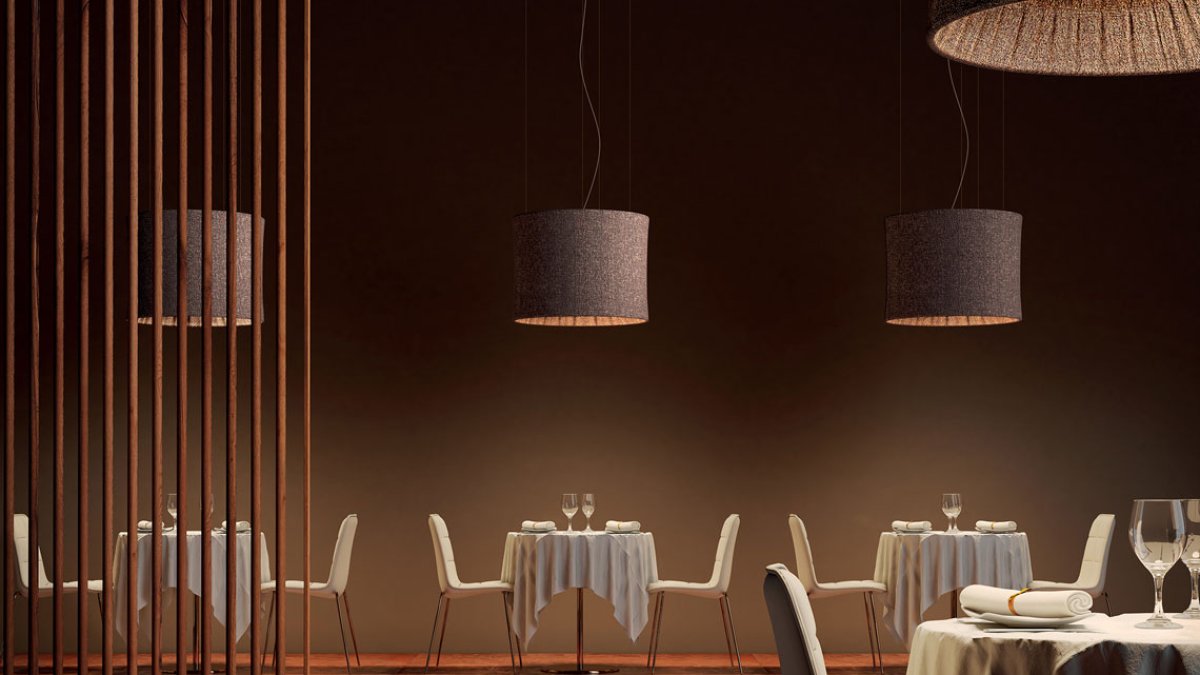
When Zagat polled nearly 13,000 avid diners across the country for its 2018 dining trends survey, the complaint at the top of the list was noise, named by 24% of respondents, just ahead of service at 23%, with crowds at 15%, high prices at 12% and parking at 10%.
The guests make the sound; the room decides how long each voice hangs in the air and how quickly the voices pile up. How many people can hold a conversation in a space depends on how long sound lingers there, measured in seconds, before it depends on how many seats you fit in, and the same chatter has a price on an open office floor. You can measure that number before you buy a single panel, and you should.
American classrooms already have a number
The clearest proof that a room can be specified for conversation sits in a school building. ANSI/ASA S12.60, the American standard on classroom acoustics, gives a core learning space of up to 10,000 cubic feet (about 283 m³) a maximum reverberation time of 0.6 seconds at 500, 1000 and 2000 Hz, and a one-hour average background level of 35 dBA. The Acoustical Society of America's companion booklet for architects walks through the ceiling treatment needed to reach it.
Put that classroom through the formula below and it supports sufficient conversation for about 23 people. For adults at work, the federal rule looks at something else: OSHA's noise standard (29 CFR 1910.95) sets an action level at an 8-hour average of 85 decibels and a permissible exposure of 90 dBA over 8 hours. Those numbers protect hearing. A conversation across a table has broken down long before.
Running the formula in feet and meters
Reverberation time (T) is the time, in seconds, for a sound to decay in a room. Jens Holger Rindel, an acoustics researcher, built a rule around it that you can work on a napkin. The result, which he names acoustic capacity, is the most people who can hold a conversation one meter (about 3.3 feet) apart at a sufficient level. Take the volume in cubic meters, divide it by T, then divide again by 20. T has to be measured with furniture in place and nobody in the room, at mid frequencies between 500 Hz and 1 kHz. The formula is metric, so convert first: one cubic foot is about 0.0283 m³.
Sufficient is the third step up on his scale. It allows ambient noise up to 71 dB, and your companion's voice can arrive 3 dB under the general din and still get through. For satisfactory conditions Rindel suggests keeping occupancy below 50% of capacity, while listeners who are hard of hearing or not native speakers need about 3 dB of extra headroom.
Here is how it plays out on three rooms with 10-foot ceilings:
1,000 sq ft, 10,000 cu ft (283 m³): 9 people at 1.5 seconds, 14 at 1.0 second, 23 at 0.6 seconds.
2,000 sq ft, 20,000 cu ft (566 m³): 18 people at 1.5 seconds, 28 at 1.0 second, 47 at 0.6 seconds.
4,000 sq ft, 40,000 cu ft (1,133 m³): 37 people at 1.5 seconds, 56 at 1.0 second, 94 at 0.6 seconds.
I rounded down each time, since a capacity is a ceiling. The floor plan never changes along a row; only the reverberation does, and it is worth two and a half times the headcount.
Rindel's real-world examples make the same point. In his table of sixteen eating places sit two halls of almost identical volume, around 2,490 m³: a 2.5-second hall rated for 50 talkers and a 0.8-second hall rated for 156. A restaurant at full occupancy, he writes, typically runs at double its acoustic capacity or beyond. His proposal is that seating exceed the capacity by no more than 25% and that the number be posted at the entrance.
Why a full room keeps getting louder
Lombard's 1911 paper described the mechanism: in noise, people raise their voices. Rindel's review of the data puts a slope on it. Above roughly 45 dB of background, each extra 2 dB of noise lifts the voice by about 1 dB. In a crowded space every table does this at once, so the background rises and the voices rise again, a feedback loop in Rindel's words. MacLean framed it in 1959 as a party: up to a certain guest count it stays quiet, and past that count it turns loud.
Loud rooms dull the sweetness
Sound also reaches the palate. In a 2011 study run with Unilever, Woods and colleagues had blindfolded volunteers taste food while their headphones played nothing, soft white noise or loud white noise. The loud setting lowered ratings of sweetness and saltiness and raised crunchiness, and liking for the noise tracked liking for the food (Food Quality and Preference). In 2015 Yan and Dando had 48 people rate the five basic tastes in a crossover test, with and without a recording simulating airline cabin noise. Sweetness went down, umami went up, and salty, sour and bitter did not change. A pastry chef has a professional reason to care about the noise in the dining room.
Guests grade the room, too. A 2021 field study in Berlin by Steffens, Wilczek and Weinzierl interviewed 142 diners across twelve restaurants, measuring loudness and reverberation with the rooms full. How loud it was, and how pleasant the soundscape felt, predicted the quality guests assigned to each restaurant; reverberation mattered, though only by way of loudness. Comfort and liveliness pull in different directions, the authors note. In Singapore, Lindborg's survey of 112 restaurants found that menu price and loudness moved in opposite directions. Repeat visits were outside the scope of all this research, so I will leave that claim to others.
The open office pays in remembered words
Swap the tables for desks and the physics stays. Banbury and Berry surveyed staff at two workplaces, 88 people in all (Ergonomics, 2005): 99% said office noise hurt their concentration, with unanswered phones on vacant desks and conversations in the background at the top, and the authors saw no evidence of habituation.
Jahncke and colleagues (2011) gave 47 students two hours of work against office sound, in a 39 dB condition and a 51 dB condition. The louder condition cost them remembered words and left more questions unanswered, and they came away more fatigued, with lower motivation; other cognitive tests showed no difference. On the break, watching a river video with its sound gave people more energy, while staying in office noise dragged motivation down further.
Intelligible speech is the real distraction. In later studies by the same researcher, performance dropped as background talk became easier to understand, and the Speech Transmission Index (STI) had to be kept under 0.50 to avoid harm. The international method for open-plan offices, ISO 3382-3:2022, sets its distraction distance at that threshold: how far from a talker the STI falls under 0.50. It adds the drop in speech level, in decibels, every time you double the distance. Between them, those figures map the reach of one voice over a particular layout.
When the plan cannot provide that distance, a phone call or a one-on-one needs an enclosed space, which is what soundproof office pods are for.
Measure first, then shop for panels
Absorbing sound and blocking it are different tasks. An absorptive panel soaks up sound energy within the room and shortens the reverberation tail. Keeping sound from passing to the next room is sound isolation, handled by walls and floor assemblies under their own requirements. Panels are tested for absorption per ISO 354 in a reverberant test room, and ISO 11654 condenses the results into a single rating, αw, with classes from A, which absorbs most, through E. The class bands are broad and only rough, so go by the αw number, along with the area the panels cover.
Before you pick a product, get five numbers on paper:
1. Room volume: multiply length, width and ceiling height, then convert cubic feet to cubic meters.
2. Reverberation time, measured with furniture in place and no occupants, by an acoustical consultant.
3. Peak occupancy and the activity: group dinners, phone calls, heads-down work.
4. Target T, solved from Rindel's rule: for 47 people to talk in 20,000 cu ft, T must drop to roughly 0.6 seconds.
5. The αw rating and square footage of panels to get there.
Then the enjoyable part begins, because acoustics gets chosen by eye as well. In the acoustics and privacy range from our brands, the αw rating cuts the list down and taste picks among products that do the same work. Working on a project with us? The first two lines we need are the cubic footage and the reverberation reading.
The 24% in that Zagat survey were reacting to something an acoustical consultant can put a number on.
Short answers
How many diners can a restaurant hold before conversation fails?
Jens Holger Rindel's rule: cubic meters ÷ (20 × T), with T the reverberation time in seconds. A 20,000 cu ft room (566 m³) at 0.6 seconds supports sufficient conversation for about 47 people; at 1.5 seconds, about 18.
Is there a US standard for reverberation time?
For classrooms, yes: ANSI/ASA S12.60 sets a maximum of 0.6 seconds for core learning spaces up to 10,000 cubic feet, with a 35 dBA background limit. OSHA's noise rule addresses hearing protection at 85 and 90 dBA, levels well above where conversation suffers.
Does open-office noise really affect performance?
Yes, in measurable ways. Jahncke's 2011 experiment compared 51 dB with 39 dB over two hours: the louder room meant fewer words recalled, more fatigue and lower motivation, with no change on other tests. What hurts is speech you can follow, so keep the STI under 0.50.
Was noise really diners' top complaint?
In Zagat's 2018 dining trends survey of nearly 13,000 diners, noise ranked first at 24%, ahead of service at 23%, crowds at 15%, high prices at 12% and parking at 10%.