Let's discuss your project
Trade terms for professionals and design studios
Let's discuss your project
Trade terms for professionals and design studios
Some halls have to be a theater on Friday and a banquet room on Saturday. Mura answers that with an accessory most fixed seating never offers: a caster system that lets the armchairs be wheeled away whenever the hall needs its floor back. It applies to seats on feet bolted down, arranged in straight rows, which is how a flat multipurpose hall is usually laid out anyway. The rows leave, the floor is clear, and the same rows come back for the next event.
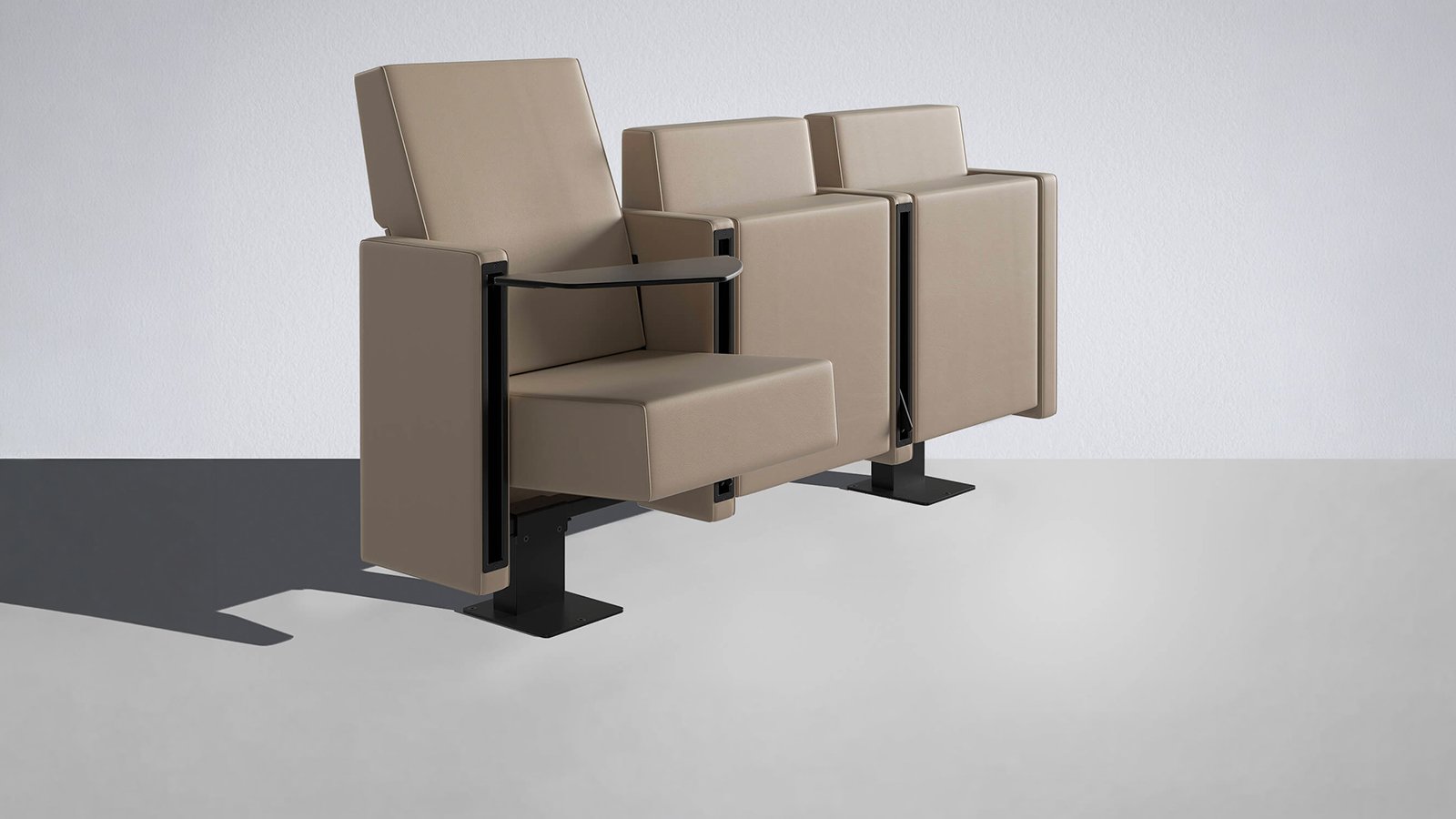
What rolls away is a serious piece of auditorium seating, not a stacking chair. Each side panel is 11 7/8 in deep and 2 3/4 in thick, upholstered on every face; seats are spaced 20 7/8 in to 22 in apart, center to center, and the backrest comes low or high, 32 1/4 or 37 3/4 in overall. Gino Gamberini designed Mura for Lamm with conference halls in mind, and compactness is what makes mobility plausible: closed, a row is only as deep as its sides.
For halls that stay fixed, the catalog adds a beam-mounted version carrying a foot at every second or third seat, a narrower 9 1/2 in side available on project, and a writing tablet folding into the standard side for college lecture halls. Rows can also follow a curve on a raked floor, where the casters do not apply. Before the first anchor is set, La Mercanti has already written on the layout which rows roll and which never move.
Collection: Mura
Made by: Lamm S.r.l., San Secondo Parmense (Parma), Italy
Designer: Gino Gamberini
Product type: compact armchair for auditoriums and conference halls; in the standard version the closed seat and backrest line up with the side panels
Configurations: side panel to the floor, or beam-mounted; low or high backrest
Where it installs: level, sloped or stepped floors; straight rows or curves
Seat pitch (center to center): 20 7/8 to 22 in
Row-to-row distance: 33 1/2 in on a level floor; 35 3/8 in on steps, per the drawings; curved rows no closer than the level-floor figure
Curve, minimum radius: 49 ft 3 in
Seat and back: plywood shell; non-deformable flame-retardant polyurethane foam; backrest offered in two heights
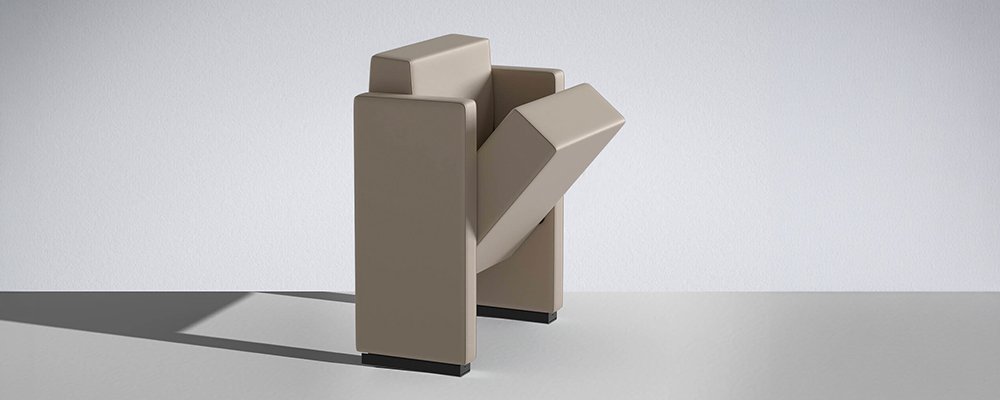
Tip-up action: gravity-operated device releases the seat, which tips up on a soft-close damper; the backrest lowers and stands vertical at the same time, cutting the overall depth
Side panel: 11 7/8 in deep; built like the seat; upholstered in fabric, or in leather, or in faux leather
Side panel, custom: 9 1/2 in deep, on project
Floor fixing: sheet-steel foot, epoxy powder coat, scratch- and corrosion-resistant
Paint finishes, foot and beam: semi-matte in black RAL 9005 or silver; textured in bronze or graphite
Beam-mounted version: 2- or 3-seat beam in square tubular steel, painted in the same finishes; painted steel foot anchored to the floor every 2 or 3 seats; side panels of one height resting on the beam, except in the first row, where they can reach the floor
Tablet (accessory, standard side): black stratified HPL top on a die-cast aluminum hinge; folds away inside the side panel with an anti-panic movement
Accessories: writing tablet; seat and row identification; provision for electrification (outlet on request); caster system for moving the armchairs away when not in use (floor-fixed feet, straight rows only)
Heights: overall 32 1/4 in (low back) or 37 3/4 in (high back); side panel 26 3/4 or 32 5/8 in; seat 18 1/2 in
Depths: closed, the same as the side panel; 15 in or 16 1/8 in with the backrest in use; 26 3/4 in or 28 in with the seat open; 28 3/4 in or 29 7/8 in with the tablet open
Side panel thickness: 2 3/4 in (front view)
Upholstery by category: cat. 1 Inca, King, Trevi CS; cat. 2 Silvertex, Extrema Au; cat. 3 Luna CS, Revive 1 (Kvadrat), Remix 2 (Kvadrat); cat. 4 Steelcut Trio 3 (Kvadrat), leather
HPL: black (tablet top)
Painted solid wood: beech, oak
Foam: CertiPUR® certified
Wood components: low formaldehyde emission
Awards: Compasso d'Oro ADI, XV edition (1989), first version
Testing: tested to European standards

Let us know which finishes you'd like to explore
The first version of Mura won the Compasso d'Oro ADI at the prize's XV edition in 1989, with a jury that met in Milan on April 12 of that year. The citation praised its formal and functional quality within the completeness of its image. For a buyer that matters less as a trophy than as a fact: the seat you specify today descends from a design a jury considered finished more than three decades ago.
With the seat down, Mura runs 26 3/4 in deep in the low-back version and 28 in with the high back. Add the writing tablet in use and the figures become 28 3/4 and 29 7/8 in. Seat height is 18 1/2 in in every case. Those are the dimensions to set against the row-to-row distance when checking knee room on the plan, because the closed depth of 11 7/8 in says nothing about the hall in use.
Each seat tips up by itself and the backrest comes to vertical, so the whole row returns to the depth of its side panels, 11 7/8 in. The distance between rows, 33 1/2 in on a level floor, is then largely free for people walking out. For an operator the practical result is an exit path that does not depend on ushers folding anything by hand.
Yes, within limits. The pitch from center to center is adjustable between 20 7/8 and 22 in, so the same Mura can be laid out tighter or looser to make the count come out on a given wall-to-wall width. A row that would end in half a seat at one pitch often works out whole at another. We run the arithmetic on the real dimensions of the room before any quantity is written down.
Inside the side panel. Mura's tablet, a stratified HPL top in black hinged on an aluminum die casting, tucks back into the standard 11 7/8 in side, and its movement is anti-panic. It is offered only with that side, not with the 9 1/2 in custom panel. Since it is an accessory rather than a fixture, one hall can mix rows with it and rows without, and nobody in the audience will tell the two apart from the aisle.
The five lines a specification for Mura should carry, all taken from the manufacturer's sheet: the shell and the foam, the wood, the steel foot and its finishes, the upholstery category, the testing statement.
Describe seat, backrest and side panels of Mura as plywood structures padded with non-deformable, flame-retardant polyurethane foam. Use those words from the sheet and no others: the specification should not add a fire rating or a test number the manufacturer does not state.
Add that the padding carries CertiPUR certification and that the formaldehyde emission of the wood parts is low. Both are the manufacturer's own declarations, and both are the lines a procurement office checks first when two seating systems are compared on paper.
Call out the floor fixing: a sheet-steel foot with an epoxy powder coat that resists scratches and corrosion, in one of four finishes: black RAL 9005 or silver, both semi-matte, or a textured bronze or graphite. Write the finish down; a line that only says painted steel leaves the choice to the installer.
Write the category, then the fabric: category 1 Inca, King or Trevi CS; category 2 Silvertex or Extrema Au; category 3 Luna CS, Revive 1 or Remix 2; category 4 Steelcut Trio 3 or leather. The category is what a bid compares; the color comes later, with the sample in hand.
Close with the sentence the manufacturer uses: Mura is tested to European standards. Resist the urge to turn it into a list of numbered standards. If a buyer asks for a specific certificate, the request goes to the manufacturer, and the answer is attached to the bid as a document, not paraphrased.