Prefer a tailored configuration?
Trade terms for professionals and design studios
Prefer a tailored configuration?
Trade terms for professionals and design studios
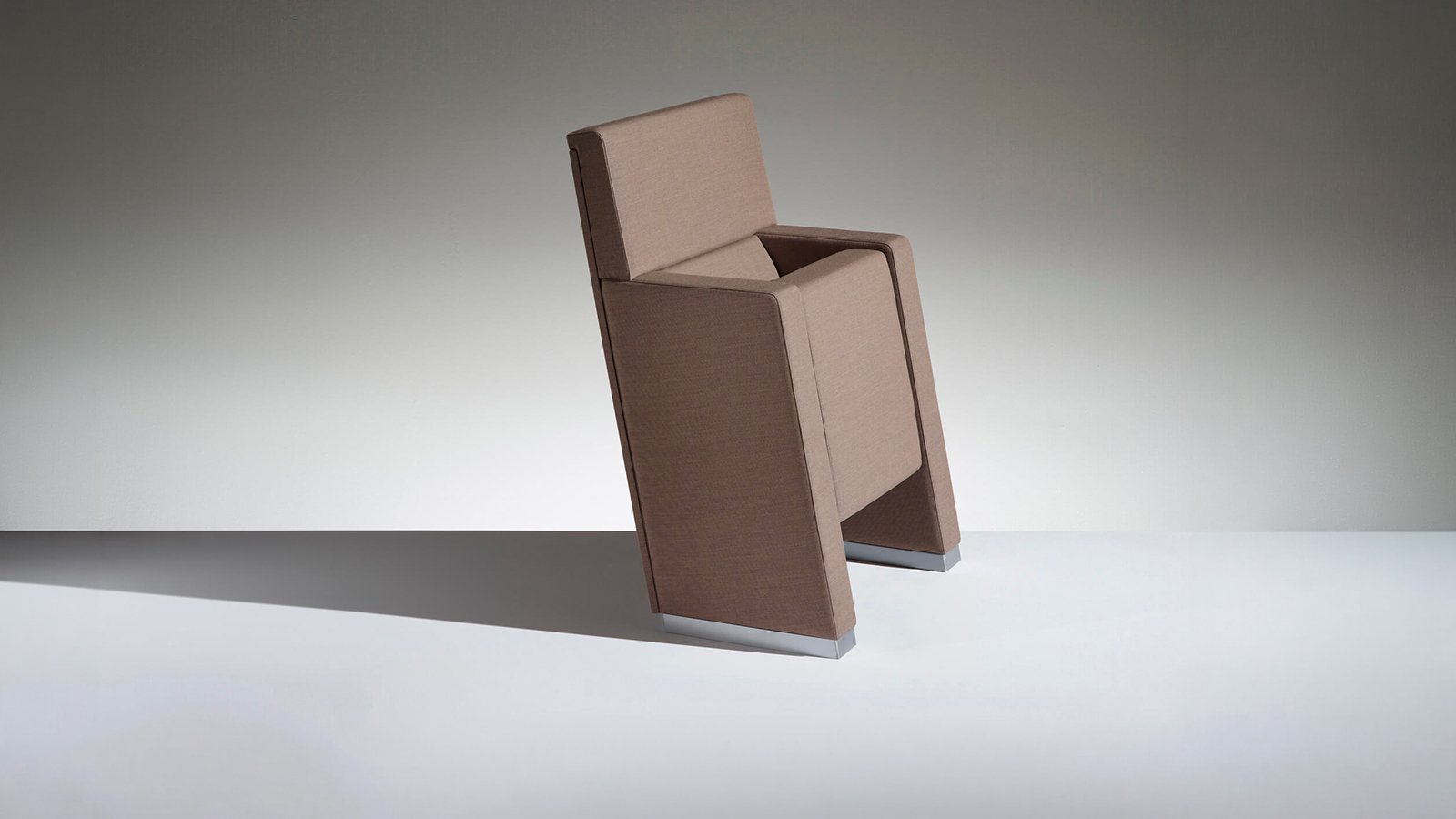
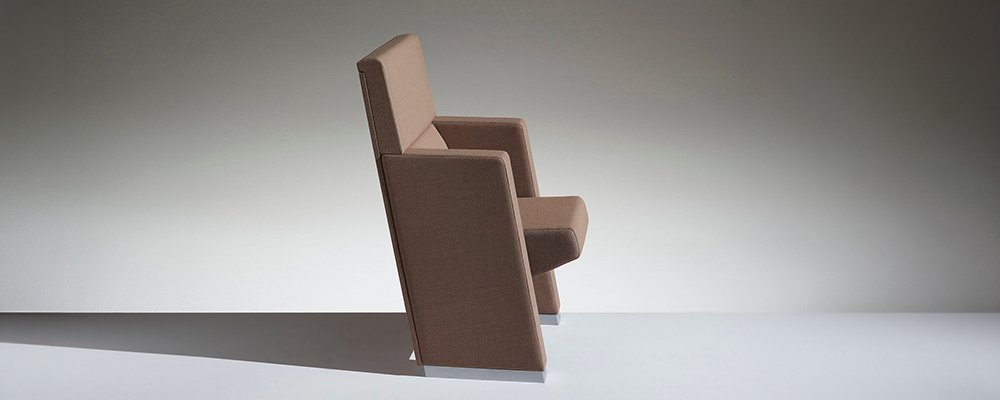
Walk through a theater after the last show and you can tell which seats were designed to close on their own. L213, developed by Lamm's in-house research and development office for theaters, convention venues and classrooms, tips its seat up by gravity, with a counterweight: when the person stands, the seat follows, and the row reads as a line of closed backs the moment the house empties.
The manufacturer's technical sheet is that plain about it, and the plainness is the point. There is nothing to reset, nothing to adjust row by row before the next session, and a tipped-up seat leaves 13 inches of free passage with the inclined side or 14 1/8 inches with the straight side when rows are set 35 3/8 inches apart. For a venue that turns over an audience several times a day, the seat that closes itself is the one the staff never thinks about.
Around that seat, L213 is a conventional chair in the best sense: plywood cores in the seat and back, full-height sides in either an inclined or a straight profile, dressed in fabric or leather or veneered in oak and beech, and a stamped sheet-steel foot bolted to the floor. La Mercanti specifies it as auditorium seating for halls that run back-to-back events and cannot afford a row left half open.
Convention centers and lecture halls get the same chair with different accessories: a tablet stowed in the side, a seatback table, a wider side for longer sessions and, where the project demands it, the Floor Technology that Lamm offers to sink every row beneath the floor. Gravity does the closing; everything else is a choice.
Collection: L213
Manufacturer: Lamm — Lamm S.r.l., San Secondo Parmense (Parma), Italy
Design: R&D LAMM (the manufacturer's research and development office)
What it is: armchair for conference halls, auditoriums, educational and multipurpose rooms; full-height load-bearing sides, inclined or straight, also available in increased width
Seat and backrest: plywood internal structure; padding in shaped, non-deformable, fire-retardant polyurethane foam (manufacturer's declaration)
Seat tip-up: by gravity, with a counterweight
Rear of the backrest: visible plywood in oak or beech finish, or completely upholstered and covered
Sides: load-bearing, inclined or straight, plywood structure with metal inserts; fully upholstered and covered in fabric, faux leather or leather, or in painted wood with oak or beech finish; thickness 3 1/8 in (standard) or 3 7/8 in (increased width)
Side with writing tablet: tip-up fold-away writing tablet in black stratified HPL, die-cast aluminum joint, folds away into the side, anti-panic movement
Floor-anchor feet: stamped sheet steel with a scratchproof, anti-corrosion epoxy powder coating in semi-matte black RAL 9005, semi-matte silver, embossed bronze or embossed graphite; fixed to the floor
Installation: on level or sloped floors or on steps, in straight or curved rows (standard minimum radius 26 ft 3 in)
Center-to-center distance: 20 7/8 or 22 in with the standard side; 22, 22 7/8 or 23 5/8 in with the increased-width side (technical sheet)
Row spacing: 35 3/8 in; free passage with the seat tipped up 13 in (inclined side) or 14 1/8 in (straight side); 36 5/8 in with the seatback table; curved rows 35 3/8 in or more
Heights: overall 38 1/4 in · seat 17 3/4 in · side tablet at 25 5/8 in (inclined side) or 26 3/8 in (straight side) · seatback table at 27 1/2 in
Overall depth: 29 1/2 in with the inclined side · 32 5/8 in with the straight side
Seatback table (accessory): tip-up, anti-panic movement, slow and cushioned closing (patent pending); top in HPL laminate, beech, oak or black
T200 table (accessory): tip-up writing table on a single base; overall footprint with the chair 41 1/8 in (inclined side) or 40 1/8 in (straight side)
Floor Technology (on project): the manufacturer's fold-away system that moves the whole body of the seat to a horizontal position under the floor
Accessories: row identification element · seat numbering · under-seat panel and backrest panel in painted wood, oak or beech finish · provision for electric power supply (outlet on request) · provision for audio/video devices (on project) · added armrest in painted solid wood, beech or oak · accessory system that moves the chairs on casters when not in use (chairs with floor-fixed feet, in straight rows)
Coverings: ten — Inca, King, Trevi CS, Silvertex, Extrema Au, Luna CS, Revive 1, Remix 2, Steelcut Trio 3, leather
HPL laminates (seatback table): beech, oak, black · Stratified HPL (side tablet): black
Painted wood (sides, rear of backrest, panels): beech, oak · Painted solid wood (armrest): beech, oak
Foot paint: black, silver, bronze, graphite
Padding: CertiPUR® certified
Wooden components: low formaldehyde emission
Testing: tested according to European standards (the manufacturer declares no standard numbers)

Let us know which finishes you'd like to explore
An epoxy powder coating the manufacturer describes as scratchproof and anti-corrosion, applied over the stamped sheet steel of the foot. It comes in semi-matte black RAL 9005, semi-matte silver, embossed bronze and embossed graphite, so the foot can match the hall instead of just surviving it.
Yes, for chairs with floor-fixed feet in straight rows: Lamm offers an accessory system that makes the chairs removable and rolls them on casters when they are not in use. The hall can host a banquet or an exhibition and reseat itself afterward without losing the row plan.
With two separate accessories: a row identification element visible from the aisle and a seat number on each chair. La Mercanti fixes the sequence against the hall plan before installation, because the numbering has to follow the way people actually enter, not the order in which the rows go in.
A tip-up writing table on its own single base, made for seats that have no backrest in front of them, typically the first row. With the chair, the overall footprint is 41 1/8 inches for the inclined side and 40 1/8 inches for the straight side.
Either. Behind the backrest you can specify exposed plywood, oak or beech, or a fully upholstered surface matching the seat. Wood gives the row behind a hard, wipeable face; upholstery makes the whole row soft, which theaters tend to prefer.
The sequence for fitting the writing tablets housed in the sides of L213 chairs, from the opening direction to the test every tablet gets before the first class.
The tablet of L213 lives inside the load-bearing side, so the decision is made per seat and per side: on the hall plan, mark each position that takes one and note whether that chair has an inclined or a straight side.
Each tablet swings out of the side toward the person seated; its anti-panic movement lets it give way in the direction of the exit. Check that the direction matches the aisle on that end of the row before the sides are fixed.
The top is black stratified HPL on a die-cast aluminum joint that folds the tablet flush into the side. Once mounted, the top sits 25 5/8 inches above the floor with the inclined side and 26 3/8 inches with the straight one.
Before the hall is handed over, each tablet is opened, loaded by hand and folded back into the side; a tablet that catches or stays proud of the side is adjusted then, not after the first lecture.
The final list of tablet seats, by row and number, stays with the hall documentation; La Mercanti keeps a copy so that any later addition uses the same orientation and the same side type.