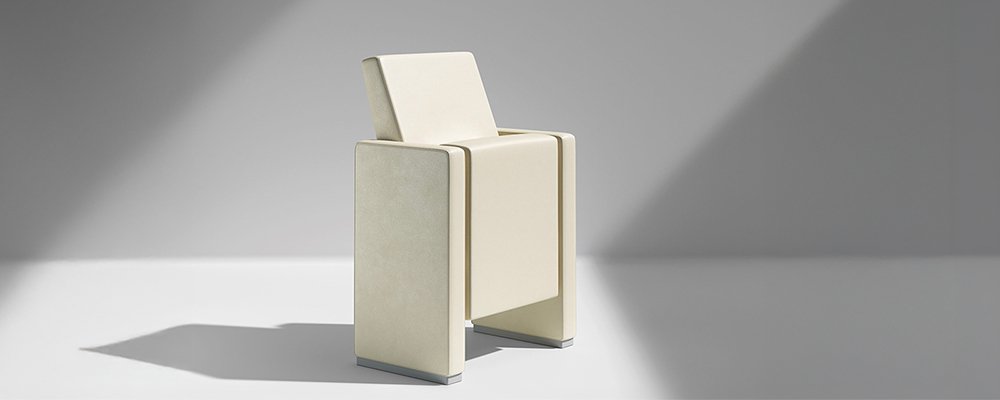
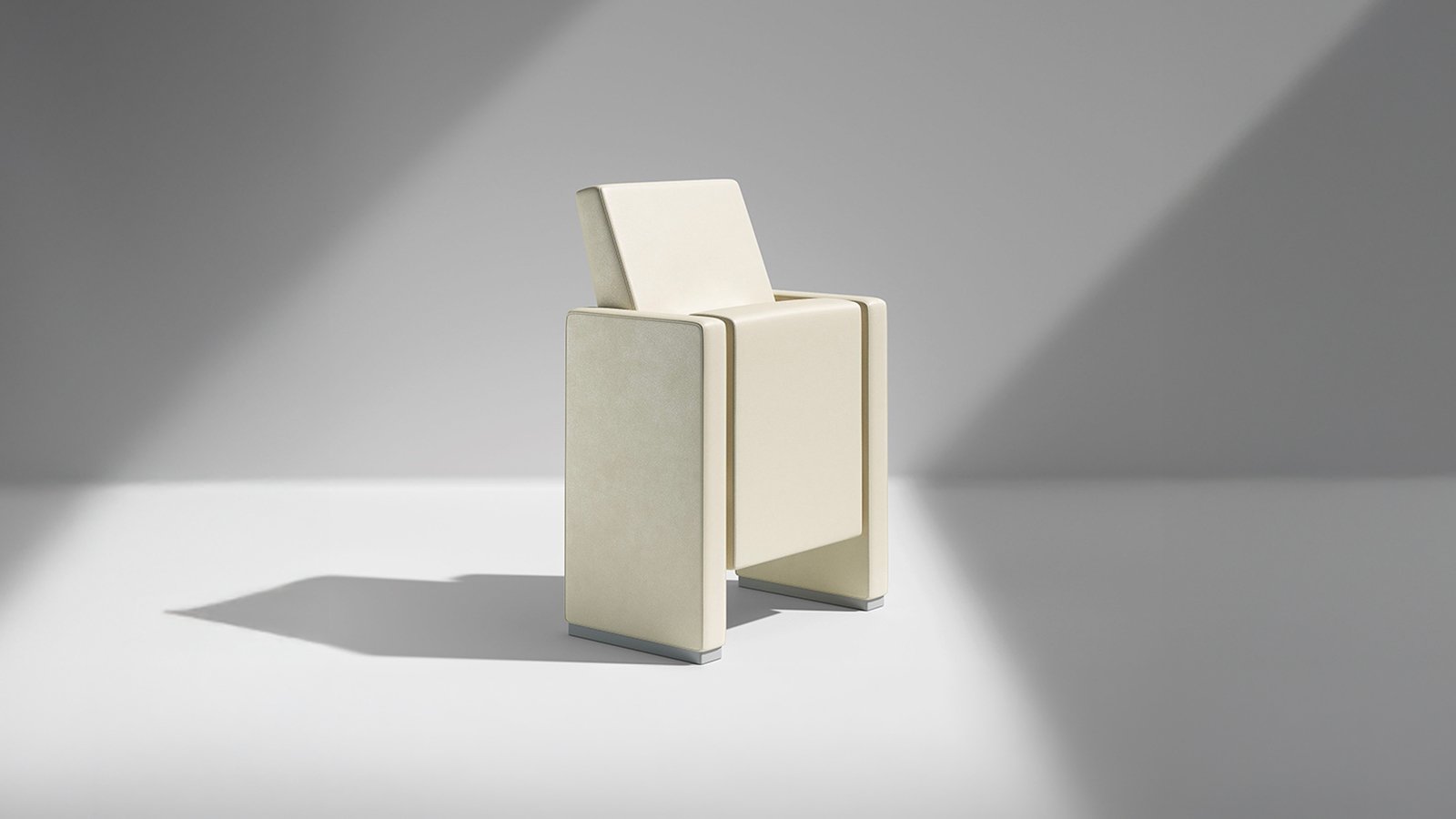
Left-handed tablet opened from the side of a Chrono auditorium seat

Left-handed delegates get a tablet of their own: Chrono auditorium seating by Ares Line

Ares Line
Chrono
Chrono An icon of Italian design

Let's discuss your project

Trade terms for professionals and design studios

Every hall has left-handed people in it, and most fixed seating pretends otherwise. The large anti-panic tablet housed in Chrono's side is available for left-handers too: the same black HPL surface, 5/16 in thick, mounted to open from the other side. Which auditorium chairs get the left-handed version is written into the order, seat by seat.

At 118 square inches it is the largest surface among the tablets in the Ares Line 2025 catalog, and the catalog states that these tablets close completely into the side, keeping the passage between rows free. With the tablet in use a Master side runs 29 1/8 in deep; closed, 17 3/8 in.

Around it is the chair BaccoliniDesign drew for theaters and convention halls: generous padding, clean lines, a backrest set at an angle, standing proud of the chair body. The seat tips up on a damper, the pitch is 21 1/4 or 22 in, and the seat sits 17 3/4 in off the floor.

Conference halls take the same chair. In multipurpose rooms the Wheels and Back System rolls whole rows aside; the Wood side adds a wooden face with a removable upholstered armrest; and a Back Table on the rear of the backrest gives campus lecture rooms a second writing surface. La Mercanti asks how many left-handed seats a hall wants before the order goes in, because the tablet side is decided at the factory, not on site.

Technical information based on data declared by the manufacturer.

Collection: Chrono
Manufacturer: Ares Line S.p.A., Thiene (Vicenza), Italy
Design: BaccoliniDesign
What it is: chair for auditoriums, theaters, convention centers and conference halls, with generous padding, clean lines and a backrest that rises at an angle from the chair body
Sides: Master, monolithic and upholstered · Wood, with wooden facing and removable upholstered armrest · Long (Master or Wood), 2 3/8 in deeper
Seat: Master, upholstered · Wood, upholstered with exposed wooden panel · Acoustic, upholstered with exposed acoustic wooden panel
Backrest: Master, upholstered · Wood, with the same exposed wooden panel at the rear · Plus, upholstered and enlarged · Plus with headrest, enlarged with headrest
Mechanism: seat with damper for a silent tip-up and a cushioned rebound; seat with micro-springs on request
Maintenance: backrest and seat tamper-proof and removable without tools by maintenance staff; components easily separable and fully recyclable
Accessories: Top (removable upholstered armrest) · Wooden Top (removable wooden armrest) · Media Top (armrest prepared for multimedia) · Steel Back (painted sheet-steel rear of the backrest) · Wooden Back (wooden rear of the backrest) · Logos (custom embroidery) · Numbering (embroidered seat and row numbers) · Microsprings · Back Stitching (stitching on the backrest) · End-Row Light · In-Seat Power · Tablet · Back Table
Tablet in the side: anti-panic, folding into the side; surface 118 sq in, black HPL 5/16 in thick; also available for left-handers
Back table: type 1, laminate top 3/4 or 1 3/16 in thick, anti-panic mechanism with a cover over the rods, quick automatic closing to the vertical position; supports for flat floors or risers
Wheels and Back System: retractable wheels that come out of the side for sideways movement; backrest that rotates and lowers to the compact position; requires a Master or Wood side without tablet
Provisions on project: In-Seat Power (side prepared for a power outlet) and Multimedia, with cabling integrated in the structure
Acoustics: configurable acoustic performance, certified to ISO 354
Materials: FSC®-certified wood
Product standards: EN 12727 level 4 · EN 15372 level 3
Reaction to fire: compliant with many national standards; for Italy, Classe 1IM
Minimum Environmental Criteria: compliant with the Italian CAM for furniture
Installation: recommended maximum riser height 15 3/4 in with the Master backrest and 23 5/8 in with Plus with headrest; maximum incline 5°; curved rows with a radius over 65 ft 7 in for the 21 1/4 / 22 in pitch (minimum 100 seats), from 16 ft 5 in to 65 ft 7 in only with the 22 in pitch, again from 100 seats, under 16 ft 5 in for the 21 1/4 / 22 in pitch with double side
Seat pitch: 21 1/4 or 22 in; seat width 18 1/2 or 19 1/4 in; side thickness 2 3/4 in
Heights: 35 3/8 in overall, 42 1/2 in with Plus with headrest · side 25 5/8 in · seat 17 3/4 in
Depths: 17 3/8 in closed · 27 1/2 in with the seat open · 29 1/8 in with the tablet in use · Long side: 19 3/4 in closed, 31 1/2 in once the tablet is open
Projects cited by Ares Line: IMA Auditorium, Ozzano dell'Emilia (2022, 260 seats) · Confcommercio Campania conference hall, Naples (2026, 35 seats) · Expo Center Ekaterinburg (5,300 seats with Zero9 and Zero7; seven different seat pitches, on project)
Warranty: 7 years, declared by Ares Line

La Mercanti USA Llc — your partner for Italian design and contract supply.
Los Angeles, CA, USA · +1 855 335 8079 · info@lamercanti.us
Supply, quotes, specifications and project support across the United States and North America.

Let us know which finishes you'd like to explore

$ 180

Credited in full toward your purchase

FAQ

Can the velvet be dyed to a color the client brings in?

It has been done. For the IMA auditorium in Ozzano dell'Emilia, 2022, Ares Line supplied 260 Chrono seats in velvet dyed to a special color on the client's own sample, with the rear of the backrest in exposed wood and the seat numbers embroidered in thread matched tone on tone. For a corporate hall that wants its own color rather than a catalog shade, the sample goes to the factory first and the color card second.

How wide is the seat, and what fixes the width?

The seat is 18 1/2 or 19 1/4 in wide, and the pitch fixes it: 21 1/4 in from center to center gives the narrower seat, 22 in the wider one. Over a long row the two pitches add up to different lengths, which is why the seat count and the seat width are decided together on the plan rather than one after the other.

Which European test levels does Chrono declare?

Two: EN 12727 at level 4 and EN 15372 at level 3, both declared by Ares Line on the product sheet. They are European references, so for a US specification they sit alongside, not instead of, whatever standard the project calls out; La Mercanti forwards the manufacturer's declaration as it stands and does not translate it into a rating the sheet does not give.

How tall is Chrono, and where does the armrest land?

The standard chair stands 35 3/8 in overall, with the side at 25 5/8 in and the seat at 17 3/4 in above the floor. With the Plus with headrest backrest the overall height becomes 42 1/2 in; the side and the seat do not move. Those three figures go onto the section of the hall, because the height of the side is what the person in the row behind sees between two heads.

What riser height can a row of Chrono sit on?

Ares Line recommends a riser no higher than 15 3/4 in with the Master backrest and 23 5/8 in with Plus with headrest, on a floor inclined no more than 5 degrees. In a steeply raked theater the backrest is therefore chosen from the section drawing, not from the catalog page: the taller the step behind, the taller the back it takes to screen the knees of the row above.

Writing the Chrono order sheet from the row geometry to the accessories

How a Chrono order is written for a US hall, starting from the figures that cannot change later: pitch and curve, then the backrest, the seat, the side, and finally the accessories listed row by row.

Fix the pitch and the curve

Begin every row of Chrono with its geometry: a pitch of 21 1/4 or 22 in, and the radius if the row bends. Over 65 ft 7 in both pitches are allowed; between 16 ft 5 in and 65 ft 7 in only the 22 in pitch; under 16 ft 5 in the chair is ordered with a double side. Curved rows start at 100 seats.

Pick the backrest from the section

Four backrests are listed: Master, Wood with an exposed wooden panel on the rear, Plus, which is enlarged, and Plus with headrest. The riser behind the row decides between them, and so does the view: a Wood backrest shows wood to the row behind, a Master backrest shows fabric.

Choose the seat and its springing

Three seats: Master, upholstered; Wood, with an exposed wooden panel underneath; Acoustic, with an exposed acoustic wooden panel. Microsprings, a seat with micro-springs, is a separate option and belongs on the same line of the order, because it changes what is inside the cushion rather than what is outside it.

Settle the side last

Write the side last among the three elements: Master, monolithic and upholstered; Wood, with a wooden facing and a removable upholstered armrest; Long, in either version, the deeper side. If a seat needs a power outlet, note In-Seat Power here: the side leaves the factory already prepared for it.

List the accessories row by row

Close with the accessories, one line per row: Top, Wooden Top or Media Top armrests; Steel Back or Wooden Back; the writing surface in the side or the Back Table; Numbering, Logos, Back Stitching, End-Row Light. Where the Wheels and Back System is planned, the side stays Master or Wood and carries no writing surface.